Gerald Howarth
Ministry of Defence · GBR
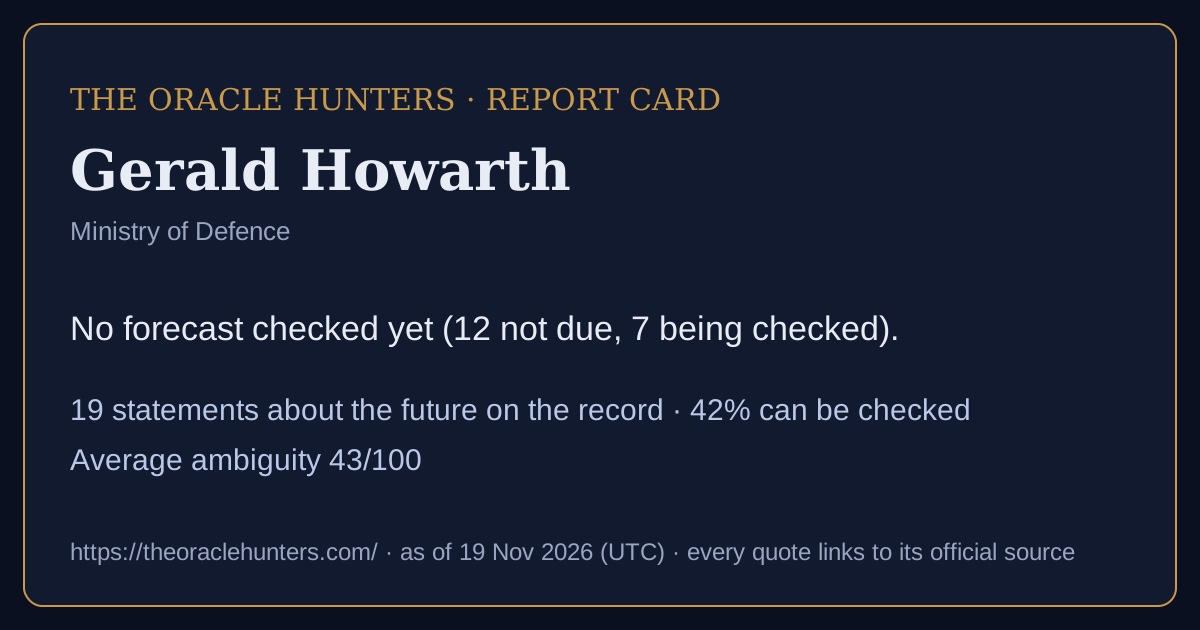
Track record: No forecast checked yet (12 not due, 7 being checked).
19forecasts & commitments on the record
42%can be checked as stated
43average ambiguity (0-100)
0goalpost moves recorded
0confirmed U-turns
Timeline
came true partly did not not due / being checked / too vague
Calibration score: shown after 10 checked forecasts with a stated likelihood (now 0).
How they speak about the future: based on data 10, stated on authority 5, educated guess 4.
Kinds of claim: forecast 10, scenario (if… then) 4, commitment 3, mixed claim 2. · Download this report card as a picture
In the nine words
πρόγνωσιςInference from evidence7 · 37%μαντείαInspired knowledge4 · 21%πρόνοιαPreparing for the future4 · 21%προαναγγελίαPublic pre-announcement3 · 16%εἰκασίαConjecture1 · 5%
How to read this
Each box is one sentence a public figure or institution said about the future, word for word, with a link to the official text. Can be checked means it names what will happen, by when, and how likely - so it can be compared with official figures later. Too vague to check means it does not. Ambiguity (0-100) is how many different ways the sentence can be read. When the date passes, the forecast is compared with official data and marked came true, partly or did not come true. Labels judge the sentence, never the person. Full guide and glossary.On the record (19)
Next month my own Policy Director will chair a meeting of Northern Group MOD Policy Directors to consider the group’s role in delivering further smart defence and pooling and sharing.
But if Nato is going to remain relevant in the 21st century, is consensus at 28 essential when like-minded allies wish to operate together within the framework of Nato to implement the will of the wider international community?
Its defence budget will be cut by at least 500 billion dollars.
We are committed to increasing the planned MOD equipment budget by over £3 billion, or 1% a year in real terms, after 2015.
Unless NATO members address the issues of finance, capability, and the political will to commit to missions of collective security we all agreed in the strategic concept, I am afraid that I agree with Bob Gates that a ‘dim and dismal future’ may fall upon it.
In some cases, this will mean allocating more, as we have done in Britain with an additional £650 million to strengthen our understanding, our resilience, and our defences in cyber space.
In May this year alone, over a million kilograms of freight was moved over the airbridge to Afghanistan.
But as a package the Strategic Defence and Security Review has ensured that we will remain in the premier league of military powers, supported by the 4th largest defence budget in the world.
So unless the rest of NATO strengthens its finances, its capabilities, and its political will to commit to missions of collective security we all agreed in the Strategic Concept, the ‘dim and dismal future’ which Bob Gates spoke of will be upon us.
In some cases this will mean spending more, which we in Britain acknowledged by allocating an additional £650m to strengthen our understanding, our resilience, and our defences in cyber space.
That’s why our recent Strategic Defence and Security Review reaffirmed that we will continue to meet the NATO 2% of GDP target throughout our current spending period.
This will be a high readiness force able to undertake complex and early interventions, and we are working towards full operational capability in 2016.
And as we mark the 40th anniversary of the five power defence arrangements with Australia, New Zealand, Malaysia, and Singapore later this year, I can see merit in discussing how NATO might interact with major powers and regional organisations assuming we’re no longer in a fixed campaign cycle.
And if the Anglo-French partnership can provide a roadmap for others to strengthen their capability by working with each other in similar ways, it will be to the benefit of both NATO and the EU.
Because once our White Paper is published later this year, the policy will be set in motion.
We could not ignore the biggest crisis in the international system in decades where we inherited the largest budget deficit of any major economy - at 12% of GDP - including national debt increasing at the rate of £3 billion per week.
Importantly, he acknowledged that “the world has changed and if we do not change with it Britain’s role is set to decline with all that means for our influence in world affairs, our national security and our economy.” So Britain will continue to be a global player and we reject the notion of “strategic shrinkage.”
Nor did we come into Government to preside over the closure of Great Britain plc - the sixth largest economy in the world - particularly when we have some of the world’s leading authorities and institutions in the fields of science, technology, and innovation; and cutting-edge Defence and Security industrial sectors, as we will see at IDEX this week.
IDEX is as integral to the international Defence and Security calendar as DSEi in London later this year or the Farnborough Air Show in my own constituency in the UK, and I am sure NAVDEX will only add to that reputation.
Also said - not checkable as stated (12 newest)
Remarks about the future with no date, figure or likelihood that could be checked. They are kept on the record and shown here, but not scored.
We need to find ways of reducing the amount of energy we use, and you will shortly be hearing more about the UK approach from Admiral Neil Morisetti, the UK Climate and Energy Security Envoy.
These are challenges we will, and must, face together.
This is an area which is going to become increasingly important, as the northern sea route, which almost halves the transit time between Europe and the far east, is likely to be open for several months of the year within the next 10 years.
Within that time the retreat of the ice will mean the opening of energy supplies and passage of shipping which is potentially game changing.
This will be a crucial contribution to Afghanistan’s future security, and we are delighted to be working on it with our close comrades from Helmand Province.
We wait to see also if international pressure, combining sanctions and diplomatic engagement, will persuade Iran that it must submit to the will of the international community and accept that only the peaceful use of nuclear energy is acceptable.
Competition is healthy, but it has to be ordered by alliances, treaties and recourse to international law, or else aggressive competition for resources or strategic advantage will ultimately threaten security, stability and prosperity.
This will be good for all our economies, and for the region’s security interests.
So how can this region manage the inevitable tensions which may arise when growing prosperity, growing defence budgets and the growing strategic interests of countries in the region collide?
The answer has to be to find the right multinational security structures and organisations which can best provide for the greater good.
I see a world in which we will need to rely on these assts more, not less.
We are improving our ability to anticipate conflict, to act rapidly when a crisis emerges to prevent escalation, and, most importantly to build up in susceptible countries strong, legitimate institutions to manage tensions peacefully.