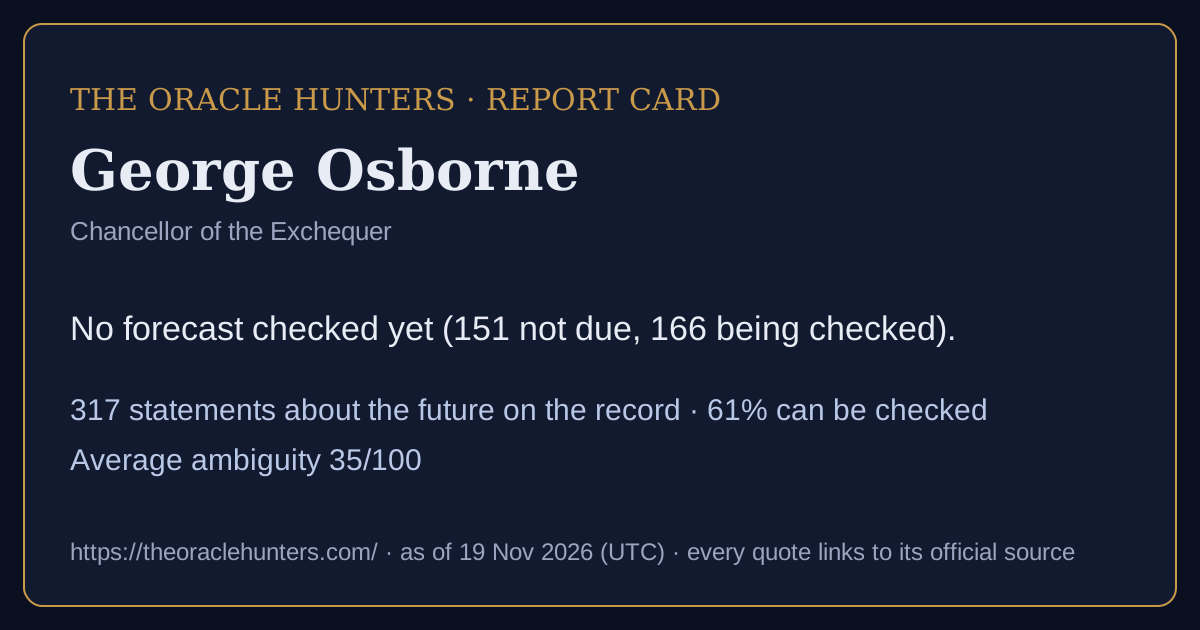
George Osborne
Chancellor of the Exchequer · GBR
Track record: No forecast checked yet (151 not due, 166 being checked).
317forecasts & commitments on the record
61%can be checked as stated
35average ambiguity (0-100)
0goalpost moves recorded
0confirmed U-turns
Timeline
came true partly did not not due / being checked / too vague
Calibration score: shown after 10 checked forecasts with a stated likelihood (now 0).
How they speak about the future: based on data 209, stated on authority 90, educated guess 18.
Kinds of claim: forecast 175, mixed claim 92, commitment 32, scenario (if… then) 18. · Download this report card as a picture
In the nine words
πρόγνωσιςInference from evidence194 · 61%μαντείαInspired knowledge67 · 21%προαναγγελίαPublic pre-announcement32 · 10%πρόνοιαPreparing for the future18 · 6%εἰκασίαConjecture6 · 2%
How to read this
Each box is one sentence a public figure or institution said about the future, word for word, with a link to the official text. Can be checked means it names what will happen, by when, and how likely - so it can be compared with official figures later. Too vague to check means it does not. Ambiguity (0-100) is how many different ways the sentence can be read. When the date passes, the forecast is compared with official data and marked came true, partly or did not come true. Labels judge the sentence, never the person. Full guide and glossary.On the record (317)
And the budget deficit has been brought down from 11% of national income, and was forecast to be below 3% this year.
The Treasury analysis shows Britain will be stronger, safer and better off if we vote to remain in the EU on 23 June.
If we remain, British farmers will go on selling their beef and lamb to Europe tariff-free.
If we remain, major British car manufacturers will go on selling hundreds of thousands of cars to Europe tariff-free.
The Treasury’s analysis finds that real wages will fall by almost 3% in the first two years compared to where they’d be if we remain in the EU.
Within two years the size of our economy – our GDP – would be at least 3% smaller as a result of leaving the EU – and it could be as much as 6% smaller.
What will it mean next month, next year?
The most likely bill our public services would pay if we left the EU is £36 billion.
And we know there will be better jobs, higher living standards and even lower prices if Europe reforms.
The analysis shows that our economy could be 4% greater if we extend that Single Market and do more free trade.
Those other countries will have given up a lot in negotiations to gain access to a bloc with 500 million customers and a quarter of the world’s GDP.
It could add up to 4% to our GDP over the coming 15 years – that’s thousands of pounds more for each British household.
If productivity falls we will see lower wages in Britain; consumption will fall and people will be permanently poorer.
Overall the business tax cuts we’ve announced since 2010 will be worth nearly £100 billion to business this decade.
But even with this slower pace of growth, the emerging economies are still expected to have accounted for 70% of all the growth in the world in 2015.
China will lead this year and the focus – on trade, and on competitive reforms – dovetail with what we need from the WTO and the IMF.
That’s why we will be publishing our far-reaching Digital Strategy this year, setting out what we will do to ensure that the benefits of digital are felt throughout the economy.
But here’s another statistic for you: just a 10% increase in the UK’s digital density could add £40 billion to GDP by 2020.
On the back of this, business investment is forecast to grow at 7.4% this year – the fastest growth since before the crisis.
If we’re complacent, Britain could find itself going the way of some other Western nations and become a society of higher welfare bills, higher taxes to pay them and lower wages as a result.
We’re working with the US and the EU to agree a new Transatlantic Trade and Investment Partnership, a big trade deal that could increase the size of our economy by £10 billion per year.
Some economists have revived the idea of secular stagnation for the modern age – warning that we will either get stagnation and unemployment, or, where there is growth it will be pinned on asset price bubbles.
It is therefore no surprise that the IMF recently downgraded their forecast for 2015 global growth to 3.1%, making it the slowest year of growth since 2009 – the height of the crisis.
First, we will borrow £8 billion less than we forecast – making faster progress towards eliminating the deficit and paying down our debt.
Now, today, in this Autumn Statement, they forecast debt this year to be lower at 82.5%.
On that new measure, debt was forecast in July to be 83.6% of national income this year.
Even with the weaker global picture, our economy this year is predicted to grow by 2.4%, growth is then revised up from the Budget forecast in the next two years, to 2.4% in 2016 and 2.5% in 2017.
To ensure large businesses share the cost of training the workforce, I announced at the Budget that we will introduce a new apprenticeship levy from April 2017.
The development and sale of Ultra Low Emission Vehicles will continue to be supported – but in light of the slower than expected introduction of more rigorous EU emissions testing, we will delay the removal of the diesel supplement from company cars until 2021.
So we will build higher and degree level apprenticeships in key sectors, starting with the finance and energy sectors.
Today I can announce that, as part of the Spending Review we will be running a £20 million competition to open a new Institute of Coding to fill the current gap in higher education and train the next generation in the high level digital and computer science skills that we need.
So I can announce today that we will create a £165 million Defence and Cyber Innovation Fund, to support innovative procurement across both defence and cyber security.
This year’s Global Information Security Workforce Study estimates that the global cyber security workforce shortage will widen to 1.5 million by 2020.
Today I can announce that in 2016 we will establish a single National Cyber Centre, which will report to the Director of GCHQ.
Combined, these departments will on average see a reduction in real terms spending of 24% by 2019-20, contributing to our economic security and enabling us to spend more on key priorities like national security.
In just over two weeks’ time I’ll set out how we will spend the £4 trillion pounds that taxpayers have entrusted us with on those public services.
We will prioritise the NHS, increasing its budget, because that’s what families, especially the poorest, rely on most.
There will be no opportunity if we lose control of the public finances and have to cut the National Health Service.
With our plan, by 2019-2020, for the first time in a generation, Britain will be saving instead of borrowing; paying down our national debt share, rather than adding to it.
We will spend £100 billion on our infrastructure over the Parliament - updating our roads and railways; investing in flood defences to protect our homes and businesses; and delivering superfast broadband across the country.
That’s why, at the Spending Review, we will meet the democratic mandate we were given by the British people this year: to bring the deficit down, finish the job, and get Britain into surplus.
If the EU allows itself to be priced out of the world economy, the next generation will not get jobs, living standards will decline and the Union will lose the popular consent of the people of Europe.
It is the question that the law will require us to put to the British people in a referendum by the end of 2017, at the very latest.
This year you have achieved a budget surplus; and I will be shortly setting out the measures required to achieve that surplus in Britain.
But we will help you strengthen Europe’s external borders in countries like Greece.
We are the only major country in the world that will spend 0.7% of our national income on overseas development assistance this year.
Next month the president of China will come on a state visit to Britain, the first such visit by a Chinese president in a decade.
But if China continues to grow as the IMF forecasts it would mean going from GDP of $11 trillion this year to a GDP around $16 trillion in just 5 years.
Next month we will host the first State visit by a Chinese President for a decade.
If we maintain our current market share of trade with China, UK exports could be worth over £30 billion by 2020.
Showing the newest 50 - the ledger has all 317.
Also said - not checkable as stated (12 newest)
Remarks about the future with no date, figure or likelihood that could be checked. They are kept on the record and shown here, but not scored.
It is inevitable, after Thursday’s vote, that Britain’s economy is going to have to adjust to the new situation we find ourselves in.
As I said before the referendum, this will have an impact on the economy and the public finances – and there will need to be action to address that.
And we are determined that unlike eight years ago, Britain’s financial system will help our country deal with any shocks and dampen them – not contribute to those shocks or make them worse.
The second challenge our analysis identified in advance was the uncertainty that a vote to leave would bring in the coming months and beyond as Britain worked with its European allies to create a new relationship.
Together, my colleagues in the government, the Conservative Party and in Parliament will have to determine what those terms should be – and we’ll have to negotiate with our European friends to agree them.
Those who will pay the price if we leave the EU are the working people up and down this country, doing the right thing, providing for their families, worrying about their children’s future; these are the people that politicians from all parties should seek to represent.
A vote to leave could see family incomes fall, growth hit, and borrowing costs rise.
But there are many challenges we need to address if we are going to go on raising living standards, and the IMF help us to identify them.
We’re taking steps to reduce it, including mobilising the whole government behind our exports strategy, and as the IMF has said, our plan to repair the public finances will support a gradual narrowing of the current account.
But the Fund are also clear that this could be a mere taste of things to come if we vote to leave.
And the IMF also put to rest the fallacy that’s been peddled by those who say Britain will have more money for public services if we’re not paying into the EU budget.
The IMF are very clear today: the hit to growth we could expect from a vote to leave would cost our public finances more than the amount we’d gain from no longer contributing to the EU budget.