George Eustice
Department for Environment, Food & Rural Affairs · GBR
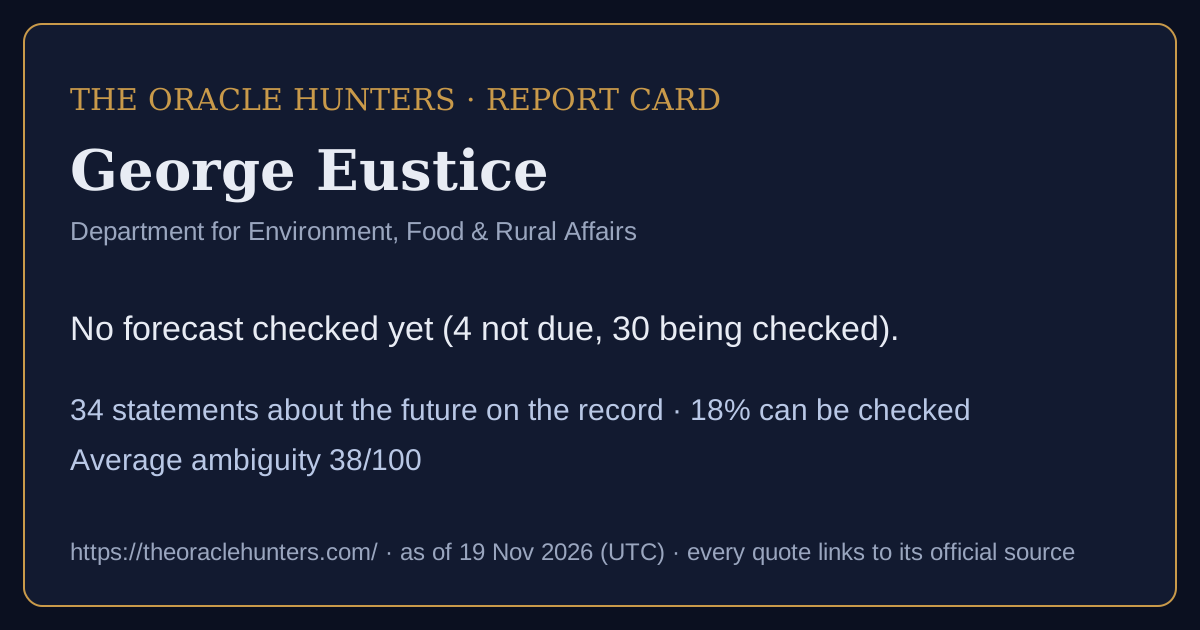
Track record: No forecast checked yet (4 not due, 30 being checked).
34forecasts & commitments on the record
18%can be checked as stated
38average ambiguity (0-100)
0goalpost moves recorded
0confirmed U-turns
Timeline
came true partly did not not due / being checked / too vague
Calibration score: shown after 10 checked forecasts with a stated likelihood (now 0).
How they speak about the future: based on data 22, stated on authority 10, educated guess 2.
Kinds of claim: mixed claim 25, forecast 8, commitment 1. · Download this report card as a picture
In the nine words
πρόγνωσιςInference from evidence21 · 62%μαντείαInspired knowledge10 · 29%εἰκασίαConjecture2 · 6%προαναγγελίαPublic pre-announcement1 · 3%
How to read this
Each box is one sentence a public figure or institution said about the future, word for word, with a link to the official text. Can be checked means it names what will happen, by when, and how likely - so it can be compared with official figures later. Too vague to check means it does not. Ambiguity (0-100) is how many different ways the sentence can be read. When the date passes, the forecast is compared with official data and marked came true, partly or did not come true. Labels judge the sentence, never the person. Full guide and glossary.On the record (34)
Next year, we are planning additional modules on nutrients which will build on the work we’re doing on soils and help farmers deal with the cost of synthetically manufactured fertilisers at the moment.
On average, we are going to increase rates in Countryside Stewardship by around 30%.
Sadly, virtually once again, which we had hoped to avoid this year, but let’s hope we’re close to turning the corner on this pandemic and endless COVID restrictions, and that we will be able to return to normal next year.
We will ensure that farmers in Countryside Stewardship next year can convert to our new schemes from 2024 onwards.
We want the Sustainable Farming Incentive to incentivise all sorts of things we’re going to do the first instalment, which we’re announcing today, in 2022.
We will provide significant funding between now and 2025 to build nursery capacity – supporting UK public and private sector nurseries and seed suppliers to enhance the quantity and quality of domestic tree production.
We will create at least three new community forests, which, together with existing community forests, will enable the planting of 6,000 hectares of new woodland around our towns and cities by 2025, building on the 500 hectares planted in the last year.
This will enable us to restore at least 35,000 hectares of peatland by 2025, supported by our new Nature for Climate Peatland Grant Scheme which will invest over £50 million over the next four years.
To recover species, we’ll need to work on habitats both within protected sites and in the wider countryside, meaning a single target for 2030 will drive wide-ranging improvements to the state of nature.
And, that is why today we will be amending the Environment Bill to require an additional legally binding target for species abundance for 2030, aiming to halt the decline of nature.
To drive higher international standards of biosecurity, we will publish a new Great Britain Plant Biosecurity Strategy by 2022.
And we also, this year, will rely more on warnings and improvement notices rather than penalties for every minor, trivial, error.
We expect to release more details later this year, as well as details of how we will invite nominations for Landscape Recovery – with around 10 large land use change projects, starting next year.
We will also be working up plans for the Local Nature Recovery schemes this year, ahead of launching the pilot for that in 2022.
So later this year, we will be opening a new round of grants to support investment to help farmers reduce costs and improve profitability.
We are going to make the early version of the Sustainable Farming Incentive open to all farms from next year but the work this year to pilot delivery will help us with implementation.
Today, I am pleased to announce that this year we will be working with hundreds of farmers across the country to pilot the Sustainable Farming Incentive, and that we will be inviting expressions of interest in the coming weeks.
By the end of 2024, the legacy Basic Payment Scheme probably will have been reduced by about 50%.
We will also increase the amount of funding available for environmental and animal welfare improvements in each year of the early transition, using funding released from Direct Payments as we move towards the roll out of the three components under Environmental Land Management, which will then take effect in full from 2024.
Between 2021 and 2024, we will help farmers prepare to take part in our Environmental Land Management offer.
They will help us to meet our targets; to plant 30,000 hectares of new woodland each year by 2025, to create and restore some of our peatlands, to protect 30% of land by 2030, to reach net zero by 2050.
In 2022 and 2023, we will reduce spend on Direct Payments by around 15% in each of those years.
We will remove the old style, top down rules and draconian penalties of the EU era starting with important changes next year that will substantially reduce guidance that farmers need to follow.
We will shortly be launching the appointment campaign for the first Chair of the Office for Environmental Protection so that they will be in place to lead a new Public Body in 2021 – to scrutinise and assess progress towards these targets.
So we will shortly be publishing a paper that sets out our approach to setting long-term targets on biodiversity, waste, water, and air quality through the new Environment Bill, so they are established in time by October 2022.
Next year we will host COP26 where we will be seeking to secure international action on climate change and biodiversity loss which will include emphasising the role of nature-based solutions in that global endeavour – such as our work to tackle illegal deforestation and promote sustainable supply chains.
We want nature-based solutions to become an important part of that agenda and that is why so much of what you have been discussing today - some of those fantastic examples of individual companies taking action that I heard about earlier, and of course an appeal to all of you to think about what you might be able to do …
And finally of course next year is going to be a very important year with the delayed COP 26.
We are looking very closely at this report and we are going to be able to say more later this year.
But one thing is clear and that is that this year we will need to rely on British workers to lend a hand to help bring that harvest home.
So this year more than ever we’ll need to work together, and I think that if we do then we will make the most of this huge opportunity to write a new, independent chapter for our country together.
By the end of 2024 we will roll out our new policy which will be open to all.
We will be keeping you updated throughout the course of this year so you can be ready for life outside the customs union and the single market, as we put in place a new free trade agreement.
But we will only realise that potential if we stick to this long term plan for growth.
Also said - not checkable as stated (12 newest)
Remarks about the future with no date, figure or likelihood that could be checked. They are kept on the record and shown here, but not scored.
When I was in agricultural college in the early 1990s, this was set to be the coming thing where we will gradually reduce our reliance on synthetic chemical pesticides using other natural predators, other agronomic techniques in conjunction with chemistry.
There will be a standard on hedgerows, because hedgerows are probably the single most important ecological building block in our farm landscape, and managed well they can be a space in which nature can recover.
And I know often it’s said that farmers need to change - we’ve got this challenge to Net Zero, problems of biodiversity.
Farmers will be able to have a vet of their choice, the family vet that they trust, and the government will pay between £372 and £684 depending on the species - because the cost of test is different – in order to support an annual visit from that vet to the farm.
So in cattle, we are particularly interested in the first instance in targeting BVD, in sheep there will be a Drench test to test for resistances to certain worms, and in pigs we will be testing for PRRS which is a growing problem in that particular sector.
In future years we will add modules on hedgerows and on integrated pest management, and we will also provide the opportunity for farmers to do more in each of those modules.
But you have to understand that the only way we could do that would be to cut the BPS payment faster than we already are.
We know that these things go in cycles and commodity prices may indeed fall again.
And the context in which climate change is going to mean that water scarcity becomes an issue in parts of the world, and parts of the world that have good and versatile agricultural land today may find it harder to produce crops in future and that means that the temperate regions of the world, including here in the UK, will …
And we will be rolling out other components to enhance animal health and welfare in the future.
They will dispense with that old style, rigid, top down rulebook and instead we will be replacing the schemes with new payments to incentivise sustainable farming.
Rates instead will be set at the level needed to incentivise uptake required on the scale we need to deliver our environmental objectives.