George A Provopoulos
Bank of Greece
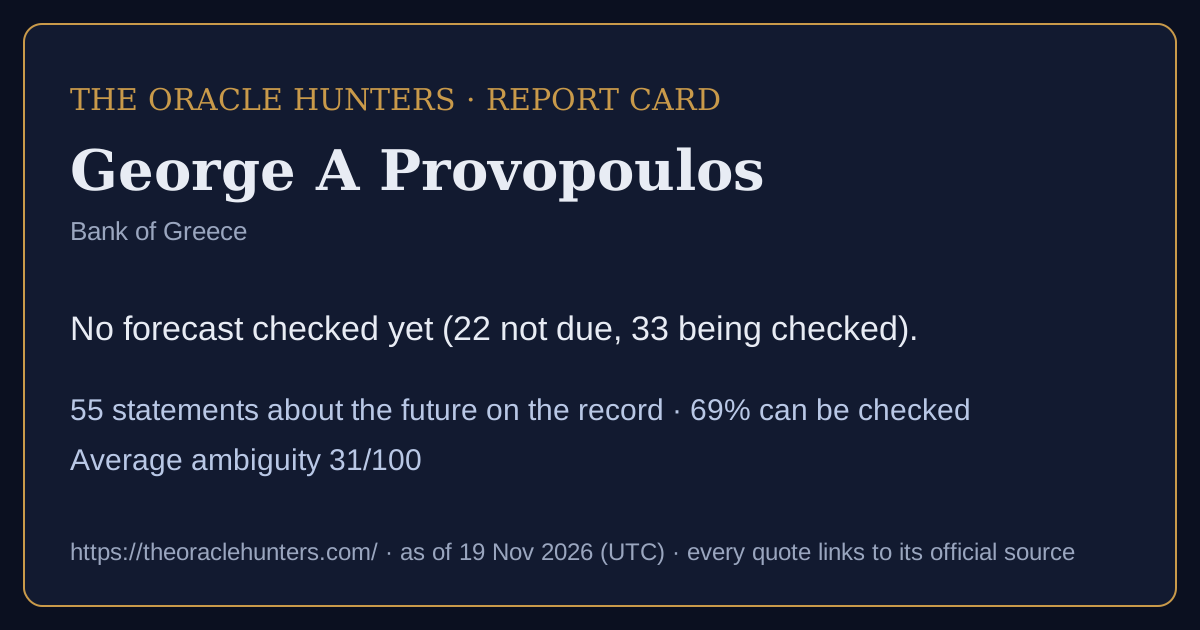
Track record: No forecast checked yet (22 not due, 33 being checked).
55forecasts & commitments on the record
69%can be checked as stated
31average ambiguity (0-100)
0goalpost moves recorded
0confirmed U-turns
Timeline
came true partly did not not due / being checked / too vague
Calibration score: shown after 10 checked forecasts with a stated likelihood (now 0).
How they speak about the future: based on data 45, educated guess 5, stated on authority 5.
Kinds of claim: forecast 43, mixed claim 8, scenario (if… then) 4. · Download this report card as a picture
In the nine words
πρόγνωσιςInference from evidence44 · 80%μαντείαInspired knowledge5 · 9%πρόνοιαPreparing for the future4 · 7%πρόβλεψιςSeeing the signs1 · 2%εἰκασίαConjecture1 · 2%
How to read this
Each box is one sentence a public figure or institution said about the future, word for word, with a link to the official text. Can be checked means it names what will happen, by when, and how likely - so it can be compared with official figures later. Too vague to check means it does not. Ambiguity (0-100) is how many different ways the sentence can be read. When the date passes, the forecast is compared with official data and marked came true, partly or did not come true. Labels judge the sentence, never the person. Full guide and glossary.On the record (55)
The declining path for real interest rates, suggested by the fact that inflation expectations are anchored close to 2% in combination with the ECB's commitment to keep an accommodative monetary policy stance, will lead to a substantial increase of the demand for credit along the way.
The anticipated recovery will prove hesitant and fragile, undermining the country's growth prospects, if we fail to implement reforms, aimed to ensure:
Member States that have signed up to the Compact are required to adopt national fiscal rules to ensure that the annual structural government deficit does not exceed 0.5% of GDP, as well as a correction mechanism to be triggered automatically in the event of deviation from either the Medium-Term Objective (MTO) itself or the adjustment path towards it.
In this respect, the Presidency will promote the Directive of Administrative Cooperation for the extension of automatic exchange of information in early 2014 and the adoption of the revised savings taxation Directive by March 2014.
The scheme will begin operation in January 2016.
Almost 85% of total banking assets in the euro area will be covered.
The Single Supervisory Mechanism, which will become fully operational this November, will lead to the transfer of the supervision of almost 85 per cent of total euro-area bank assets to the ECB.
A 'code of conduct' for banks' dealings with distressed borrowers is being drawn up and will be implemented as of 2015.
These measures will increase the primary fiscal surplus to 1 ½ per cent of GDP this year.
Presently, the debt-to-GDP ratio stands at about 175 per cent and it is projected to decline to 110 per cent in 2023.
If Greece achieves a primary surplus in 2013, which seems very likely to happen, the euro area will be discussing further debt reducing measures in spring 2014.
In light of these developments, I expect economic growth to return, starting in 2014.
As you may know, we have recently engaged BlackRock for a second time - to update credit loss projections for banks' loan portfolios up to 2016, and to study the efficiency of banks' procedures in managing non-performing loans.
The structural fiscal deficit - that is, the deficit corrected for the business cycle - will have shrunk by almost 20 percentage points of GDP by end2013.
By the end of this year, the entire loss will have been recovered.
These measures will increase the primary fiscal surplus to 3 per cent of GDP in two years.
It is projected to swing into a small surplus this year.
As the overhaul of the Greek economy continues, I expect economic growth to resume starting in 2014.
Further debt-reducing measures were announced by the EuroGroup last November, subject to Greece reaching a primary surplus, which the government expects to achieve this year.
## 2013 will be a difficult year, but recovery will be visible in the course of 2014
The recession led to a dramatic decline in employment and pushed the unemployment rate up to a historically high annual average of 24.5% in 2012; a further rise is expected in 2013.
If they fail to do so, the Bank of Greece will activate the steps envisaged in the resolution framework, at the latest by June 2013, in a manner that will safeguard financial stability.
Following the recent European Council decision, the Structural Funds available to Greece for 2014-2020 will total EUR 18.3 billion.
But we can expect recessionary forces to weaken gradually and the Greek economy to return to positive growth rates in the course of 2014.
According to the Memorandum, the other banks will have to raise private capital by the end of April 2013.
So if we are able to change the mood and boost confidence and growth, the debt dynamics will improve fast.
Plus, by the end of this year, Greece will have fully regained the 32 percent loss in competitiveness (measured in terms of relative unit labor costs) that we suffered from 2001 to 2009.
- The Bank of Greece forecasts an average annual rate of decline in GDP of close to 5%; implying that the recession will be less pronounced than in 2011; this forecast assumes that the necessary structural reforms will be implemented without delay.
Thus, the speedy implementation of the policies contained in the second adjustment programme will place the economy back on track to recovery by the end of 2013 and gradually into a virtuous circle of confidence-fiscal balance-growth.
The privatisation programme, with expected proceeds of €19 billion by 2015, mainly in the form of capital inflows from abroad, will lead to much greater total inflows if the additional investments required to fully exploit the assets to-beacquired are taken into consideration.
The available short-term indicators for the first months of 2012 suggest that the recession will continue this year.
In 2013 inflation is projected to fall further, possibly to below 0.5%.
- The average unemployment rate is projected to increase this year and exceed 19%, up from 17.7% last year.
- The current account deficit will narrow to below 9% of GDP, as a result of the recovery of exports and receipts from tourism and the continuing fall of consumer good imports.
- Unemployment will continue to rise and will exceed 15%.
GDP is projected to decline by 3%, and a slightly larger decline cannot be ruled out.
In light of the above, there will be a need to formulate and implement economic policies geared toward developing alternative sources of growth - policies that will render the economies less vulnerable to external shocks and that will allow them to better navigate their way through shocks should they occur.
That earlier widening of spreads occurred despite the fact that markets were expecting a fiscal deficit of less than 4 per cent of GDP and a debt-to-GDP level of only about 96 per cent of GDP, figures that would be repeatedly revised upward during the remainder of the year.
Meanwhile, the euro has fallen sharply against the dollar since the beginning of this year, and the speculation that the euro will soon replace the dollar as the leading international currency has subsided.
In particular, it will be of crucial importance for the overall economic climate, if fiscal consolidation on the expenditure side progresses even further than currently planned and achieves a deficit reduction this year of more than 5% of GDP, especially considering that the deficit figures for 2009 were revised upward to 13.6% and may undergo further revision.
A further drop in employment is projected for 2010, while the rate of unemployment will come close to 11%.
The recommended acceleration - as of this year - of fiscal consolidation, through reducing expenditure and rationalising the operation of the public sector, will indeed favourably surprise the markets and contribute to restoring confidence faster.
Indeed, if the 2009 debt is eventually revised to 120% or 122% (as is considered possible by Eurostat), these projections will have to be revised unfavourably.
According to projections based on plausible assumptions, the debt-to-GDP ratio will continue to rise and will tend to stabilise only in 2014, and then again at very high levels (130%).
If the recovery were to stall, followed by a prolonged period of very-low growth, deficits and debt could swell to difficult-to-sustain levels.
However, this outcome reflects factors that, if left untreated, will reduce growth potential in the medium term.
The IMF projects that the aggregate fiscal deficit of the euro area will rise from 1.8 per cent of GDP in 2008, to over 6 per cent of GDP in 2010.
In January of this year, the IMF again reduced its growth forecast for 2009, this time to 0.5 per cent.
As a result of the crisis, I expect that growth will slow from almost 3 per cent last year, to zero per cent this year, perhaps even moving into negative territory.
The IMF also projects that global growth will re-emerge in 2010, but at 1.9 per cent it would be sluggish compared with past recoveries.
Showing the newest 50 - the ledger has all 55.
Also said - not checkable as stated (12 newest)
Remarks about the future with no date, figure or likelihood that could be checked. They are kept on the record and shown here, but not scored.
Public spending kept increasing, while revenue could not possibly keep pace, leading to large deficits and historically high levels of public debt, despite the unprecedented low interest rates.
Revenue must be increased by reducing tax evasion and broadening the tax base to make possible the necessary lowering of tax rates and the tax burden in the future.
A radical reorientation of the economy towards a new model requires a comprehensive National Plan for Growth, which will have far-reaching goals and will be implemented consistently.
I shall only briefly refer to the most important among them.
The provision of emergency liquidity assistance was reviewed every two weeks and the ECB Governing Council could put a stop to it for a variety of reasons (lack of collateral, low capital adequacy ratios of the banks, incomplete implementation of the programme, etc.).
In Chapter 8 of the book we release for the first time data on the increased demand for cash and the Bank's cash management during the crisis, which I believe you will find very interesting.
Second, I will provide reflections on another important issue - the financing of the real economy and European initiatives related to that financing.
A key pillar of the euro-area's banking union will be the Single Resolution Mechanism (SRM).
Second, the responsibility for deciding the time that resolution of a credit institution is warranted remains primarily a task for supervisors, while the Supervisory Board also retains the right to declare a credit institution 'failing or likely-to-fail' in some cases.
The repair of banks' balance sheets is unavoidable and will, of necessity, involve some deleveraging.
I am therefore confident that the second stage of recapitalization will play an important role in restoring confidence in Greece and a healthy financing of the economy.
However, if this forecast is to become a reality, not only must the conditions contributing to the improved outlook remain unchanged, but they also have to be taken further.