Gent Sejko
Bank of Albania
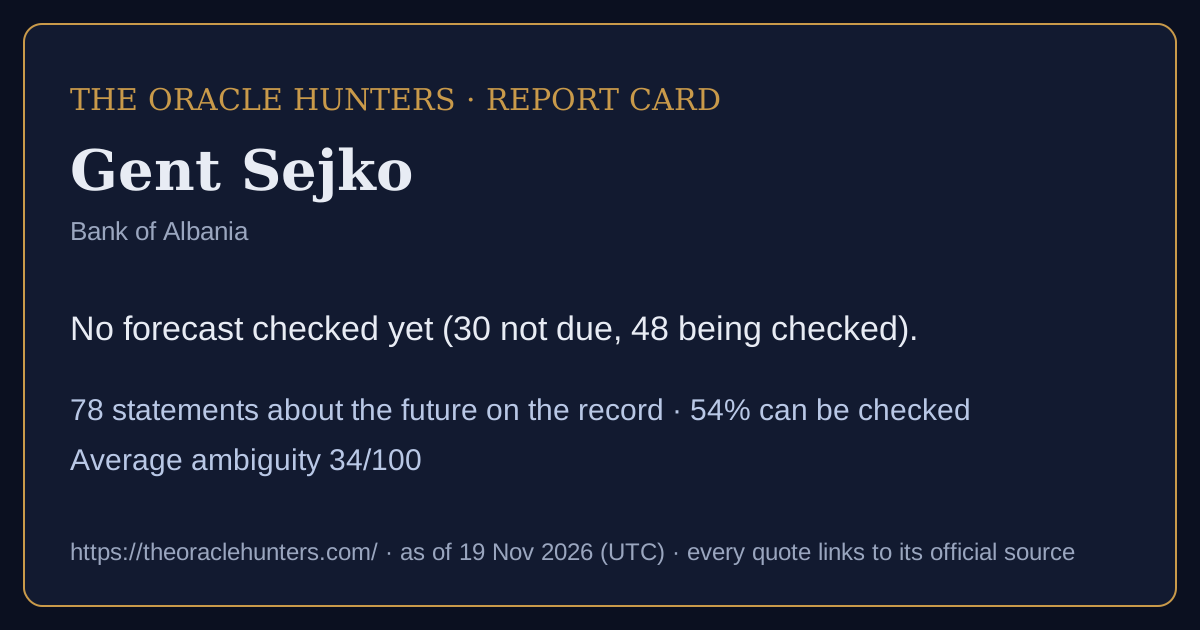
Track record: No forecast checked yet (30 not due, 48 being checked).
78forecasts & commitments on the record
54%can be checked as stated
34average ambiguity (0-100)
0goalpost moves recorded
0confirmed U-turns
Timeline
came true partly did not not due / being checked / too vague
Calibration score: shown after 10 checked forecasts with a stated likelihood (now 0).
How they speak about the future: based on data 56, stated on authority 19, educated guess 3.
Kinds of claim: forecast 73, scenario (if… then) 2, mixed claim 2, commitment 1. · Download this report card as a picture
In the nine words
πρόγνωσιςInference from evidence54 · 69%μαντείαInspired knowledge18 · 23%πρόνοιαPreparing for the future2 · 3%πρόβλεψιςSeeing the signs2 · 3%φρόνησιςPractical wisdom1 · 1%προαναγγελίαPublic pre-announcement1 · 1%
How to read this
Each box is one sentence a public figure or institution said about the future, word for word, with a link to the official text. Can be checked means it names what will happen, by when, and how likely - so it can be compared with official figures later. Too vague to check means it does not. Ambiguity (0-100) is how many different ways the sentence can be read. When the date passes, the forecast is compared with official data and marked came true, partly or did not come true. Labels judge the sentence, never the person. Full guide and glossary.On the record (78)
This phase is expected to be finalised within the third quarter of this year.
Integration into SEPA, combined with the expansion of digital payments, is expected to generate savings of around EUR 20 million in the first year only, with progressive growth in the years to come.
This program, which will be implemented through commercial banks, offers the possibility of significantly reducing the cost of credit for these businesses, which could reach up to 2%, but in any case, will not exceed the level of 3.5%, in turn enabling them to invest in physical assets, capital equipment, or technological platforms that serve to increase productivity.
2025 will be a jubilee year for us, as it marks the 100th anniversary of our central bank.
Second, the establishment of a supportive environment for key sectors of the economy, such as trade, will facilitate transactions with our main European partners, in addition to enabling for Albanian businesses potential access to a market of 500 million people.
Inflation and expectations on inflation, as a result of this reaction, stay already close to our 3% target, while forecasts for the future are positive.
In more concrete terms, based on the experience of AIPS Euro, through which the Bank of Albania has saved the Albanian market EUR 50 million since its launching in January 2022, the impact from SEPA membership will be even broader.
Thus, based on official data from the national register of bank accounts, in 2023, around 78% of adults own a bank account, a figure which could reach 85%, if payment accounts of electronic money institutions were to be included as well.
Last but not least, fulfilling this objective marks the first step toward our engagement in the framework of the new Growth Plan for the Western Balkans, which will enable Albania to obtain the necessary funds to pave a sustainable path toward the EU membership in 2030, which is also our final objective.
Inflation and expectations on inflation, as a result of this reaction, stay already close to our 3% target, while second-round effects remain under control and the outlook for the future is positive.
In addition, we expect inflation to stay close to our 3% target.
On the other hand, based on the baseline scenario, inflation is expected to continue to decline gradually in the next quarters and return to the target by the mid-next year.
Economic growth pace is expected to record a slight slowdown in the current year and in the next year, owing to a weaker economic activity in the euro area and tighter financing conditions, in both Albanian and globally.
The Albanian economy - based on the current trends and their supportive factors - is expected to continue to grow in the next years, while inflation is expected to turn to the target by mid-next year.
However, inflation trend recorded a turning point in October 2022, declining progressively onwards at 4.7% in May 2023.
Our projections suggest inflation will reach the target in 2024, driven by the stability of prices in global markets and the effects of monetary policy stance normalisation.
Our projections suggest inflation will continue on a downward trajectory during 2023, and will return to target within the first half of 2024.
I wish that our cooperation, which is at the service of best public interest, will continue to follow the same model in 2023 as well.
In this context, I would like to point out that the latest forecasts at the Bank of Albania show that inflation is expected to progressively reduce during 2023, and return to target in the middle of 2024.
The development of abilities to foresee and assess in an objective manner the solvency of the existing clients - without being inclined to fast and short-term profits, which may harm an already established long-term relationship - will be one of the main challenges in the next year.
Notwithstanding the challenges and hardships caused by the soaring inflation during this year, forecasts for the Albanian economic growth remain positive.
This development introduced another important player in the group of large banks, which share above 70% of market, and it is expected to contribute positively towards a more competitive and expanded market.
Though risks remain present, our projections suggest inflation will return to target within the first half of 2024 and the Albanian economy will continue to maintain a positive growth pace throughout this period.
Forward looking, projections in our baseline scenario suggest inflation will reduce in the course of the next year, and return in our 3% target in 2024.
Furthermore, the stabilisation of prices in foreign markets and the normalisation of the monetary policy stance will induce a progressive reduction of inflation, until its return to the target in 2024 H1.
20 research projects will be presented and discussed this year, which in in spite of covering a broad gamut/range of topics, are directly related to the activity and interests of the central bank.
I am glad to note that we have again a full house and a rich agenda this year, with two days in which colleagues and researchers from central banks as well as distinguished universities in Albanian and worldwide will present their works.
On the other side, data show that the wrong communication of Lek value occurs very rarely across financial institutions (banks, non-banks, etc.), only 28.1%, or in the offices of public administration (39.4%), although it might be expected
The first results are promising and they will be followed by other steps by the Bank of Albania and the banking sector, aimed at achieving a quantitative objective, that is, to see the number of bank account holders doubled by 2023.
The process is extended over a long time frame and during this frame we will closely monitor the progress of building necessary capital and MREL buffers, as well as carefully calibrate the aggregate capital requirements in an appropriate and flexible manner, in order not to hamper the organic and healthy growth of the banking activity.
First, the banking sector will continue to consolidate further in the next year, after the acquisition of Alpha Bank from OTP NYRT.
In the next year, we will continue the dialogue with the industry, following the results of the first EIR cap application and mostly debated rate cap on consumer loan penalties.
The economic growth will help the strengthening of inflationary pressures and the return of inflation to target within 2022.
We are optimistic that the economic activity is expected to revitalize over the next two years.
In the wake of a double shock in the form of 2019's earthquake and the pandemic, GDP is expected to drop by around 7% of GDP.
For this reason, the Bank of Albania kept the key interest rate unchanged at 1.0%, oriented the market on maintaining the easing direction of monetary policy in medium-term horizon, as well as supplied banks with the necessary liquidity.
Hence, the Bank of Albania: kept the policy rate unchanged at 1.0%; oriented the markets towards maintaining the accommodative monetary policy stance in the medium-term horizon; and supplied banks with the necessary liquidity.
Further, this improvement will turn more obvious and notable during 2021.
The first results are promising and further steps by the Bank of Albania and the banking sector will be taken aimed at achieving a quantitative objective, which is to see the number of bank account holders doubled by 2022.
Hoping that in the spring of 2020 we will see a green light for the opening of accession negotiations for Albania, I would like to reassure you of Bank of Albania's commitment to fulfilling priorities arising from the European integration process.
These important issues will be discussed in a jointly-organized workshop with all BCC partners on capacity building for central banks, in Tirana in spring 2020.
The Conference this year will seek to address the latest trends in the banking industry in Albania, in the region and the rest of the world, focusing on challenges and opportunities that lie ahead of us.
lending, if it deepens further it will jeopardise the performance of credit and the pace of economic growth.
All the above reasons fuel the optimism on the perspective of economic growth in the next year and onward.
The first results are promising and they will be followed by other steps by the Bank of Albania and the banking sector, aimed at achieving a quantitative objective, that is, to see the number of bank account holders doubled by 2022.
I t may be considered as a special year in view of important structural changes in the system, which are expected to be finalised in the next year.
In the baseline scenario, these projections suggest that economic growth will continue in the medium-term horizon, production capacities will be utilised in fuller terms, and inflation will converge to the central bank target by 2020.
- Second, the assessment of the risk arising from public-private partnership programmes, the so-called PPPs, suggests that deviations from the requirements of the law for annual PPP payments to the level of 5% of tax revenues of the previous year will be covered through the increase in revenues.
Analysed in greater detail, the deficit of the social security scheme, also known as the pension scheme, is expected to be at around 1.5% of the GDP, within the projections made in the reform of this system, and set on a downward trend.
- Reducing the public debt, to 65.5% of the GDP against 69.1% expected for 2018;
Showing the newest 50 - the ledger has all 78.
Also said - not checkable as stated (12 newest)
Remarks about the future with no date, figure or likelihood that could be checked. They are kept on the record and shown here, but not scored.
At the same time, the adoption of the Medium-Term Development Strategy 2026-2028 has clarified the Bank's institutional priorities and provided a solid foundation for its further modernisation in the period ahead.
Looking ahead, the Bank of Albania will remain committed to safeguarding financial stability, strengthening prudential supervision, advancing regulatory reforms, and further aligning its framework with European standards.
In this context, I would like to reaffirm that the Bank of Albania will closely monitor inflation developments and stand ready to respond in a timely manner to prevent second-round effects and safeguard price stability.
In this context, the Bank of Albania will continue to exercise its mandate with professionalism, independence, and transparency, safeguarding monetary and financial stability, supporting the European integration process, and serving the long-term interests of Albanian citizens.
Address by Mr Gent Sejko, Governor of the Bank of Albania, at the signing ceremony of the Memorandum of Understanding on the "National initiative for financing micro, small, and medium-sized enterprises", Tirana, 13 May 2026.
For this reason, expanding credit to this segment should be considered as an important national priority.
Address by Mr Gent Sejko, Governor of the Bank of Albania, at the Israel Albania Cyber Summit, Tirana, 12 May 2026.
This process will continue to be repeated until the Bank of Albania ensures an appropriate and consistent level of cybersecurity maturity across all banks.
Wishing you fruitful proceedings of this Summit, I am confident that strengthened institutional cooperation, the further consolidation of processes developed to date, and the effective implementation of new initiatives will further enhance our cybersecurity capabilities and reinforce the resilience of the financial system and critical infrastructure.
Special address by Mr Gent Sejko, Governor of the Bank of Albania, at the IIA Albania (Institute of Internal Auditors Albania) International Conference 2026 "Empowering internal audit", Tirana, 11 May 2026.
I am confident that the cooperation among public institutions, the banking sector, professional organisations, and international partners will continue to deliver tangible results in strengthening governance and safeguarding financial stability.
Through open lectures, competitions, educational activities, and interactive sessions, students will have the opportunity to gain a deeper understanding of the financial world and the importance of cautious decision-making.