GE Aerospace
Institution - official statements with no named speaker · USA
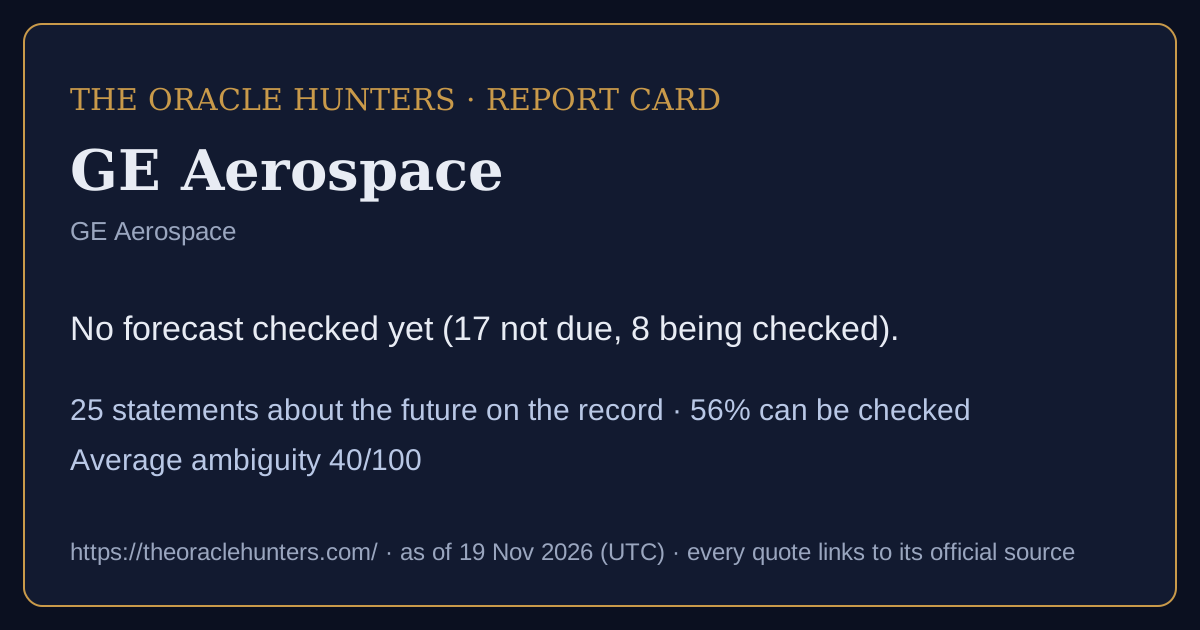
Track record: No forecast checked yet (17 not due, 8 being checked).
25forecasts & commitments on the record
56%can be checked as stated
40average ambiguity (0-100)
0goalpost moves recorded
0confirmed U-turns
Timeline
came true partly did not not due / being checked / too vague
Calibration score: shown after 10 checked forecasts with a stated likelihood (now 0).
How they speak about the future: based on data 25.
Kinds of claim: forecast 24, mixed claim 1. · Download this report card as a picture
In the nine words
How to read this
Each box is one sentence a public figure or institution said about the future, word for word, with a link to the official text. Can be checked means it names what will happen, by when, and how likely - so it can be compared with official figures later. Too vague to check means it does not. Ambiguity (0-100) is how many different ways the sentence can be read. When the date passes, the forecast is compared with official data and marked came true, partly or did not come true. Labels judge the sentence, never the person. Full guide and glossary.On the record (25)
Gas Power revenues were down 1% reported and 2% organically*, driven by significantly lower turnkey projects, partially offset by services, which were up 13% reported and organically*, as we saw strong transactional backlog execution and higher outages.
GE expects to use the proceeds from the transaction to further reduce debt for a total reduction of more than $70 billion since the end of 2018.
Renewable Energy ended 2020 with a record-high $30 billion backlog and is focused on continuing to improve its cost structure, project execution, and deal selectivity.
Segment profit of $0.1 billion was up by $0.3 billion, largely due to higher Gas Power equipment revenues and better equipment project execution, as well as improved cost productivity across Gas Power and Power Portfolio.
In 2021, we expect an additional contribution from GE to GE Capital to meet its existing insurance statutory funding requirement of approximately $2 billion.
While our work continues, GE’s transformation is accelerating, and we expect Industrial free cash flow to be at least $2.5 billion in the fourth quarter and positive in 2021.
Segment loss of $195 million was down 6%, mainly driven by the negative impact of supply chain and project fulfillment disruptions associated with COVID-19 and quality-related costs, partially offset by Onshore Wind price and lower project execution losses.
We expect to return to positive Industrial free cash flow in 2021.
Reduced near-term liquidity needs by $10.5 billion through a series of GE and GE Capital debt offerings and repayments that GE expects to be leverage neutral by the end of 2021.
The commitments under these syndicated credit facilities may be reduced by up to $6.7 billion due to offset provisions for any bank that holds a commitment to lend under both facilities.
Segment margins improved, largely due to lower project and product charges and fixed costs* down 12% in Gas Power, partially offset by lower service volumes.
GE continues to expect Industrial free cash flow* to be in positive territory in 2020 with further acceleration in 2021.
Announced or completed more than $9 billion of total Industrial deleveraging actions, including completing a ~$5 billion debt tender, repaying a portion of the intercompany loans from GE Capital, and announcing multiple changes related to U.S. pension benefits that GE expects will reduce its Industrial net debt* by $4-6 billion through 2020.
We have more work to do, and we will continue to take actions to improve our financial position and strengthen our businesses as we prepare for 2020 and beyond.
Segment profit of negative $184 million was driven by joint venture consolidation, higher losses on legacy contracts, challenging Onshore project execution in Asia Pacific, increased R&D investment, tariffs, and pricing, partially offset by cost productivity and strong volume.
Increasing 2019 outlook for Industrial segment organic revenues growth to the mid-single-digit range, adjusted EPS to $0.55 - $0.65, and GE Industrial free cash flows to $(1) - $1 billion
GE continues to expect adjusted Industrial free cash flow to be in positive territory in 2020 with further acceleration in 2021.
GE announced last week that the comprehensive review and reserve testing for GE Capital’s run-off insurance portfolio, North American Life & Health (NALH), resulted in an after-tax GAAP charge of $6.2 billion for the fourth quarter of 2017, and GE Capital expects to make statutory reserve contributions of approximately $15 billion over 7 years.
Verticals include businesses expected to be retained (GECAS, Energy Financial Services, Industrial Finance, and run-off insurance activities), including allocated corporate after-tax costs of $25 million in the three months ended September 30, 2017 and 2016.
Verticals include businesses expected to be retained (GECAS, Energy Financial Services, Industrial Finance, and run-off Insurance), including allocated corporate after-tax costs of $25 million in both the three months ended June 30, 2017 and 2016.
Verticals include businesses expected to be retained (GECAS, EFS, Industrial Finance, and run-off Insurance), including allocated corporate after tax costs of $25 million in both the three months ended December 31, 2016 and 2015 and $100 million and $133 million in the twelve months ended December 31, 2016 and 2015, respectively.
Verticals include businesses expected to be retained (GECAS, EFS, Industrial Finance, and run-off Insurance), including allocated corporate costs of $25 million after tax in both the three months ended September 30, 2016 and 2015.
Verticals include businesses expected to be retained (GECAS, EFS, Industrial Finance, and run-off Insurance), including allocated corporate costs of $25 million after tax in both the three months ended June 30, 2016 and 2015.
Verticals include businesses expected to be retained (GECAS, EFS, Industrial Finance, and run-off Insurance), including allocated corporate costs of $25 million and $58 million after tax in the three months ended March 31, 2016 and 2015, respectively.
Verticals include businesses expected to be retained (GECAS, EFS, CLL, and run-off Insurance), including allocated corporate costs of $25 million and $58 million after tax in the three months ended December 31, 2015 and 2014, respectively, and $133 million and $233 million after tax for the years ended December 31, 2015 and 2014, respectively.