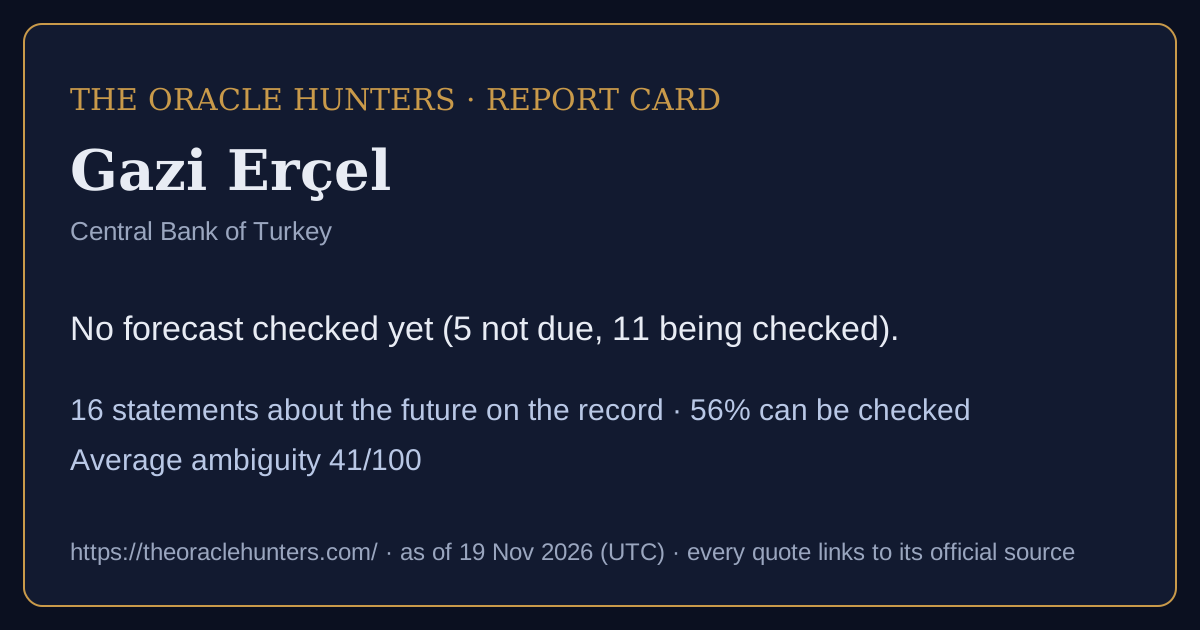
Gazi Erçel
Central Bank of Turkey
Track record: No forecast checked yet (5 not due, 11 being checked).
16forecasts & commitments on the record
56%can be checked as stated
41average ambiguity (0-100)
0goalpost moves recorded
0confirmed U-turns
Timeline
came true partly did not not due / being checked / too vague
Calibration score: shown after 10 checked forecasts with a stated likelihood (now 0).
How they speak about the future: based on data 14, stated on authority 2.
Kinds of claim: forecast 14, mixed claim 1, commitment 1. · Download this report card as a picture
In the nine words
πρόγνωσιςInference from evidence11 · 69%μαντείαInspired knowledge2 · 12%προαναγγελίαPublic pre-announcement1 · 6%πρόβλεψιςSeeing the signs1 · 6%φρόνησιςPractical wisdom1 · 6%
How to read this
Each box is one sentence a public figure or institution said about the future, word for word, with a link to the official text. Can be checked means it names what will happen, by when, and how likely - so it can be compared with official figures later. Too vague to check means it does not. Ambiguity (0-100) is how many different ways the sentence can be read. When the date passes, the forecast is compared with official data and marked came true, partly or did not come true. Labels judge the sentence, never the person. Full guide and glossary.On the record (16)
The exchange rate band mechanism will provide greater flexibility for net domestic assets after the second half of 2001.
Then, starting in July 2001, a gradually widening symmetrical band will be introduced for the pre-announce exchange basket.
From this point on, the total width of the band will be 7.5% by end-2001, 15% by end-June 2002, and 22.5% by end-December 2002.
This primary surplus will increase further to 3.7% of GNP in 2001, and will remain around that level in 2002 as well.
As a result of the improvement in the primary balance, and the increase in privatization receipts, some of which can be used to retire public debt, the cash debt-to-GNP ratio is expected to level off at around 24% this year and to begin a gradual decline in coming years.
For example, the social security reform law passed by the parliament last fall is expected to save 0.5% of GNP in social security expenditures in 2000.
This program is gradual in nature and aims to reduce inflation, which had reached 91% by the end of 1997, to single digits over the medium term.
Consistent with these inflation targets for the next two years, fiscal policy will be conducted according to a broad-based approach aimed at improving all aspects of public sector revenues and expenditures.
A comprehensive program of macroeconomic and fiscal adjustment, aimed at lowering inflation to 10% by the end of 2001.
With the strengthening of credibility that will come with the completion of these reforms, I believe Turkey's disinflation program will shift into a new stage starting in 2000.
Once we manage to stabilise the macroeconomic environment, we will be able to reduce the 100 percent coverage to internationally acceptable levels.
The ECB has indicated that even if it has an inflation target, it will no These monetary policy conditions absolutely guarantee that there will be some uncertain questions, and the first question will be whether it will be possible to lower the inflat 2% when the intermediate targets are indicators calculated using the monetary aggregates of countries.
European economic and monetary union (EMU) will come to life at the beginning of next year European Central Bank (ECB) will commence operations, and the euro will become an offi reserve currency.
Money market placements on the other hand will continue to be transacted in their original currencies until July 1st, 2002.
With monetary union the share of the Euro area in Turkey's overall trade in goods or services will be more than 50%.
It is estimated that the share of foreign trade of the Euro area will be only about 10% of GNP in comparison to about 30% for Germany today.
Also said - not checkable as stated (12 newest)
Remarks about the future with no date, figure or likelihood that could be checked. They are kept on the record and shown here, but not scored.
Those whose external debt is largely denominated in European Union currencies will be affected the most.
I personally think that acceptance of the euro in daily life and financial transactions will come faster in Turkey than in other countries, for three reasons: the large numbers of Turkish citizens living in Europe, the large volume of trade and tourism transactions with Europe, and the consistent stability of the deutsche mark for 20 years and more.
Increased acceptance of euros in Turkish trade and financial transactions, of course combined with an environment of low inflation, will make direct investments in Turkey more attractive to European firms.
Under such circumstances, both Turkish and European banks could be expected to increase their merger and acquisition activities.
In this situation, the correction of the euro's value against other major currencies will have a beneficial effect on Turkey's current account balance, in addition to the offsetting of the negative effects of the weak euro provided by the high productivity of our manufacturing sector and the diversified nature of our exports.
Debt monetization will no longer be allowed.
So even though the underlying rate of inflation has been lower, central banks have to consider what is likely to happen to prices in the future.
This Conference will review the country experiences on inflation targeting, particularly touching on the best ways to design policy objectives, responses, and implementation issues.
Some papers will consider not only inflation targeting framework, but also the case of economies during the shift to low inflation.
If monetary policy could not be expected to dampen business cycles by fine tuning, it might do so by stabilizing inflation expectations as the result of a clear and credible commitment to a nominal anchor that is believed to stabilize prices on average in the long run.
Such a policy has two goals: the first is to provide the market with reliable information on what the rate of inflation will be so that investment, wage setting, and other market decisions can be made with greater confidence in what the future price level will be.
Such a policy might minimize the gap between actual and expected inflation that spill over to the real economy.