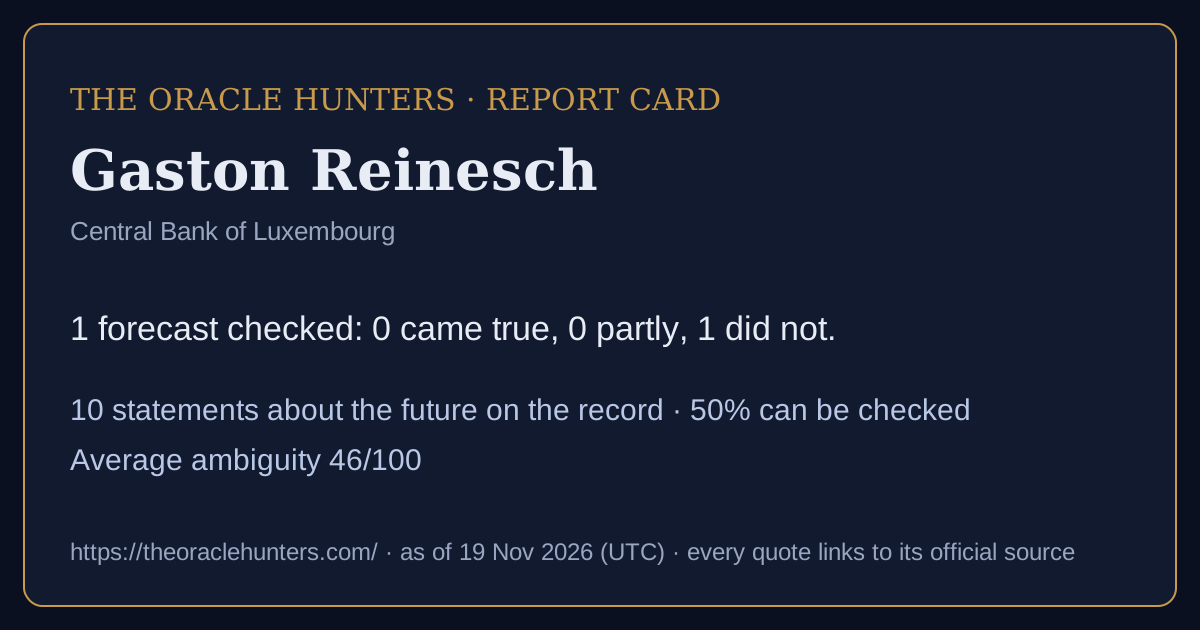
Gaston Reinesch
Central Bank of Luxembourg
Track record: 1 forecast checked: 0 came true, 0 partly, 1 did not.
10forecasts & commitments on the record
50%can be checked as stated
46average ambiguity (0-100)
0goalpost moves recorded
0confirmed U-turns
Timeline
came true partly did not not due / being checked / too vague
Calibration score: shown after 10 checked forecasts with a stated likelihood (now 0).
How they speak about the future: based on data 9, stated on authority 1.
Kinds of claim: forecast 10. · Download this report card as a picture
In the nine words
How to read this
Each box is one sentence a public figure or institution said about the future, word for word, with a link to the official text. Can be checked means it names what will happen, by when, and how likely - so it can be compared with official figures later. Too vague to check means it does not. Ambiguity (0-100) is how many different ways the sentence can be read. When the date passes, the forecast is compared with official data and marked came true, partly or did not come true. Labels judge the sentence, never the person. Full guide and glossary.Checked
Overall, this assessment is broadly reflected in the staff projections which foresee an annual real GDP growth of 1.4% in 2015, 1.7% in 2016 and 1.8% in 2017.
Did not come true. Said: economic growth around 1.7% in 2016. Official figure for Luxembourg: 5.0% (World Bank open data). Missed. Off by 3.3 points. official data · checked 14 Nov 2026 · automatic check against official data (rules v3)
On the record (10)
As announced some days ago, the Commission will make a legislative proposal on the first steps towards a common European Deposit Insurance Scheme by the end of this year.
From 2016, the Single Resolution Fund, which will be built up over a period of eight years, will replace these national funds in Member States participating in the SSM and the SRM.
The Single Resolution Board, which will be fully operational as from 1st of January 2016, is at the core of the SRM.
The September 2015 ECB staff (June 2015 Eurosystem) macroeconomic projections foresee real GDP growing by 1.4% (1.5%) in 2015, by 1.7% (1.9%) in 2016 and by 1.8% (2.0%) in 2017.
6 The September 2015 ECB staff (June 2015 Eurosystem) macroeconomic projections foresee annual HICP inflation at 0.1% (0.3%) in 2015, 1.1% (1.5%) in 2016 and 1.7% (1.8%) in 2017.
They are intended to run until the end of September 2016, or beyond if necessary, and, in any case, until we see a sustained adjustment in the path of inflation that is consistent with our aim of achieving inflation rates below, but close to, 2% over the medium term.
However, it is also necessary to stress that while the output gap is narrowing, it is occurring against a background of weak potential output growth, which is estimated to be around 1% over the projection horizon.
8 'The Great Distortion - A Dangerous Flaw at the Heart of the World Economy', The Economist, 16 May 2016.
Overall, this assessment is broadly reflected in the staff projections which foresee an annual real GDP growth of 1.4% in 2015, 1.7% in 2016 and 1.8% in 2017.
Did not come true. Said: economic growth around 1.7% in 2016. Official figure for Luxembourg: 5.0% (World Bank open data). Missed. Off by 3.3 points. official data · checked 14 Nov 2026 · automatic check against official data (rules v3)
As far as inflation is concerned, the staff projections foresee an annual Harmonized Index of Consumer Price Inflation (HICP) of 0.1% in 2015, 1.1% in 2016 and 1.7% in 2017. 1 In comparison with the June projections, 2 the outlook for inflation has been revised down, largely owing to lower oil prices and, to a much lesser extent, a slower …
Also said - not checkable as stated (2 newest)
Remarks about the future with no date, figure or likelihood that could be checked. They are kept on the record and shown here, but not scored.
With regard to monetary policy, which has to be focused on the primary objective of maintaining price stability over the medium term, its highly accommodative stance has contributed and continues to contribute to support economic activity and investment, narrow the negative output gap and foster economic growth.
I will do so in light of the European Central Bank's (ECB) staff euro-area macroeconomic projections, which have been published last week, referred to hereafter as the 'staff projections'.