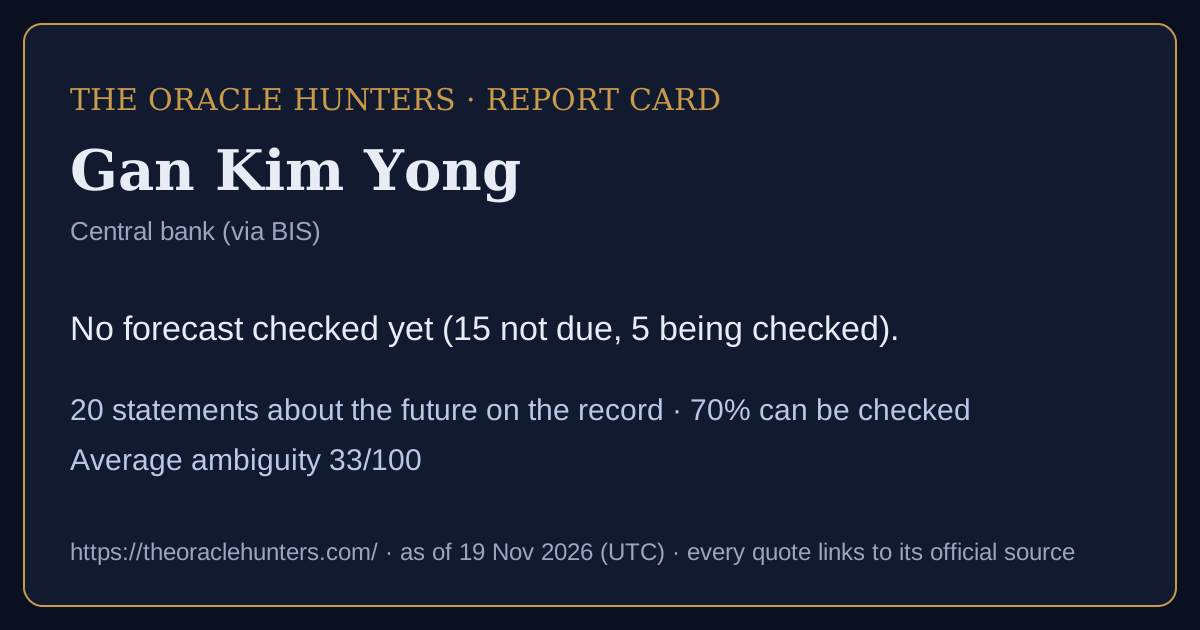
Gan Kim Yong
Central bank (via BIS)
Track record: No forecast checked yet (15 not due, 5 being checked).
20forecasts & commitments on the record
70%can be checked as stated
33average ambiguity (0-100)
0goalpost moves recorded
0confirmed U-turns
Timeline
came true partly did not not due / being checked / too vague
Calibration score: shown after 10 checked forecasts with a stated likelihood (now 0).
How they speak about the future: based on data 15, stated on authority 5.
Kinds of claim: forecast 17, mixed claim 2, commitment 1. · Download this report card as a picture
In the nine words
πρόγνωσιςInference from evidence15 · 75%μαντείαInspired knowledge4 · 20%προαναγγελίαPublic pre-announcement1 · 5%
How to read this
Each box is one sentence a public figure or institution said about the future, word for word, with a link to the official text. Can be checked means it names what will happen, by when, and how likely - so it can be compared with official figures later. Too vague to check means it does not. Ambiguity (0-100) is how many different ways the sentence can be read. When the date passes, the forecast is compared with official data and marked came true, partly or did not come true. Labels judge the sentence, never the person. Full guide and glossary.On the record (20)
This will also be ready later this year.
And given the rising fiscal deficit, tariffs will increasingly be an important source of tax revenue for the US government - in fact, the latest projections indicate that these new tariffs will reduce the US budget deficit by US$3 trillion over the next decade.
The US has also imposed product specific tariffs - 50% on steel and aluminium; and 25% on auto and auto-parts and has also signalled that it may introduce other sectoral tariffs in time to come, such as on semiconductors and pharmaceuticals.
We will consult the industry on these guidelines later this year.
By 2030, India and Southeast Asia are expected to be the 3rd and 4th largest economies in the world respectively.
MAS will also be issuing a set of good practices next year for addressing Al model, technology and cyber risks.
Amidst this demand growth, we will reinforce Singapore as Asia's leading reinsurance hub.
By 2030, the digital economy in the Asia-Pacific is expected to reach $2 trillion or more, driven by factors such as -
We will publish the findings and recommendations early next year.
It is estimated that Asia Pacific will account for a quarter, or US$59 billion of cumulative global renewable energy insurance premiums between 2022 and 2035.!1°]
Under this scenario, Asia could lose about 20% of its GDP by 2048 from 2021 levels, whilst ASEAN collectively could lose about 29% of its GDP.!¢!
It is also expected to account for 90% of the world's future growth in energy demand.
ASEAN's digital economy is projected to grow from US$300 billion to US$1 trillion by 2030.
Despite potential headwinds and uncertainties, S&P Global projects that private markets will reach more than US$18 trillion by 2027, propelled by the strong growth of private credit, real assets and secondary markets.
And including China and India, Asia is expected to account for 40 - 50% of global GDP by 2030.
We expect to unveil the GenAI JTM key findings early next year. c.
But achieving this will be no small feat; in fact, many advanced economies have only managed to achieve an average labour productivity growth of less than 1% per annum over the past decade.
- 4 "Southeast Asia enters its "digital decade" as the internet economy is expected to reach US$1 trillion in Gross Merchandise Value by 2030", Nov 2021
ASEAN's digital economy is projected to grow to a value of US$1 trillion by 2030 .
With Singapore set to hit 'super-aged' status in 2026 and our falling birth rates, the growth of our local labour force will slow down significantly.
Also said - not checkable as stated (12 newest)
Remarks about the future with no date, figure or likelihood that could be checked. They are kept on the record and shown here, but not scored.
The growing emphasis on "security of supply chains" will further raise costs for businesses, given the need to invest in resilience.
The JTM lays out the impact of sustainability trends on jobs in our financial sector, and identifies the skills that our workforce will need to develop in order to serve the growing sustainable finance market in the region.
The Review Group and SGX will therefore need to define the space where Singapore can be attractive to growth companies.
As we seek to revitalise our local equities market, we will need to address three key issues.
And with a healthy IPO pipeline comprising data centres, healthcare, industrial and accommodation assets, there is good reason to be optimistic that we will continue to be a preferred listing destination for REITs in Asia.
While it is inevitable that a sizeable proportion of liquidity will be concentrated in a number of well-known counters, we must aim to broaden liquidity beyond these counters.
China will also remain a big part of Asia's growth story.
We will contribute concessional capital towards this platform, alongside multilateral development banks, development finance institutions and philanthropies.
First, we will continue to maintain a conducive environment for businesses to set up in Singapore.
Tonight, we will also see 54 of our young, promising ITE students receive the IBF Golden Jubilee ITE Scholarship.
Those who perform well will be offered a fulltime position with the bank upon graduation and may also receive sponsorship should they wish to pursue further education.
Keynote speech by Mr Gan Kim Yong, Deputy Prime Minister and Minister for Finance, and Deputy Chairman of the Monetary Authority of Singapore, at the launch of Institute of Banking and Finance (IBF) Golden Jubilee ITE Scholarship, Singapore, 14 May 2024.