Gabriel Makhlouf
Central Bank of Ireland
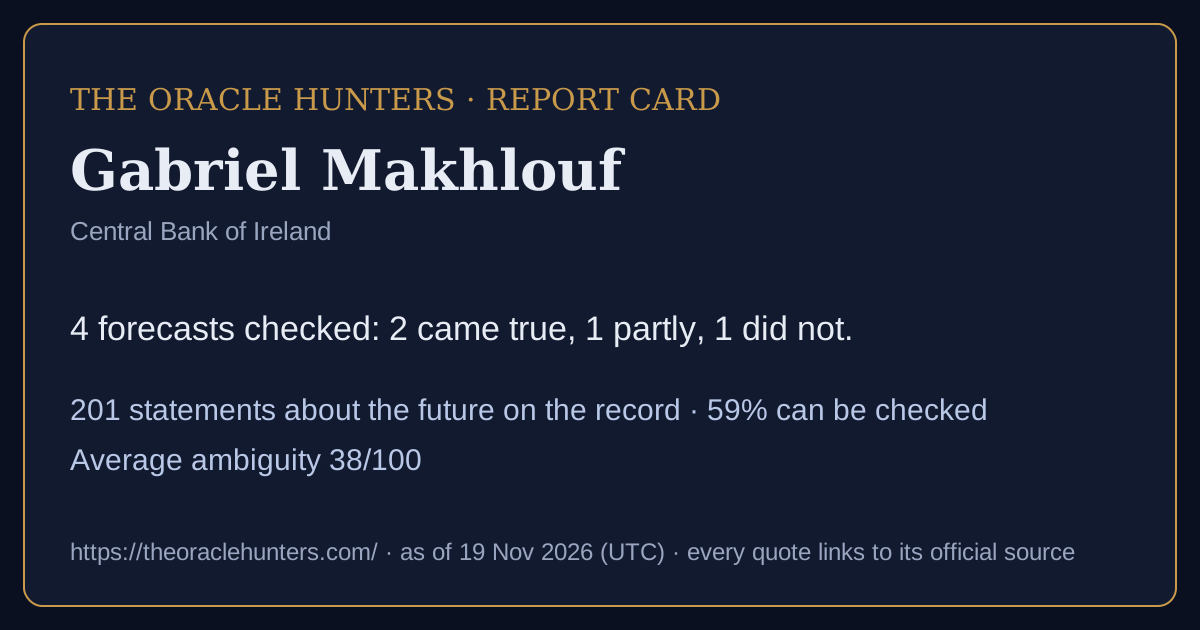
Track record: 4 forecasts checked: 2 came true, 1 partly, 1 did not.
201forecasts & commitments on the record
59%can be checked as stated
38average ambiguity (0-100)
0goalpost moves recorded
0confirmed U-turns
Timeline
came true partly did not not due / being checked / too vague
Calibration score: shown after 10 checked forecasts with a stated likelihood (now 1).
How they speak about the future: based on data 152, stated on authority 35, educated guess 14.
Kinds of claim: forecast 152, mixed claim 26, scenario (if… then) 13, commitment 10. · Download this report card as a picture
In the nine words
πρόγνωσιςInference from evidence141 · 70%μαντείαInspired knowledge28 · 14%πρόνοιαPreparing for the future13 · 6%προαναγγελίαPublic pre-announcement10 · 5%εἰκασίαConjecture6 · 3%φρόνησιςPractical wisdom2 · 1%πρόβλεψιςSeeing the signs1 · 0%
How to read this
Each box is one sentence a public figure or institution said about the future, word for word, with a link to the official text. Can be checked means it names what will happen, by when, and how likely - so it can be compared with official figures later. Too vague to check means it does not. Ambiguity (0-100) is how many different ways the sentence can be read. When the date passes, the forecast is compared with official data and marked came true, partly or did not come true. Labels judge the sentence, never the person. Full guide and glossary.Checked
The projections include a small uptick in the unemployment rate in the euro area, rising from its current historical low of 6.4 per cent to 6.7 per cent in 2025.
Partly came true. Said: unemployment between 6.4% and 6.7% in 2025. Official figure for Euro area: 6.3% (World Bank open data). Close: outside the margin, but within one more half point. Off by 0.1 points. official data · checked 14 Nov 2026 · automatic check against official data (rules v3)
Ireland's consumer price inflation also remains high but declining, and it is anticipated to reach 2.3 per cent by 2025 in the central outlook.
Came true. Said: inflation around 2.3% in 2025. Official figure for Ireland: 2.2% (World Bank open data). On target. Off by 0.1 points. official data · checked 14 Nov 2026 · automatic check against official data (rules v3)
The outlook is for a decline in euro area inflation to 3.2 and 2.1 per cent in 2024 and 2025, as energy, food and industrial goods price growth slows, offsetting more persistent upward pressure from services.
Came true. Said: inflation around 2.1% in 2024. Official figure for Euro area: 2.3% (World Bank open data). On target. Off by 0.2 points. official data · checked 14 Nov 2026 · automatic check against official data (rules v3)
GDP is forecast to grow by 4.8 per cent in 2020 and 4.2 per cent in 2021.
Did not come true. Said: economic growth around 4.2% in 2021. Official figure for Ireland: 16.3% (World Bank open data). Missed. Off by 12.1 points. official data · checked 14 Nov 2026 · automatic check against official data (rules v3)
On the record (201)
Deepening Europe's capital markets in particular could help unlock the almost €12 trillion that Europeans hold in savings and cash deposits for productive investment.
Following a spotlight in last year’s Regulatory and Supervisory Outlook report, this year we set out our supervisory perspectives on the use of AI by firms and our expectations around governance, strategic alignment and accountability.10 While these can be powerful tools, it is humans who deploy them and therefore humans who remain accountable and responsible for them.
Second, we will continue to support efforts domestically and across the EU to advance legal regulatory clarity, including working with the Department of Finance to support delivery on the actions arising from the Ireland for Finance Strategy – Vision 2030.
The challenge is that our growth performance is not what we should expect from an advanced economy of 450 million people.
Inflation forecasts have been revised upwards to 3.5 per cent this year and 2.9 per cent in 2027, with the outlook for international energy prices substantially higher than assumed in our March Bulletin.
As our latest Financial Stability Review put it, if the conflict in the Middle East is unresolved, rising inflation and slower growth will be acutely felt by households and businesses.
My colleagues and I on the Governing Council were unanimous in making the decision; all of us are committed to a monetary policy that delivers our 2% inflation target over the medium term.
It is worth comparing these with the projections from June 2022, where the communication from the Governing Council at the time was that this was the start of a hiking cycle: inflation was projected to average 6.8% in 2022, 3.5% in 2023, and 2.1% in 2024.
At the median, consumers' twelve-month ahead expected inflation rose from just over 2.5 to 4 per cent in March and has remained there since.
Energy inflation alone was close to 11% in May.
The flash estimate for euro area headline inflation in May was 3.2%, up from 3% in April and 1.9% in February.
Services and goods annual inflation, at 3.2 per cent and 0.5 per cent respectively, are in-line with the path set out in the December projections.
The Governing Council is determined to ensure inflation stabilises at our 2 per cent target in the medium term but we are not on a pre-determined path and have adopted, as I hope you all know, a meeting-by-meeting approach.
Compared to December projections expecting growth around 1.2 per cent in 2026 - near the euro area's growth potential - in the severe scenario, this falls by two-thirds to just 0.4 per cent.
Reaching typical EU targets of 90 per cent storage by November could support higher gas prices through spring and summer, further amplifying geopolitical price pressures.
Initially, futures pricing suggested a short, sharp shock, with energy prices reverting to pre-war levels through late 2026 and 2027, closer to the baseline scenario in the ECB staff March projections (cutoff: 11 March). 1 However, as the conflict persists without clear resolution, a more prolonged period of higher prices becomes likely.
The challenge is that our growth performance is not as high as we would expect from an advanced economy of 450 million people accounting for over 14 per cent of global GDP.
tariff on goods and a 110 per cent tariff on services. 8 ECB analysis suggests further deepening of integration could unlock significant economic potential, with estimated welfare gains of up to 1.3 per cent for convergence in the goods sector and up to 1.8 per cent in the service sector. 9
Looking ahead to 2026, our research and economic policy advice will continue to be influenced by the external environment, helping us to inform the debate on matters of major public policy importance.
The last set of Central Bank projections back in September - the next set are due next week - described an economy growing steadily with employment up 2.3 per cent in the year to Q3 2025 and with unemployment remaining low.
Addressing these issues will also enable a step change to leveraging the potential in Europe's capital markets and mobilising the vast savings potential across the Union, unlocking the €11.5 trillion held by Europeans in deposits and cash and channelling it to drive European innovation, while maintaining our resilience in the face of future potential shocks.
The State's books are in good order: the Government's Budget forecast a headline surplus of 3 per cent with debt at 62 per cent of modified national income (GNI*).
Green mortgages now make up 40 per cent 3 of new lending in the Irish market, and since the launch of Irish Sovereign Green Bonds in 2018, a total of €11.5bn has been allocated to green projects . 4
This compares to a projected increase in emissions of between 20-48 per cent, before the adoption of the Paris Agreement.
Global greenhouse gas emissions are now projected to be around 12 per cent below 2019 levels in 2035.
We will consult on a new Regulatory Impact Assessment Framework next year, which will further embed evidence-based policymaking into our processes and support us to ensure the orderly and proper functioning of financial markets.
We are going to review the corporate governance requirements in 2026 to remove duplication, improve alignment across sectors, and embed proportionality and clarity into governance design.
And as we had committed to, we will be conducting our review of SEAR in 2027.
In terms of the macroprudential framework for non-banks, Irish property funds are making progress towards meeting the macroprudential leverage limit ahead of the end of the implementation period in November 2027 and we expect to see continued progress in this regard.
Our analysis suggests that 15 per cent tariffs - as per the recent agreement - will reduce exports to the US.
Real euro area GDP growth is projected to average 1.2 per cent in 2025, 1 per cent in 2026 and 1.3 per cent in 2027.
Overall, our latest projections anticipate a slowdown from 2.9 per cent growth this year to just over 2 per cent in the coming years. 5
At the Central Bank of Ireland, we are guided by the objective set out in our founding legislation that our "constant and predominant aim shall be the welfare of the people as a whole." We will remain focused on delivering the stability, resilience, and protections that consumers and the wider economy need and the public expects.
Overall, our latest projections anticipate a slowdown from 2.9 per cent growth this year to just over 2 per cent in the coming years. 1
The 'high migration' scenario assumes 33 per cent more immigration than in the baseline from non-EU countries in each year covering the projection horizon.
To put these changes in context, allowing for a 'high migration' scenario in population projections results in a relatively small decrease in the euro area 2050 dependency ratio, to just 48.9; for Ireland, it falls to 40.8. 11 12
Central Bank of Ireland analysis (PDF 1.19MB) projects the long-term growth rate of the economy to slow by 2050 to below half its historic average growth rate observed over the last half century. relatively higher fertility rates 9
The longer-term impact is stark: the 'old-age dependency ratio' in the euro area, that is, the population aged 65 and over as a proportion of the population aged 15-64, is set to increase sharply from 33.7 in 2022 to 51.2 in 2050. projected to fall by 0.7 per cent
The September ECB staff macroeconomic projections have annual employment growth averaging around 0.5 per cent over the next two years, a significant drop-off compared to the recent experience. 8
Looking ahead, at a euro area level some labour market cooling is expected over the current forecast horizon, through to end-2027.
This likelihood increases further if trade-related barriers coincide with broader changes in tax and industrial policy that could discourage investment and activity in Ireland.
Higher tariff and non-tariff barriers won't necessarily address these imbalances, and if they do it will be at a substantial cost to productivity growth and long term sustainable growth for the countries affected.
- the Central Bank we will remain focused on ensuring that the financial system operates in the best interests of consumers and the wider economy, as well as playing our part in communicating with consumers to raise their awareness of the revised Code.
We will continue to engage with industry and consumer representatives in relation to its implementation over the next year.
We have entered a more uncertain geoeconomic and political environment where social capital will need to be nurtured carefully if it is to make its important contribution to growing our economic capital and enhancing the prosperity of our communities.
We stand ready to react to changes in the outlook, for both inflation and growth, which is why my colleagues and I continue to believe that we should not commit to any specific future path for interest rates.
Based on our most recent published forecasts from mid-December, we expect the domestic economy to grow in-line with its mediumterm potential out to 2027, having been operating above that level in 2023 and 2024.
With current projections (from the Environmental Protection Agency) signalling a significant undershoot in meeting this target, estimates point to an additional annual investment need of around 1.7 per cent of GNI* to 2030, or €54.5bn in total by 2050 to achieve it, at least 20 per cent of which would likely comprise public investment.
Estimates from the Department of Finance show that total age-related public spending is projected to rise by 6 percentage points of GNI* by 2050 (which would be the largest increase in age-related expenditure over this period across the EU).
In particular, services inflation remains high at just below 4 per cent, and is expected to be the main positive contributor to headline and core inflation out to 2026.
Showing the newest 50 - the ledger has all 201.
Also said - not checkable as stated (12 newest)
Remarks about the future with no date, figure or likelihood that could be checked. They are kept on the record and shown here, but not scored.
Deepening the Single Market – in goods, in services and in capital – will be important in the face of headwinds from broader global economic fragmentation.
Closer to home, maximising the delivery of new public infrastructure to address known deficits in key national infrastructure and crowd-in higher private investment will boost the economy’s long-run growth potential.
And it’s clear that, at the current juncture in Europe, fiscal trade-offs need to be made in many countries, and industrial policy is no free lunch.
First, as part of the Eurosystem, we will work to enable central bank money settlement and evolving the collateral framework.
In the Central Bank’s case, we will do this by, among other things, continuing to be open and engaged.
We will remain focused on these outcomes but also neutral on the means or the technology used to achieve them.
The Discussion Paper has informed how we will continue to respond to this technological transformation.
We will do so in partnership with the private sector, enabling the innovation the economy needs, while safeguarding trust and stability on which the system depends.
At the same time, trust in digital banks is notably lower among respondents than trust in high-street banks - although these differentials are less pronounced among younger consumers, suggestive of the direction in which the market may gradually evolve.
To conclude, the future of the payments has not yet been written, but central banks and regulators will shape its evolution.
This Signed Article provides a baseline description of Ireland's retail payments landscape, charting the roles of traditional banks, digital banks, and non-bank fintechs, and identifying three structural shifts likely to reshape the ecosystem in the years ahead: (i) the continued unbundling of payment services from credit provision;
Interlinkages between the traditional financial system and tokenised finance are increasing, while the future role of stablecoins within the payments system remains uncertain; there are questions around monetary stability and financial resilience that need to be answered.