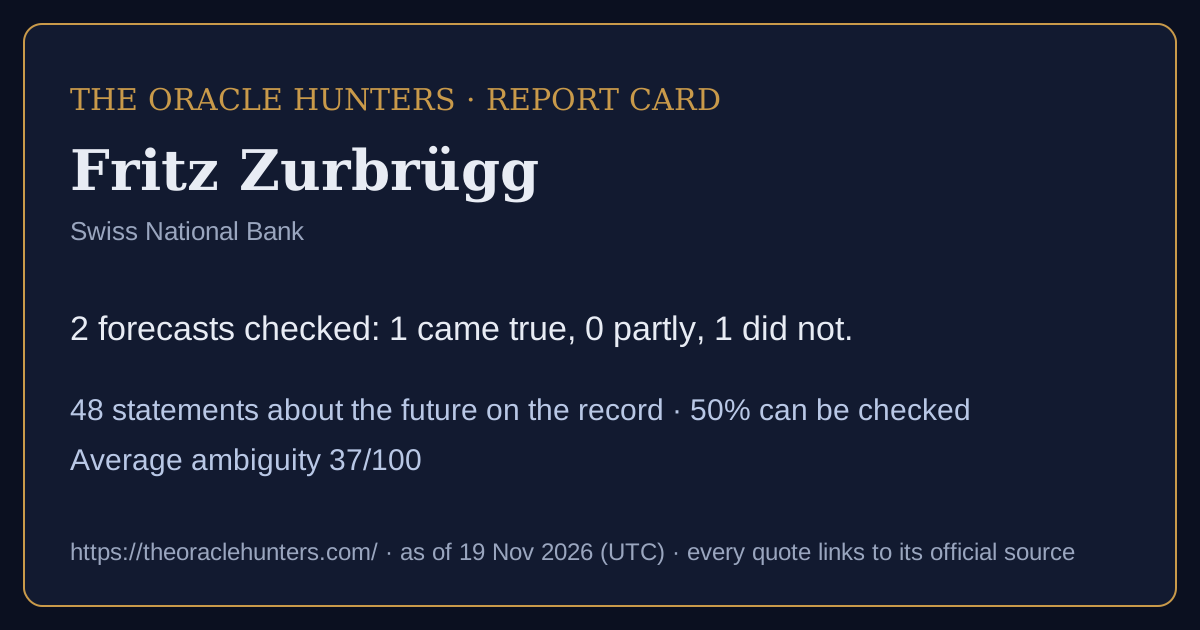
Fritz Zurbrügg
Swiss National Bank
Track record: 2 forecasts checked: 1 came true, 0 partly, 1 did not.
48forecasts & commitments on the record
50%can be checked as stated
37average ambiguity (0-100)
0goalpost moves recorded
0confirmed U-turns
Timeline
came true partly did not not due / being checked / too vague
Calibration score: shown after 10 checked forecasts with a stated likelihood (now 1).
How they speak about the future: based on data 38, educated guess 7, stated on authority 3.
Kinds of claim: forecast 36, scenario (if… then) 7, mixed claim 4, commitment 1. · Download this report card as a picture
In the nine words
πρόγνωσιςInference from evidence36 · 75%πρόνοιαPreparing for the future7 · 15%μαντείαInspired knowledge3 · 6%προαναγγελίαPublic pre-announcement1 · 2%εἰκασίαConjecture1 · 2%
How to read this
Each box is one sentence a public figure or institution said about the future, word for word, with a link to the official text. Can be checked means it names what will happen, by when, and how likely - so it can be compared with official figures later. Too vague to check means it does not. Ambiguity (0-100) is how many different ways the sentence can be read. When the date passes, the forecast is compared with official data and marked came true, partly or did not come true. Labels judge the sentence, never the person. Full guide and glossary.Checked
We anticipate inflation of -0.5% for 2016.
Came true. Said: inflation around -0.5% in 2016. Official figure for Switzerland: -0.4% (World Bank open data). On target. Off by 0.1 points. official data · checked 14 Nov 2026 · automatic check against official data (rules v3)
The SNB is now expecting inflation of 0% in the current year and 0.4% in 2015.
Did not come true. Said: inflation around 0.4% in 2015. Official figure for Switzerland: -1.1% (World Bank open data). Missed. Off by 1.5 points. official data · checked 14 Nov 2026 · automatic check against official data (rules v3)
On the record (48)
Both the SCCyB and the increase in capital cost for high-LTV mortgages have in fact led to a reduction in the share of newly granted mortgages characterised by high LTV ratios. 8 In recent years, as we will see later in more detail, growth in residential real estate prices and mortgage lending has however increased once again.
Growth rates in many advanced economies are projected to remain above average this year, and unemployment rates are falling back to pre-pandemic levels.
These points demonstrate that the banking system is currently highly exposed to the vulnerabilities on the mortgage and real estate markets, and could face considerable losses in the event of an abrupt increase in interest rates.
The SNB will communicate the detailed survey results in mid-2021.
Under the baseline scenario, the impact on Credit Suisse and UBS is likely to be limited as a result of the partial economic recovery expected in the second half of 2020 as well as the stabilisation in financial markets.
The partial economic recovery expected in the second half of 2020, together with the measures taken by the authorities, should help to limit the adverse impact on these banks.
In the event of an interest rate rise, initial yields on investment properties will also have to increase upon a change of ownership.
In this context, the Federal Council has announced that, during the first half of 2019, it will decide on the corresponding requirements for the highest operating unit of the big banks - i.e. the parent entity.
The mere assumption that a bank is too big to fail can be a self-fulfilling prophecy. 4 On the assumption that it will be bailed out if necessary, the bank may take on excessive risk much more readily, and focus its business model too heavily on debt-based growth.
The higher the bank's market share of lending business, the greater the probability that the economy will not be provided with enough liquidity if that bank gets into difficulties.
The larger the bank and the higher its market share, the smaller the likelihood that other market participants will be able take over important functions at short notice in the event of a crisis.
They already fully meet the requirements for risk-weighted capital that will apply from end-2019.
We are therefore confident that full implementation by the end-2019 deadline will create the conditions necessary for resolving the 'too big to fail' issue in Switzerland.
For example, by end-2019, systemically important banks in Switzerland have to prepare 'emergency plans' demonstrating that they will be able to continue their systemically important functions in Switzerland without interruption in the event of a crisis.
The 1000-franc note and the 100-franc note will follow in 2019.
As announced, the next denomination, the 200-franc note, will be issued in autumn 2018.
This year, the SNB issued two further denominations: the new 20-franc note was released in May and the new 10franc note in October.
Payment difficulties could arise if, for example, a divorce or rising interest rates lead to an unexpected hike in current expenses, or if the family's future income is reduced by unemployment or illness.
By end-2019, the big banks will need to demonstrate that they would be able to maintain their systemically important functions in Switzerland without interruption in the event of impending insolvency.
It will be presented at a press conference on Wednesday, 10 May 2017, and the first notes will be issued one week later, on 17 May 2017.
These revised regulations envisage that the requirements will gradually be increased to the specified level over a phase-in period ending at the beginning of 2020.
However, to meet the requirements applicable from the beginning of 2020 - i.e. after the phase-in period - action will need to be taken.
With a phase-in period until end-2019, the requirements will be gradually increased to the definitive level.
Both big banks are already almost fully compliant with the requirements of the current Swiss 'too big to fail' regulations (TBTF1), which will apply in full from the beginning of 2019.
The forecast shows that, assuming an unchanged interest rate policy, inflation will rise gradually over the coming quarters, and will exceed 1.0% in 2018 (cf. chart 12).
The new 50-franc note will be presented to the public for the first time at a news conference on 6 April 2016, and will first be issued on Tuesday, 12 April 2016.
The SNB will actively support the finalisation of the Basel Committee's reforms as planned and the publication of these reforms by the end of 2016.
If global economic growth continues at the same moderate pace, this will help mitigate the negative effects of the strong Swiss franc.
The provisional inflation forecast in chart 4 is also based on a depreciation, along with a Libor rate of -0.75%.
For 2015 we expect real gross domestic product (GDP) to grow by just under 1%.
The decision by the Swiss National Bank (SNB) of 15 January to discontinue the minimum exchange rate of CHF 1.20 to the euro and to lower the interest rate on sight deposit accounts at the SNB to -0.75% rendered important assumptions of the existing forecast obsolete.
Thus, most market participants expect that the US Federal Reserve will initiate a reversal in interest rates before the end of the year.
The SNB's monetary policy strategy provides for positive inflation rates of below 2% in the medium term.
Inflation is expected to reach its low point in the third quarter of 2015, at -1.2%.
As you can see from chart 7, inflation will move back into positive territory only at the start of 2017.
It will come as no surprise to you that this year I have decided to devote my talk exclusively to monetary policy.
We anticipate inflation of -0.5% for 2016.
Came true. Said: inflation around -0.5% in 2016. Official figure for Switzerland: -0.4% (World Bank open data). On target. Off by 0.1 points. official data · checked 14 Nov 2026 · automatic check against official data (rules v3)
We thus expect a much more modest expansion of real economic output this year of just under 1%.
The SNB is now expecting inflation of 0% in the current year and 0.4% in 2015.
Did not come true. Said: inflation around 0.4% in 2015. Official figure for Switzerland: -1.1% (World Bank open data). Missed. Off by 1.5 points. official data · checked 14 Nov 2026 · automatic check against official data (rules v3)
We anticipate growth of 1.5-2.0% for the current year.
The possibility that the Federal Reserve might announce a reduction in the monthly bond purchase programme sparked an increase in long-term US interest rates, which had risen by over 100 basis points by the beginning of September (cf. chart 4).
No interest rate increase for 2014 expected by market
The SNB's conditional inflation forecast from September (cf. chart 10) shows a very small increase in inflation to 2015, despite the assumption that the three-month Libor remains at zero over the entire period.
The latest World Economic Outlook by the IMF reports that 'Global growth is in low gear (…) and downside risks persist.' The IMF now anticipates global growth of 2.9% for 2013 and 3.6% for 2014.
At the moment, the markets are assuming that the Federal Reserve will increase its key interest rate in the second quarter of 2015, the ECB in the fourth quarter of 2015 and the SNB in the first quarter of 2016.
In Japan, monetary policy announcements resulted in significantly improved investor sentiment, with the Nikkei stock index climbing by 80% between November 2012 and May 2013 on the back of a strongly depreciated yen and the ensuing higher profit expectations of Japanese companies.
In the light of this, the SNB has decided to conduct its monetary policy operations via a new trading platform, provided by SIX Group Ltd, as of May 2014.
But if a government is heavily in debt, there is a danger that households will save rather than consume, despite a low level of taxation, because they are expecting future tax increases (Ricardian equivalence).
Also said - not checkable as stated (12 newest)
Remarks about the future with no date, figure or likelihood that could be checked. They are kept on the record and shown here, but not scored.
As my colleague Thomas Jordan has explained, the SNB's baseline scenario assumes that the impact of the war in Ukraine on domestic economic activity and inflation will be temporary and moderate.
However, an escalation of the war or a further widening of sanctions could adversely affect the economic environment and financial market conditions.
First, an escalation of the war in Ukraine could result in a worse-than-
This could lead to a deterioration in the quality of credit portfolios.
Second, a significant tightening of financial and monetary conditions could trigger a correction on the Swiss mortgage and real estate markets.
However, these simulations also suggest that the capital ratios of certain banks could decline significantly and approach, or even fall below, the regulatory minimum requirements.
If banks are not sufficiently capitalised to absorb these losses, they may have to deleverage, tightening credit to the real economy.
In my remarks this evening, I will be talking about macroprudential policy and rising challenges to financial stability, two topics that remain very relevant today.
According to our monetary policy assessment last week, the global economic recovery is expected to continue, although somewhat subdued by the economic consequences of the war in Ukraine.
A shock causing a correction may also trigger mutually reinforcing effects of falling prices, loan defaults, and ensuing losses for banks.
First, the interest rate margin is likely to narrow further should interest rates persist at a low level.
I will then provide an assessment of the current situation at the two globally active banks, Credit Suisse and UBS, as well as at the domestically focused banks.