The public record of what the powerful say about the futureAll times UTCYour time ATHENA News Room is liveSealed daily · anchored in BitcoinΕλληνικά A Tekmerion product
THE ORACLE HUNTERS • EVERY PROPHECY ON THE RECORD •AAAWgmp1bWIAAAAeanVtZGMycGEAEQAQgAAAqgA4m3EDYzJwYQAAABZcanVtYgAAAEdqdW1kYzJtYQARABCAAACqADibcQN1cm46YzJwYTo4MTk5ZDlhYi0zYzIzLTQwZDYtYTc1NS04MTM5NWJhODhjMTYAAAADl2p1bWIAAAApanVtZGMyYXMAEQAQgAAAqgA4m3EDYzJwYS5hc3NlcnRpb25zAAAAALxqdW1iAAAARGp1bWRjYm9yABEAEIAAAKoAOJtxE2MycGEuaW5ncmVkaWVudC52MwAAAAAYYzJzaIxn7Lz8d2kiZVLVmLMqjH8AAABwY2JvcqNpZGM6Zm9ybWF0bWltYWdlL3N2Zyt4bWxqaW5zdGFuY2VJRHgseG1wOmlpZDpjNjQzY2M2MC03NmU5LTRkODUtODAzNi04Y2U2YmUwZDA0MzRscmVsYXRpb25zaGlwaHBhcmVudE9mAAAB4mp1bWIAAABBanVtZGNib3IAEQAQgAAAqgA4m3ETYzJwYS5hY3Rpb25zLnYyAAAAABhjMnNoYoNKEfN7QooyLxBggQwrRAAAAZljYm9yomdhY3Rpb25zgqJmYWN0aW9ua2MycGEub3BlbmVkanBhcmFtZXRlcnOha2luZ3JlZGllbnRzgaJjdXJseC1zZWxmI2p1bWJmPWMycGEuYXNzZXJ0aW9ucy9jMnBhLmluZ3JlZGllbnQudjNkaGFzaFggGR++KIZKhTpFlfMpaeP4xKARvK6IpGRCm/JKHJsg8z+kZmFjdGlvbngdY29tLmFudGhyb3BpYy5jbGF1ZGUucHJvdmlkZWRqcGFyYW1ldGVyc6F4H2NvbS5hbnRocm9waWMub3JpZ2luLWNvbmZpZGVuY2VndW5rbm93bmtkZXNjcmlwdGlvbnhmQ2xhdWRlIHByb3ZpZGVkIHRoaXMgZmlsZSBhdCB0aGUgcmVxdWVzdCBvZiBhIHVzZXIgYW5kIG1heSBoYXZlIGNyZWF0ZWQgb3IgbW9kaWZpZWQgdGhlIGZpbGUgY29udGVudHMubXNvZnR3YXJlQWdlbnShZG5hbWVmQ2xhdWRlcmFsbEFjdGlvbnNJbmNsdWRlZPUAAADIanVtYgAAAEBqdW1kY2JvcgARABCAAACqADibcRNjMnBhLmhhc2guZGF0YQAAAAAYYzJzaLTPAMahVK/46OuJ/Q+uuA8AAACAY2JvcqVjYWxnZnNoYTI1NmNwYWRMAAAAAAAAAAAAAAAAZGhhc2hYII7HF9R24wInyRZy4rI4Fw0mI4Rb/ZNxjfxeO7PO35j2ZG5hbWVuanVtYmYgbWFuaWZlc3RqZXhjbHVzaW9uc4GiZXN0YXJ0GQiaZmxlbmd0aBkeBAAAAj5qdW1iAAAAJ2p1bWRjMmNsABEAEIAAAKoAOJtxA2MycGEuY2xhaW0udjIAAAACD2Nib3KlY2FsZ2ZzaGEyNTZpc2lnbmF0dXJleE1zZWxmI2p1bWJmPS9jMnBhL3VybjpjMnBhOjgxOTlkOWFiLTNjMjMtNDBkNi1hNzU1LTgxMzk1YmE4OGMxNi9jMnBhLnNpZ25hdHVyZWppbnN0YW5jZUlEeCx4bXA6aWlkOjljYzUwMDc4LTgzMDctNDI0ZS04NjE4LTVmYTQzMmE1MWJmNHJjcmVhdGVkX2Fzc2VydGlvbnODomN1cmx4LXNlbGYjanVtYmY9YzJwYS5hc3NlcnRpb25zL2MycGEuaW5ncmVkaWVudC52M2RoYXNoWCAZH74ohkqFOkWV8ylp4/jEoBG8roikZEKb8kocmyDzP6JjdXJseCpzZWxmI2p1bWJmPWMycGEuYXNzZXJ0aW9ucy9jMnBhLmFjdGlvbnMudjJkaGFzaFggjvXIkXvJ7aXB5IwuH8TLLMTeq4OAYClzgZHySVCatNCiY3VybHgpc2VsZiNqdW1iZj1jMnBhLmFzc2VydGlvbnMvYzJwYS5oYXNoLmRhdGFkaGFzaFggIhTKhum+9R2LsXAUkQyOeb6aKanhapGjq6FRT3EaJ9V0Y2xhaW1fZ2VuZXJhdG9yX2luZm+jZG5hbWVvQW50aHJvcGljIEZpbGVzZ3ZlcnNpb25lMS4wLjBrc3BlY1ZlcnNpb25lMi40LjAAABA4anVtYgAAAChqdW1kYzJjcwARABCAAACqADibcQNjMnBhLnNpZ25hdHVyZQAAABAIY2JvctKEWQISogEmGCFZAgowggIGMIIBjaADAgECAhRA5aAK7sI50L64g/oGQgU9Z1UTADAKBggqhkjOPQQDAzBJMRcwFQYDVQQKEw5BbnRocm9waWMsIFBCQzEuMCwGA1UEAxMlQW50aHJvcGljIENvbnRlbnQgQ3JlZGVudGlhbHMgUm9vdCBDQTAeFw0yNjA4MDcxODQzNTZaFw0yODA4MDYxOTQzNTZaMEQxFzAVBgNVBAoTDkFudGhyb3BpYywgUEJDMSkwJwYDVQQDEyBBbnRocm9waWMgQ2xhdWRlIENvbnRlbnQgU2lnbmluZzBZMBMGByqGSM49AgEGCCqGSM49AwEHA0IABJh6CmvLUBgFFNU0vUKlOVtE6djd17L5SuwX0LemFisBM3dkd/3cyjxFA3Qo5S46fX0/ihY0VZ7mfb9KF703t5OjWDBWMA4GA1UdDwEB/wQEAwIHgDAVBgNVHSUEDjAMBgorBgEEAYPoXgIBMAwGA1UdEwEB/wQCMAAwHwYDVR0jBBgwFoAUzlHiBIFOZFsj+OPEz5o+nMHXXMIwCgYIKoZIzj0EAwMDZwAwZAIwMXMdFJ4BetLLVY7ORuE9noqbbAZOZn/aArXyTwFAZfKrPzxF2vPoJNf1+UCdg1XGAjBwX1zd9WGqYkqmL5SFqw1QySjr1zJfpJM9+1rdDwSPLMOPOjKuiXjoU/pUUeG9RwmhY3BhZFkNngAAAAAAAAAAAAAAAAAAAAAAAAAAAAAAAAAAAAAAAAAAAAAAAAAAAAAAAAAAAAAAAAAAAAAAAAAAAAAAAAAAAAAAAAAAAAAAAAAAAAAAAAAAAAAAAAAAAAAAAAAAAAAAAAAAAAAAAAAAAAAAAAAAAAAAAAAAAAAAAAAAAAAAAAAAAAAAAAAAAAAAAAAAAAAAAAAAAAAAAAAAAAAAAAAAAAAAAAAAAAAAAAAAAAAAAAAAAAAAAAAAAAAAAAAAAAAAAAAAAAAAAAAAAAAAAAAAAAAAAAAAAAAAAAAAAAAAAAAAAAAAAAAAAAAAAAAAAAAAAAAAAAAAAAAAAAAAAAAAAAAAAAAAAAAAAAAAAAAAAAAAAAAAAAAAAAAAAAAAAAAAAAAAAAAAAAAAAAAAAAAAAAAAAAAAAAAAAAAAAAAAAAAAAAAAAAAAAAAAAAAAAAAAAAAAAAAAAAAAAAAAAAAAAAAAAAAAAAAAAAAAAAAAAAAAAAAAAAAAAAAAAAAAAAAAAAAAAAAAAAAAAAAAAAAAAAAAAAAAAAAAAAAAAAAAAAAAAAAAAAAAAAAAAAAAAAAAAAAAAAAAAAAAAAAAAAAAAAAAAAAAAAAAAAAAAAAAAAAAAAAAAAAAAAAAAAAAAAAAAAAAAAAAAAAAAAAAAAAAAAAAAAAAAAAAAAAAAAAAAAAAAAAAAAAAAAAAAAAAAAAAAAAAAAAAAAAAAAAAAAAAAAAAAAAAAAAAAAAAAAAAAAAAAAAAAAAAAAAAAAAAAAAAAAAAAAAAAAAAAAAAAAAAAAAAAAAAAAAAAAAAAAAAAAAAAAAAAAAAAAAAAAAAAAAAAAAAAAAAAAAAAAAAAAAAAAAAAAAAAAAAAAAAAAAAAAAAAAAAAAAAAAAAAAAAAAAAAAAAAAAAAAAAAAAAAAAAAAAAAAAAAAAAAAAAAAAAAAAAAAAAAAAAAAAAAAAAAAAAAAAAAAAAAAAAAAAAAAAAAAAAAAAAAAAAAAAAAAAAAAAAAAAAAAAAAAAAAAAAAAAAAAAAAAAAAAAAAAAAAAAAAAAAAAAAAAAAAAAAAAAAAAAAAAAAAAAAAAAAAAAAAAAAAAAAAAAAAAAAAAAAAAAAAAAAAAAAAAAAAAAAAAAAAAAAAAAAAAAAAAAAAAAAAAAAAAAAAAAAAAAAAAAAAAAAAAAAAAAAAAAAAAAAAAAAAAAAAAAAAAAAAAAAAAAAAAAAAAAAAAAAAAAAAAAAAAAAAAAAAAAAAAAAAAAAAAAAAAAAAAAAAAAAAAAAAAAAAAAAAAAAAAAAAAAAAAAAAAAAAAAAAAAAAAAAAAAAAAAAAAAAAAAAAAAAAAAAAAAAAAAAAAAAAAAAAAAAAAAAAAAAAAAAAAAAAAAAAAAAAAAAAAAAAAAAAAAAAAAAAAAAAAAAAAAAAAAAAAAAAAAAAAAAAAAAAAAAAAAAAAAAAAAAAAAAAAAAAAAAAAAAAAAAAAAAAAAAAAAAAAAAAAAAAAAAAAAAAAAAAAAAAAAAAAAAAAAAAAAAAAAAAAAAAAAAAAAAAAAAAAAAAAAAAAAAAAAAAAAAAAAAAAAAAAAAAAAAAAAAAAAAAAAAAAAAAAAAAAAAAAAAAAAAAAAAAAAAAAAAAAAAAAAAAAAAAAAAAAAAAAAAAAAAAAAAAAAAAAAAAAAAAAAAAAAAAAAAAAAAAAAAAAAAAAAAAAAAAAAAAAAAAAAAAAAAAAAAAAAAAAAAAAAAAAAAAAAAAAAAAAAAAAAAAAAAAAAAAAAAAAAAAAAAAAAAAAAAAAAAAAAAAAAAAAAAAAAAAAAAAAAAAAAAAAAAAAAAAAAAAAAAAAAAAAAAAAAAAAAAAAAAAAAAAAAAAAAAAAAAAAAAAAAAAAAAAAAAAAAAAAAAAAAAAAAAAAAAAAAAAAAAAAAAAAAAAAAAAAAAAAAAAAAAAAAAAAAAAAAAAAAAAAAAAAAAAAAAAAAAAAAAAAAAAAAAAAAAAAAAAAAAAAAAAAAAAAAAAAAAAAAAAAAAAAAAAAAAAAAAAAAAAAAAAAAAAAAAAAAAAAAAAAAAAAAAAAAAAAAAAAAAAAAAAAAAAAAAAAAAAAAAAAAAAAAAAAAAAAAAAAAAAAAAAAAAAAAAAAAAAAAAAAAAAAAAAAAAAAAAAAAAAAAAAAAAAAAAAAAAAAAAAAAAAAAAAAAAAAAAAAAAAAAAAAAAAAAAAAAAAAAAAAAAAAAAAAAAAAAAAAAAAAAAAAAAAAAAAAAAAAAAAAAAAAAAAAAAAAAAAAAAAAAAAAAAAAAAAAAAAAAAAAAAAAAAAAAAAAAAAAAAAAAAAAAAAAAAAAAAAAAAAAAAAAAAAAAAAAAAAAAAAAAAAAAAAAAAAAAAAAAAAAAAAAAAAAAAAAAAAAAAAAAAAAAAAAAAAAAAAAAAAAAAAAAAAAAAAAAAAAAAAAAAAAAAAAAAAAAAAAAAAAAAAAAAAAAAAAAAAAAAAAAAAAAAAAAAAAAAAAAAAAAAAAAAAAAAAAAAAAAAAAAAAAAAAAAAAAAAAAAAAAAAAAAAAAAAAAAAAAAAAAAAAAAAAAAAAAAAAAAAAAAAAAAAAAAAAAAAAAAAAAAAAAAAAAAAAAAAAAAAAAAAAAAAAAAAAAAAAAAAAAAAAAAAAAAAAAAAAAAAAAAAAAAAAAAAAAAAAAAAAAAAAAAAAAAAAAAAAAAAAAAAAAAAAAAAAAAAAAAAAAAAAAAAAAAAAAAAAAAAAAAAAAAAAAAAAAAAAAAAAAAAAAAAAAAAAAAAAAAAAAAAAAAAAAAAAAAAAAAAAAAAAAAAAAAAAAAAAAAAAAAAAAAAAAAAAAAAAAAAAAAAAAAAAAAAAAAAAAAAAAAAAAAAAAAAAAAAAAAAAAAAAAAAAAAAAAAAAAAAAAAAAAAAAAAAAAAAAAAAAAAAAAAAAAAAAAAAAAAAAAAAAAAAAAAAAAAAAAAAAAAAAAAAAAAAAAAAAAAAAAAAAAAAAAAAAAAAAAAAAAAAAAAAAAAAAAAAAAAAAAAAAAAAAAAAAAAAAAAAAAAAAAAAAAAAAAAAAAAAAAAAAAAAAAAAAAAAAAAAAAAAAAAAAAAAAAAAAAAAAAAAAAAAAAAAAAAAAAAAAAAAAAAAAAAAAAAAAAAAAAAAAAAAAAAAAAAAAAAAAAAAAAAAAAAAAAAAAAAAAAAAAAAAAAAAAAAAAAAAAAAAAAAAAAAAAAAAAAAAAAAAAAAAAAAAAAAAAAAAAAAAAAAAAAAAAAAAAAAAAAAAAAAAAAAAAAAAAAAAAAAAAAAAAAAAAAAAAAAAAAAAAAAAAAAAAAAAAAAAAAAAAAAAAAAAAAAAAAAAAAAAAAAAAAAAAAAAAAAAAAAAAAAAAAAAAAAAAAAAAAAAAAAAAAAAAAAAAAAAAAAAAAAAAAAAAAAAAAAAAAAAAAAAAAAAAAAAAAAAAAAAAAAAAAAAAAAAAAAAAAAAAAAAAAAAAAAAAAAAAAAAAAAAAAAAAAAAAAAAAAAAAAAAAAAAAAAAAAAAAAAAAAAAAAAAAAAAAAAAAAAAAAAAAAAAAAAAAAAAAAAAAAAAAAAAAAAAAAAAAAAAAAAAAAAAAAAAAAAAAAAAAAAAAAAAAAAAAAAAAAAAAAAAAAAAAAAAAAAAAAAAAAAAAAAAAAAAAAAAAAAAAAAAAAAAAAAAAAAAAAAAAAAAAAAAAAAAAAAAAAAAAAAAAAAAAAAAAAAAAAAAAAAAAAAAAAAAAAAAAAAAAAAAAAAAAAAAAAAAAAAAAAAAAAAAAAAAAAAAAAAAAAAAAAAAAAAAAAAAAAAAAAAAAAAAAAAAAAAAAAAAAAAAAAAAAAAAAAAAAAAAAAAAAAAAAAAAAAAAAAAAAAAAAAAAAAAAAAAAAAAAAAAAAAAAAAAAAAAAAAAAAAAAAAAAAAAAAAAAAAAAAAAAAAAAAAAAAAAAAAAAAAAAAAAAAAAAAAAAAAAAAAAAAAAAAAAAAAAAAAAAAAAAAAAAAAAAAAAAAAAAAAAAAAAAAAAAAAAAAAAAAAAAAAAAAAAAAAAAAAAAAAAAAAAAAAAAAAAAAAAAAAAAAAAAAAAAAAAAAAAAAAAAAAAAAAAAAAAAAAAAAAAAAAAAAAAAAAAAAAAAAAAAAAAAAAAAAAAAAAAAAAAAAAAAAAAAAAAAAAAAAAAAAAAAAAAAAAAAAAAAAAAAAAAAAAAAAAAAAAAAAAAAAAAAAAAAAAAAAAAAAAAAAAAAAAAAAAAAAAAAAAAAAAAAAAAAAAAAAAAAAAAAAAAAAAAAAAAAAAAAAAAAAAAAAAAAAAAAAAAAAAAAAAAAAAAAAAAAAAAAAAAAAAAAAAAAAAAAAAAAAAAAAAAAAAAAAAAAAAAAAAAAAAAAAAAAAAAAAAAAAAAAAAAAAAAAAAAAAAAAAAAAAAAAAAAAAAAAAAAAAAAAAAAAAAAAAAAAAAAAAAAAAAAAAAAAAAAAAAAAAAAAAAAAAAAAAAAAAAAAAAAAAAAAAAAAAAAAAAAAAAAAAAAAAAAAAAAAAAAAAAAAAAAAAAAAAAAAAAAAAAAAAAAAAAAAAAAAAAAAAAAAAAAAAAAAAAAAAAAAAAAAAAAAAAAAAAAAAAAAAAAAAAAAAAAAAAAAAAAAAAAAAAAAAAAAAAAAAAAAAAAAAAAAAAAAAAAAAAAAAPZYQLfUpeT/MPsu1gA3RgZ8fvvIDmyZYJDWmz6ftVFNojm4kOQbEdCSTa0XP3aqZnboyhQ+RU/hD3bq8nBGJ+yvrXI=The Oracle HuntersEvery prophecy, on the record. · Οἱ Κυνηγοὶ τῶν ΧρησμῶνUnder development

← Tracking the Prophets

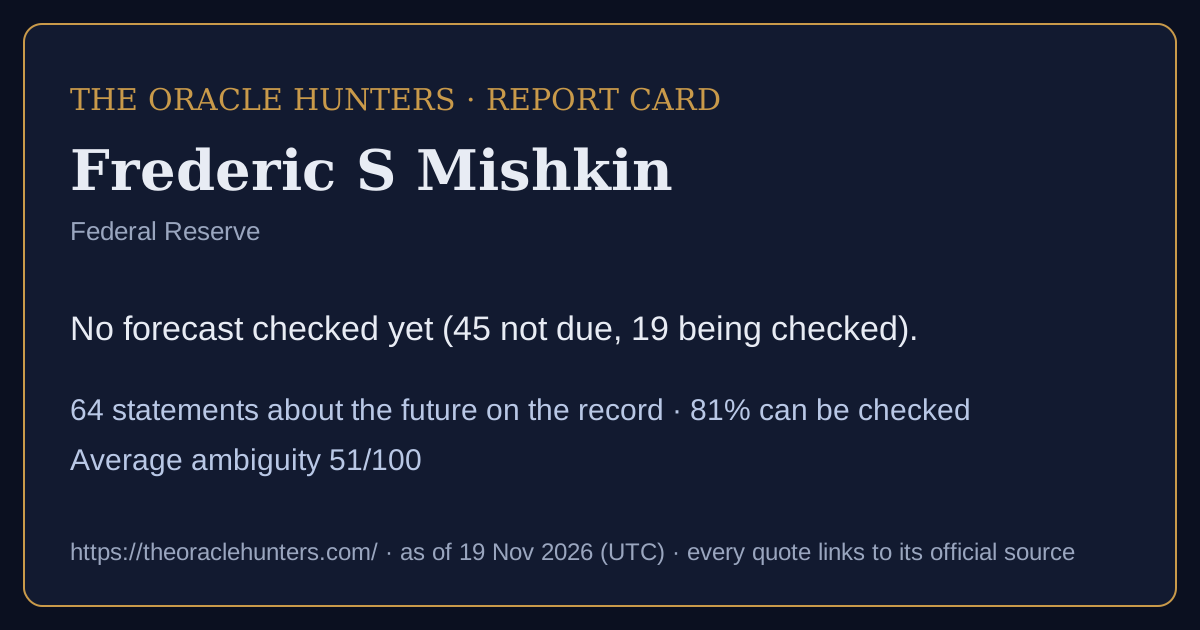
Frederic S Mishkin

Federal Reserve

Track record: No forecast checked yet (45 not due, 19 being checked).
64forecasts & commitments on the record
81%can be checked as stated
51average ambiguity (0-100)
0goalpost moves recorded
0confirmed U-turns

Timeline

20062006: Not due yet20072007: Due - being checked2007: Due - being checked2007: Due - being checked2007: Due - being checked2007: Due - being checked2007: Due - being checked2007: Not due yet2007: Not due yet (+27 more)20082008: Not due yet2008: Due - being checked2008: Not due yet2008: Not due yet2008: Not due yet2008: Due - being checked2008: Due - being checked2008: Not due yet (+20 more)
came true partly did not not due / being checked / too vague

Calibration score: shown after 10 checked forecasts with a stated likelihood (now 0).
How they speak about the future: based on data 35, educated guess 20, stated on authority 9.
Kinds of claim: forecast 38, scenario (if… then) 19, mixed claim 5, commitment 2. · Download this report card as a picture
In the nine words

πρόγνωσιςInference from evidence34 · 53%πρόνοιαPreparing for the future19 · 30%μαντείαInspired knowledge8 · 12%προαναγγελίαPublic pre-announcement2 · 3%πρόβλεψιςSeeing the signs1 · 2%
How to read this Each box is one sentence a public figure or institution said about the future, word for word, with a link to the official text. Can be checked means it names what will happen, by when, and how likely - so it can be compared with official figures later. Too vague to check means it does not. Ambiguity (0-100) is how many different ways the sentence can be read. When the date passes, the forecast is compared with official data and marked came true, partly or did not come true. Labels judge the sentence, never the person. Full guide and glossary.

On the record (64)

Moreover, I interpret the available economic theory and empirical evidence as indicating that a long-run average inflation rate of about 2 percent, or perhaps a bit lower, is low enough to facilitate the everyday decisions of households and businesses while also alleviating the risk of debt deflation and other pitfalls of excessively low inflation.5
Federal Reserve · said 28 Jul 2008 (date) · Whither Federal Reserve Communications · evidence & why
πρόγνωσις · Inference from evidencePartly checkableForecastbased on dataambiguity 71/100below the RIM-1 standardNot due yetinflationfiscal
Of course, once I return to academia at the end of next month, I will no longer be participating in any official consideration of these issues.
Federal Reserve · said 28 Jul 2008 (date) · Whither Federal Reserve Communications · evidence & why
μαντεία · Inspired knowledgePartly checkableForecaststated on authorityambiguity 36/100implied call / likelihood: Yes · 85% · for the most partbelow the RIM-1 standarddue 11 Sep 2008Due - being checked
In another instructive example, the ECB had initially emphasized a broad objective of keeping inflation below 2 percent over the medium term, but in May 2003, the ECB clarified that policy would be aimed at maintaining inflation below, but close to, 2 percent.
Federal Reserve · said 28 Jul 2008 (date) · Whither Federal Reserve Communications · evidence & why
In the United States, inflation expectations as measured by the mean or median forecast in the Survey of Professional Forecasters are also quite fixed at around 2-1/2 percent for consumer price index (CPI) inflation, but those in other surveys move around somewhat more.
Federal Reserve · said 28 Jul 2008 (date) · Whither Federal Reserve Communications · evidence & why
This problem may currently be somewhat less acute for the current set of inflation projections, because inflation is projected to moderate to about 2 percent or below by the end of the projection period.
Federal Reserve · said 28 Jul 2008 (date) · Whither Federal Reserve Communications · evidence & why
Nevertheless, to the extent that some slack in economic activity is projected to persist through 2010, that slack might well induce a modest further decline in inflation, implying that policymakers' projections for inflation in 2010 might be a bit higher than their assessments of the mandate-consistent inflation rate.
Federal Reserve · said 28 Jul 2008 (date) · Whither Federal Reserve Communications · evidence & why
πρόγνωσις · Inference from evidenceCan be checkedForecastbased on dataambiguity 71/100implied call / likelihood: Yes · 70% · probablebelow the RIM-1 standarddue 31 Dec 2010Due - being checkedinflationgrowth
Thus, growth could continue to be quite weak, though I would hope it would pick up next year.
Federal Reserve · said 02 Jul 2008 (date) · Global Financial Turmoil and the World Economy · evidence & why
μαντεία · Inspired knowledgeCan be checkedForecaststated on authorityambiguity 36/100implied call / likelihood: No · 35% · probablebelow the RIM-1 standarddue 31 Dec 2009Due - being checkedgrowth
The reasoning here suggests that a rapid rise in asset prices accompanied by a credit boom provides a signal that should lead central bankers and other financial supervisors to carefully scrutinize financial developments to see if market failures might be driving the asset price boom.
Federal Reserve · said 15 May 2008 (date) · How Should We Respond to Asset Price Bubbles? · evidence & why
πρόβλεψις · Seeing the signsPartly checkableMixed claimeducated guessambiguity 56/100implied call / likelihood: No · 35% · probablebelow the RIM-1 standardNot due yetinflationfinance
If demand conditions continue to deteriorate, reduced demand for loans could lead to future declines in small business loans even if credit supply conditions remain about the same.
Central bank (via BIS) · said 16 Apr 2008 (date) · Small business lending · evidence & why
πρόνοια · Preparing for the futurePartly checkableScenario (if… then)educated guessambiguity 83/100implied call / likelihood: No · 35% · probablebelow the RIM-1 standardNot due yetfinance
Words, however, do matter if those words help ensure that the appropriate policy actions will be taken and strengthen the public's confidence that the central bank will continue to act in a manner consistent with its long-run objectives.
Federal Reserve · said 03 Apr 2008 (date) · Central Bank Commitment and Communication · evidence & why
πρόνοια · Preparing for the futurePartly checkableScenario (if… then)educated guessambiguity 36/100implied call / likelihood: Yes · 85% · for the most partbelow the RIM-1 standardNot due yetfinance
For example, if the private sector becomes less certain about the longer-run inflation outlook, then an increase in the inflation risk premium could boost longer-term interest rates by more than the increase in expected inflation.
Federal Reserve · said 03 Apr 2008 (date) · Central Bank Commitment and Communication · evidence & why
πρόνοια · Preparing for the futurePartly checkableScenario (if… then)educated guessambiguity 56/100implied call / likelihood: Yes · 70% · probablebelow the RIM-1 standardNot due yetinflationinterest rates
For instance, a negative shock to aggregate demand that brought inflation near the bottom end of the range might cause long-run expected inflation to fall, which would raise the real interest rate if the nominal interest rate remained unchanged.
Federal Reserve · said 27 Mar 2008 (date) · Comfort Zones, Shmumfort Zones · evidence & why
πρόνοια · Preparing for the futurePartly checkableScenario (if… then)educated guessambiguity 56/100implied call / likelihood: Yes · 70% · probablebelow the RIM-1 standardNot due yetinflationinterest rates
Second, framing price stability in terms of a comfort zone could lead to perverse expectations dynamics and thereby generate larger fluctuations in economic activity, especially if policymakers maintain a neutral stance regardless of where the inflation rate falls within the comfort zone.
Federal Reserve · said 27 Mar 2008 (date) · Comfort Zones, Shmumfort Zones · evidence & why
πρόνοια · Preparing for the futurePartly checkableScenario (if… then)educated guessambiguity 56/100implied call / likelihood: No · 35% · probablebelow the RIM-1 standardNot due yetinflationgrowth
But if the central bank has an inflation objective very close to zero, the zero lower bound can prevent the full implementation of this policy response, and hence the economy will tend to exhibit greater volatility of economic activity and inflation.
Federal Reserve · said 27 Mar 2008 (date) · Comfort Zones, Shmumfort Zones · evidence & why
πρόνοια · Preparing for the futurePartly checkableScenario (if… then)educated guessambiguity 36/100implied call / likelihood: Yes · 85% · for the most partbelow the RIM-1 standardNot due yetinflationgrowthfinance
Specifically, if the average inflation rate is too low, then the economy faces a greater risk that a given adverse shock could distort labor markets, induce debt deflation, or cause monetary policy to become constrained by the zero lower bound on nominal interest rates.
Federal Reserve · said 27 Mar 2008 (date) · Comfort Zones, Shmumfort Zones · evidence & why
πρόνοια · Preparing for the futurePartly checkableScenario (if… then)educated guessambiguity 56/100implied call / likelihood: No · 35% · probablebelow the RIM-1 standardNot due yetinflationinterest rateslabourfiscal
For example, in May 2003 the European Central Bank (ECB) clarified that in implementing its mandate of price stability, monetary policy would be aimed at maintaining inflation "below, but close to, 2 percent in the medium term" (European Central Bank, 2003).
Federal Reserve · said 27 Mar 2008 (date) · Comfort Zones, Shmumfort Zones · evidence & why
πρόγνωσις · Inference from evidencePartly checkableForecastbased on dataambiguity 56/100implied call / likelihood: No · 40% · probablebelow the RIM-1 standardNot due yetinflationinterest ratesfinance
The monetary policy objective of the Reserve Bank of New Zealand is to "keep future CPI inflation outcomes between 1 and 3 per cent on average over the medium term." The narrowness of this range may seem surprising, especially given the historical volatility of inflation in New Zealand.
Federal Reserve · said 27 Mar 2008 (date) · Comfort Zones, Shmumfort Zones · evidence & why
πρόγνωσις · Inference from evidencePartly checkableForecastbased on dataambiguity 56/100implied call / likelihood: No · 40% · probablebelow the RIM-1 standardNot due yetinflationinterest ratesfinance
The decline in the value of the U.S. dollar, particularly if it continues, has raised concerns that it might lead to higher inflation.
Federal Reserve · said 07 Mar 2008 (date) · Exchange Rate Pass-Through and Monetary Policy · evidence & why
πρόνοια · Preparing for the futurePartly checkableScenario (if… then)educated guessambiguity 56/100implied call / likelihood: No · 35% · probablebelow the RIM-1 standardNot due yetinflation
Consequently, if house prices fall more than expected, and that condition leads to more adverse expectations for future changes in house prices, then housing demand could fall as a result.
Federal Reserve · said 04 Mar 2008 (date) · Outlook and Risks for the U.S. Economy · evidence & why
πρόνοια · Preparing for the futurePartly checkableScenario (if… then)educated guessambiguity 56/100implied call / likelihood: Yes · 70% · probablebelow the RIM-1 standardNot due yetinflationhousing
In addition, I continue to believe that long-run inflation expectations remain consistent with increases in PCE prices in the neighborhood of 2 percent per year.4 Accordingly, I anticipate that over time core PCE inflation will move back to around 2 percent.
Federal Reserve · said 04 Mar 2008 (date) · Outlook and Risks for the U.S. Economy · evidence & why
Indeed, a drop of 1 percentage point in the expected rate of change in real house prices, all else being equal, is equivalent in the user-cost framework to an increase of 100 basis points in the after-tax mortgage interest rate.
Federal Reserve · said 04 Mar 2008 (date) · Outlook and Risks for the U.S. Economy · evidence & why
πρόγνωσις · Inference from evidencePartly checkableForecastbased on dataambiguity 36/100implied call / likelihood: Yes · 70% · probablebelow the RIM-1 standardNot due yetinflationinterest ratesfiscalhousing
The most recent economic projections made by Federal Reserve Board members and Reserve Bank presidents--released a couple of weeks ago but submitted around the time of the late January FOMC meeting--show sluggish economic growth this year but not a downturn in activity.
Federal Reserve · said 04 Mar 2008 (date) · Outlook and Risks for the U.S. Economy · evidence & why
πρόγνωσις · Inference from evidencePartly checkableForecastbased on dataambiguity 56/100below the RIM-1 standarddue 31 Dec 2008Due - being checkedgrowthfinance
With the pace of economic activity expected to be sluggish in the near term, I anticipate some further rise in joblessness this year.
Federal Reserve · said 04 Mar 2008 (date) · Outlook and Risks for the U.S. Economy · evidence & why
μαντεία · Inspired knowledgeCan be checkedForecaststated on authorityambiguity 36/100implied call / likelihood: Yes · 70% · probablebelow the RIM-1 standarddue 31 Dec 2008Due - being checkedgrowth
It is anticipated that investment spending should receive some help in the second half of this year from the accelerated depreciation provisions in the fiscal stimulus bill; however, based on experience with a similar tax provision in 2002 and 2003, the magnitude and timing of these effects is very uncertain.
Federal Reserve · said 04 Mar 2008 (date) · Outlook and Risks for the U.S. Economy · evidence & why
πρόγνωσις · Inference from evidencePartly checkableMixed claimbased on dataambiguity 71/100below the RIM-1 standarddue 31 Dec 2008Due - being checkedfiscal
Second, if leveraged financial institutions such as banks were the only ones that had credit losses and, as a result, cut back lending, other institutions or securities issuance could replace some of the lost lending.
Federal Reserve · said 29 Feb 2008 (date) · On "Leveraged Losses: Lessons from the Mortgage Meltdown" · evidence & why
πρόνοια · Preparing for the futurePartly checkableScenario (if… then)educated guessambiguity 71/100implied call / likelihood: No · 35% · probablebelow the RIM-1 standardNot due yetfinance
Therefore, preemptive actions of the sort I have described here would be counterproductive if these actions caused an increase in inflation expectations and in the underlying rate of inflation; in other words, the flexibility to act preemptively against a financial disruption presumes that inflation expectations are firmly anchored and unlikely to rise during a period of temporary monetary easing.
πρόνοια · Preparing for the futurePartly checkableScenario (if… then)educated guessambiguity 36/100implied call / likelihood: No · 25% · for the most partbelow the RIM-1 standardNot due yetinflation
Therefore, preemptive actions of the sort I have described here would be counterproductive if these actions caused an increase in inflation expectations and the underlying rate of inflation; in other words, the flexibility to act preemptively against a financial disruption presumes that inflation expectations are well anchored and unlikely to rise during a period of temporary monetary easing.
πρόνοια · Preparing for the futurePartly checkableScenario (if… then)educated guessambiguity 36/100implied call / likelihood: No · 25% · for the most partbelow the RIM-1 standardNot due yetinflation
Nonetheless, we will continue to monitor incoming data on inflation and inflation expectations, especially given the potential risks to price stability that are associated with the rapid increase in energy prices and the depreciation of the dollar.
The range of forecasts for the growth of real GDP in 2008 is from 1.6 percent to 2.6 percent--twice as wide as in the previous set of FOMC projections, which were published last June.
πρόγνωσις · Inference from evidencePartly checkableForecastbased on dataambiguity 36/100below the RIM-1 standarddue 31 Dec 2008Due - being checkedgrowth
The midpoint of the range of projections for real GDP growth declines noticeably from about 2-1/2 percent for 2007 to roughly 2 percent in 2008; then it returns to about 2-1/2 percent in 2009 and 2010.
πρόγνωσις · Inference from evidencePartly checkableForecastbased on dataambiguity 56/100below the RIM-1 standarddue 31 Dec 2008Due - being checkedgrowth
Meanwhile, given an anticipated flattening out of energy prices, overall consumer inflation in these projections declines toward the core inflation rate; it drops from about 3 percent this year to about 2 percent in 2008 and then drops a bit further near the end of the decade.
πρόγνωσις · Inference from evidencePartly checkableForecastbased on dataambiguity 36/100below the RIM-1 standarddue 31 Dec 2008Due - being checkedinflationenergy
For 2010, the central tendency of the range of projections for the growth of real GDP is 2.5 percent to 2.6 percent, and the projections for the unemployment rate have a central tendency of 4.7 percent to 4.9 percent.
πρόγνωσις · Inference from evidencePartly checkableForecastbased on dataambiguity 36/100below the RIM-1 standarddue 31 Dec 2010Due - being checkedgrowthlabour
The projections for both overall and core inflation at the three-year horizon (which is currently 2010) fall in the range of 1.5 percent to 2.0 percent; the central tendency of these projections is 1.6 percent to 1.9 percent.
πρόγνωσις · Inference from evidencePartly checkableForecastbased on dataambiguity 36/100below the RIM-1 standarddue 31 Dec 2010Due - being checkedinflation
Thus, although FOMC participants' projections for the unemployment rate in 2010 provide information about their assessments of the sustainable unemployment rate, the analysis of Staiger, Stock, and Watson highlights the degree of uncertainty about these assessments--namely, the true value of that rate might well be as low as 3-3/4 percent or as high as 5-3/4 percent.
πρόγνωσις · Inference from evidenceCan be checkedForecastbased on dataambiguity 56/100implied call / likelihood: No · 35% · probablebelow the RIM-1 standarddue 31 Dec 2010Due - being checkedlabour
I reasoned that the anticipated softening of economic growth and perhaps the emergence of some slack in the labor market might reduce those pressures, and I judged that a cut of 25 basis points in the target federal funds rate would not materially alter that modal outlook.
Federal Reserve · said 05 Nov 2007 (date) · Financial Instability and Monetary Policy · evidence & why
πρόγνωσις · Inference from evidencePartly checkableForecastbased on dataambiguity 83/100implied call / likelihood: No · 35% · probablebelow the RIM-1 standardNot due yetinterest ratesgrowthlabour
The first action was larger than markets expected at the time--indeed, quotes from the federal funds futures market as well as survey data indicated that most investors had anticipated a cut of only 25 basis points in the target federal funds rate ahead of that meeting.
Federal Reserve · said 05 Nov 2007 (date) · Financial Instability and Monetary Policy · evidence & why
However, I recognized the risk that, even if readings on core inflation have improved modestly this year, recent increases in energy and commodity prices, among other factors, may put renewed upward pressure on inflation.
Federal Reserve · said 05 Nov 2007 (date) · Financial Instability and Monetary Policy · evidence & why
μαντεία · Inspired knowledgeCan be checkedForecaststated on authorityambiguity 36/100implied call / likelihood: No · 40% · probablebelow the RIM-1 standarddue 31 Dec 2007Due - being checkedinflationenergy
The combined 75 basis points of policy easing put in place at the past two meetings should help forestall some of the adverse effects on the broader economy that might otherwise arise from the disruptions in financial markets and should help promote moderate growth over time.
Federal Reserve · said 05 Nov 2007 (date) · Financial Instability and Monetary Policy · evidence & why
Under these circumstances, if monetary policy is tightened appreciably in the face of a surge in headline inflation, the policy would likely be excessively tight and lead to an unnecessary decline in employment.
πρόνοια · Preparing for the futurePartly checkableScenario (if… then)educated guessambiguity 36/100implied call / likelihood: Yes · 70% · probablebelow the RIM-1 standardNot due yetinflationinterest rateslabour
If monetary policy allowed aggregate demand to get out of sync with supply and if the Fed was not expected to bring demand back into balance with supply, then inflation expectations would be much less likely to remain stable.
Federal Reserve · said 10 Sep 2007 (date) · Outlook and Risks for the U.S. Economy · evidence & why
πρόνοια · Preparing for the futurePartly checkableScenario (if… then)educated guessambiguity 36/100implied call / likelihood: Yes · 70% · probablebelow the RIM-1 standardNot due yetinflationinterest rates
If households and businesses believe that the Federal Reserve will set monetary policy in a way that keeps aggregate demand in reasonable alignment with aggregate supply over time, then expectations of future resource utilization will be stable, and current resource utilization will provide less information about future inflation movements.
Federal Reserve · said 10 Sep 2007 (date) · Outlook and Risks for the U.S. Economy · evidence & why
πρόνοια · Preparing for the futurePartly checkableScenario (if… then)educated guessambiguity 56/100implied call / likelihood: Yes · 85% · for the most partbelow the RIM-1 standardNot due yetinflationinterest rates
Still, the professional forecasters surveyed by the Philadelphia Fed also project PCE inflation to be close to 2 percent over the next five to ten years.
Federal Reserve · said 10 Sep 2007 (date) · Outlook and Risks for the U.S. Economy · evidence & why
πρόγνωσις · Inference from evidencePartly checkableForecastbased on dataambiguity 56/100below the RIM-1 standardNot due yetinflation
This summer’s retrenchment in equity markets and the sharp deceleration in house prices have damped gains in household wealth this year and are likely to restrain consumer outlays.
Federal Reserve · said 10 Sep 2007 (date) · Outlook and Risks for the U.S. Economy · evidence & why
μαντεία · Inspired knowledgePartly checkableForecaststated on authorityambiguity 36/100implied call / likelihood: Yes · 70% · probablebelow the RIM-1 standarddue 31 Dec 2007Due - being checkedinflationhousing
Given this sizable backlog and the likelihood that sales will remain weak or weaken further in coming months, cutbacks in housing construction are likely to continue to be a drag on economic activity in future quarters.
Federal Reserve · said 10 Sep 2007 (date) · Outlook and Risks for the U.S. Economy · evidence & why
μαντεία · Inspired knowledgePartly checkableForecaststated on authorityambiguity 36/100implied call / likelihood: Yes · 70% · probablebelow the RIM-1 standarddue 08 Mar 2008 (vague)Due - being checkedgrowthhousing
The new law becomes effective on June 1, 2007, but reportedly will not apply to state-owned enterprises until 2008.
Federal Reserve · said 23 Jun 2007 (date) · Globalization and Financial Development · evidence & why
πρόγνωσις · Inference from evidencePartly checkableForecastbased on dataambiguity 36/100implied call / likelihood: Yes · 85% · for the most partbelow the RIM-1 standarddue 31 Dec 2008Due - being checked
Under the proposal, an advertisement may refer to a rate as "fixed" only if the advertisement specifies a period during which the rate cannot increase for any reason (and the agreement does not give the creditor the right to increase it during that period), or if the rate will not increase while the plan is open.
Central bank (via BIS) · said 07 Jun 2007 (date) · Credit card disclosures · evidence & why
πρόνοια · Preparing for the futurePartly checkableScenario (if… then)educated guessambiguity 56/100implied call / likelihood: Yes · 85% · for the most partbelow the RIM-1 standardNot due yetfinance
2 Card issuers must establish and maintain their own toll-free telephone numbers to provide the repayment estimates, except that depository institutions having assets of $250 million or less may rely for two years on a number the Board is required to establish and maintain for them, and non-depository creditors may rely on a number the FTC is required to establish …
Central bank (via BIS) · said 07 Jun 2007 (date) · Credit card disclosures · evidence & why
When the actual level of output is above potential output--so that the output gap is positive--labor and product markets are excessively tight; then, if things such as expected inflation and temporary supply factors are held constant, inflation will tend to rise.
Federal Reserve · said 24 May 2007 (date) · Estimating Potential Output · evidence & why
πρόνοια · Preparing for the futurePartly checkableScenario (if… then)educated guessambiguity 36/100implied call / likelihood: Yes · 70% · probablebelow the RIM-1 standardNot due yetinflationgrowth
The results from the Survey of Professional Forecasters, readings on household opinion such as the Reuters/Michigan survey, and the spread between standard Treasury securities and Treasury inflation-protected securities--taken together--suggest that long-term inflation expectations are currently around 2 percent, although this guess is far from certain.
Federal Reserve · said 20 Apr 2007 (date) · The U.S. Economic Outlook · evidence & why
πρόγνωσις · Inference from evidencePartly checkableForecastbased on dataambiguity 71/100below the RIM-1 standardNot due yetinflation
Turning now to the inflation outlook, in February the twelve-month change in core personal consumption expenditure (PCE) prices was 2.4 percent, and in March the year-over-year change in the core consumer price index (CPI) was 2.5 percent.
Federal Reserve · said 20 Apr 2007 (date) · The U.S. Economic Outlook · evidence & why
πρόγνωσις · Inference from evidencePartly checkableForecastbased on dataambiguity 56/100below the RIM-1 standardNot due yetinflation

Showing the newest 50 - the ledger has all 64.

Also said - not checkable as stated (12 newest)

Remarks about the future with no date, figure or likelihood that could be checked. They are kept on the record and shown here, but not scored.

Banks are tightening their lending standards, and conditions could worsen again should the economic outlook deteriorate further.
Federal Reserve · said 02 Jul 2008 (date) · Global Financial Turmoil and the World Economy · evidence & why
I am confident that it will be studied for some time to come, and that we will forge a better financial system as a result.
Federal Reserve · said 02 Jul 2008 (date) · Global Financial Turmoil and the World Economy · evidence & why
In the United States, a potential customer with an Internet connection could quickly fill out an online form, and a mortgage broker could rapidly price a loan with the help of credit-scoring technology.
Federal Reserve · said 02 Jul 2008 (date) · Global Financial Turmoil and the World Economy · evidence & why
εἰκασία · ConjectureToo vague to checkSpeculationeducated guessambiguity 83/100implied call / likelihood: No · 35% · probablebelow the RIM-1 standardfinancehousing
The resulting mortgages were bundled together to produce mortgage-backed securities, which could then be sold off to investors.
Federal Reserve · said 02 Jul 2008 (date) · Global Financial Turmoil and the World Economy · evidence & why
In part, the outsized impact of mortgage losses on broader financial markets probably stems from the fact that they exposed a more extensive set of problems in financial intermediation that were not limited to the original subprime loans.
Federal Reserve · said 02 Jul 2008 (date) · Global Financial Turmoil and the World Economy · evidence & why
More generally, our approach to regulation should favor policies that will help prevent future feedback loops between asset price bubbles and credit supply.
Federal Reserve · said 15 May 2008 (date) · How Should We Respond to Asset Price Bubbles? · evidence & why
Just as doctors take the Hippocratic oath to do no harm, central banks should recognize that trying to prick asset price bubbles using monetary policy is likely to do more harm than good.
Federal Reserve · said 15 May 2008 (date) · How Should We Respond to Asset Price Bubbles? · evidence & why
πρόνοια · Preparing for the futureToo vague to checkCall for actionstated on authorityambiguity 56/100implied call / likelihood: Yes · 70% · probablebelow the RIM-1 standardinterest ratesfinance
"Should Central Banks Respond to Movements in Asset Prices?" American Economic Review, vol. 91 (May), pp. 253-57.
Federal Reserve · said 15 May 2008 (date) · How Should We Respond to Asset Price Bubbles? · evidence & why
πρόνοια · Preparing for the futureToo vague to checkCall for actionbased on dataambiguity 71/100implied call / likelihood: No · 40% · probablebelow the RIM-1 standardinflationfinance
Whether an asset price bubble is occurring or not, as asset prices rise and boost the outlook for economic activity and inflation, monetary policy should respond by moving to a more restrictive stance.
Federal Reserve · said 15 May 2008 (date) · How Should We Respond to Asset Price Bubbles? · evidence & why
πρόνοια · Preparing for the futurePartly checkableCall for actionstated on authorityambiguity 56/100below the RIM-1 standardinflationinterest ratesgrowth
To be clear, I think that in most cases, monetary policy should not respond to asset prices per se, but rather to changes in the outlook for inflation and aggregate demand resulting from asset price movements.
Federal Reserve · said 15 May 2008 (date) · How Should We Respond to Asset Price Bubbles? · evidence & why
πρόνοια · Preparing for the futureToo vague to checkCall for actioneducated guessambiguity 71/100below the RIM-1 standardinflationinterest rates
My testimony today will address the unusual stress imposed on credit markets in recent months and how that stress appears to be affecting small businesses.
Central bank (via BIS) · said 16 Apr 2008 (date) · Small business lending · evidence & why
As you may recall, in my testimony before the House Committee on Small Business in November, I concluded that while credit conditions had no doubt tightened since mid-August, small businesses generally seemed to have been able to retain access to credit. 1 However, I emphasized that the uncertainty surrounding that conclusion was unusually high, and it was far too early …
Central bank (via BIS) · said 16 Apr 2008 (date) · Small business lending · evidence & why