Franz-Christoph Zeitler
Deutsche Bundesbank
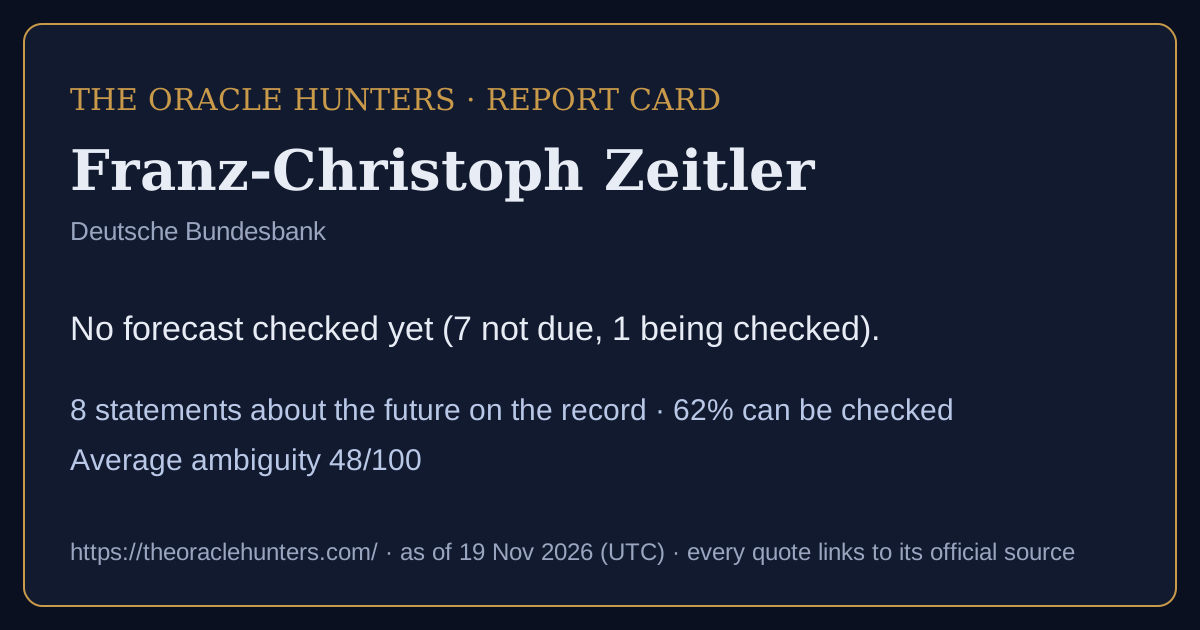
Track record: No forecast checked yet (7 not due, 1 being checked).
8forecasts & commitments on the record
62%can be checked as stated
48average ambiguity (0-100)
0goalpost moves recorded
0confirmed U-turns
Timeline
came true partly did not not due / being checked / too vague
Calibration score: shown after 10 checked forecasts with a stated likelihood (now 0).
How they speak about the future: based on data 8.
Kinds of claim: forecast 7, mixed claim 1. · Download this report card as a picture
In the nine words
How to read this
Each box is one sentence a public figure or institution said about the future, word for word, with a link to the official text. Can be checked means it names what will happen, by when, and how likely - so it can be compared with official figures later. Too vague to check means it does not. Ambiguity (0-100) is how many different ways the sentence can be read. When the date passes, the forecast is compared with official data and marked came true, partly or did not come true. Labels judge the sentence, never the person. Full guide and glossary.On the record (8)
Furthermore, from 2008 on a revised enterprise taxation will be valid.
Empirical literature states that the Euro has probably boosted intra-eurozone trade by around 5 to 15% so far. 1 And indeed, German exports of goods within the euro area grew from 12% of GDP in 1988 to 16.5% in 2006, with an interim downswing to 8.5 % in 1993 which was mainly caused by the German re-unification.
For example, the flexibility provided for setting the medium-term budgetary targets reduces the margin to the 3% ceiling and thus increases the danger of exceeding this ceiling during an economic downturn.
Under Article 2a of the new Regulation, the medium-term budgetary objectives are to be set - taking into account the debt level and potential growth rates of the member states concerned - within a range of up to -1% of GDP. 21
In Germany, for example, the government deficit exceeded the Maastricht limit in every year since 2002 and even in 2005 the deficit will not be brought back under the 3%-theshold.
There may indeed be some well-meaning and reasonable suggestions out there with the intent of improving the Pact's effectiveness, such as the idea of 'giving the Pact more muscle' in the event that a member state fails to reduce structural deficits in good years and thereby robs itself of the discretionary scope to stay under the 3%-limit in not-so-good years.
4. -Finally, what is often forgotten is that the 3%-limit was chosen for Maastricht against the background of an expected nominal growth rate of 5% and a real trend growth rate of 3% (3% nominal deficit in terms of 5% growth result in a trend debt level of 60%).
A comparison of growth rates in Europe confirms that countries with lower deficits have faster growth rates, whereas countries like Germany, which have repeatedly exceeded the Pact's 3% deficit limit (2002: 3.5%, 2003: 4%, also expected to be well over 3% in 2004), have to battle persistent stagnation and unemployment.
Also said - not checkable as stated (12 newest)
Remarks about the future with no date, figure or likelihood that could be checked. They are kept on the record and shown here, but not scored.
The big picture should be kept in mind when evaluating the impact the measures will have on the capital situation of institutions; before any final decisions are taken, an in-depth impact
Although encouraging signs of recovery are emerging, the crisis is not yet over and it will take years to come back to previous levels of output.
## Franz-Christoph Zeitler: How should banking regulation change?
- The scope of supervision is all about setting the right incentives; here, the G20 made an important policy decision back in the autumn of last year: all financial market players - including near banks and shadow banks - must be regulated; 1
Regulators wishing to avoid this having a knock-on effect on banks' ability to lend should therefore not implement capital measures until the crisis has been safely resolved.
Panel contribution by Professor Franz-Christoph Zeitler, Vice-President of the Deutsche Bundesbank, at the Conference dedicated to the 15th anniversary of the re-introduction of the Estonian kroon, at the Bank of Estonia, Tallinn, 23 May 2007.
Despite all these measures, however, no hopes should be nurtured that they will provide a definitive solution to the problem of counterfeiting.
Over the past few years, currency in circulation in the euro area has hit doubledigit annual growth rates and thus increased much more than the quantitative models based on economic growth and the rise in cashless payments led us to expect.
Just as books and newspapers have their place in the age of the internet and television, cash will likewise retain its importance in the age of 'cybermoney'.
However, people rightly expect their currency to provide not just security against depreciation but also security of the cash in circulation - in other words, banknotes and coins that are of good quality and, in particular, protected against counterfeiting.
The Bundesbank therefore attaches great importance to combating counterfeit money and pursues what might be termed a 'multi-dimensional' strategy based on different levels.
It can only be answered by means of co-operation between central banks and the private sector, which must each play their part as efficiently as possible.