Frans Timmermans
European Commission · EU
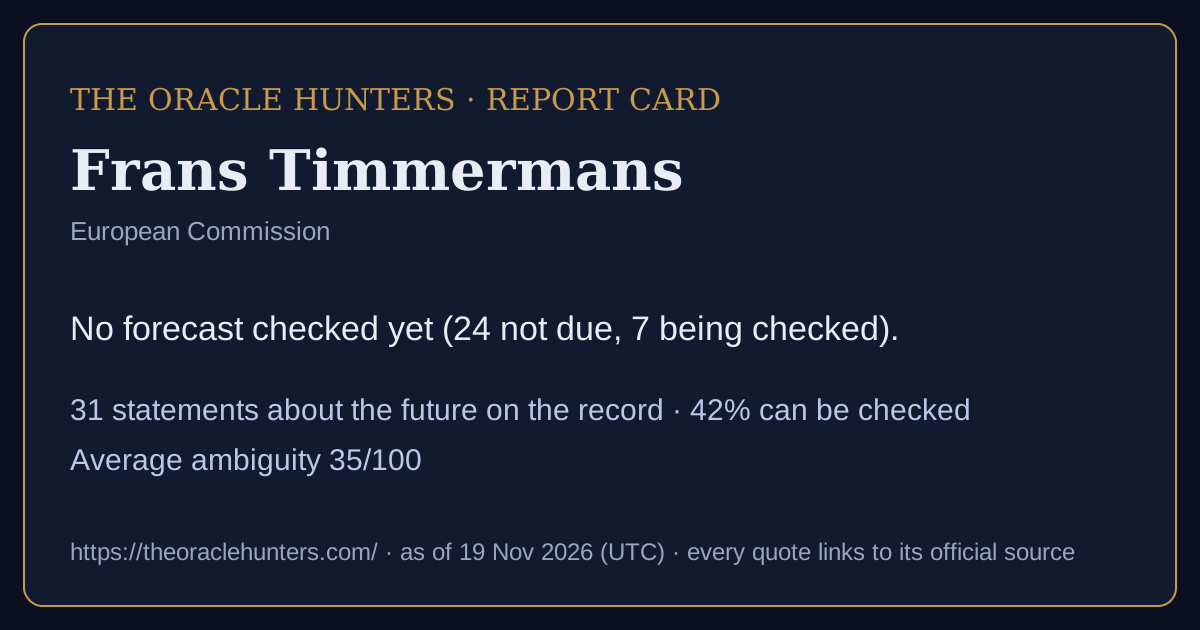
Track record: No forecast checked yet (24 not due, 7 being checked).
31forecasts & commitments on the record
42%can be checked as stated
35average ambiguity (0-100)
0goalpost moves recorded
0confirmed U-turns
Timeline
came true partly did not not due / being checked / too vague
Calibration score: shown after 10 checked forecasts with a stated likelihood (now 0).
How they speak about the future: based on data 21, stated on authority 8, educated guess 2.
Kinds of claim: mixed claim 13, forecast 13, commitment 4, scenario (if… then) 1. · Download this report card as a picture
In the nine words
πρόγνωσιςInference from evidence19 · 61%μαντείαInspired knowledge6 · 19%προαναγγελίαPublic pre-announcement4 · 13%πρόνοιαPreparing for the future1 · 3%εἰκασίαConjecture1 · 3%
How to read this
Each box is one sentence a public figure or institution said about the future, word for word, with a link to the official text. Can be checked means it names what will happen, by when, and how likely - so it can be compared with official figures later. Too vague to check means it does not. Ambiguity (0-100) is how many different ways the sentence can be read. When the date passes, the forecast is compared with official data and marked came true, partly or did not come true. Labels judge the sentence, never the person. Full guide and glossary.On the record (31)
Market rules will be applied in two phases: before and after 2030.
To protect the most vulnerable, we will require all buildings in the lowest class to be renovated by 2030.
With these new rules in place, we estimate that by 2030, methane emissions related to oil, gas and coal will be 80% lower.
We will therefore develop a European certification scheme next year to make sure that carbon removals are truly that.
Most of the buildings today will still be there in 2050, so to bring down energy use and emissions we have to renovate them.
One person only that will still be around in 2030, and think of how that person will live if we do not stick to the 1.5 degrees here today.
In addition, by the end of 2021, the Commission will revise the Guidelines on State aid for energy and environmental protection and ensure that they support the goals of this strategy.
Over the next years, we will aim to turn it into an even greater opportunity for clean energy, high quality jobs, international competitiveness, and sustainable growth.
We estimate that reaching 300 gigawatts of offshore wind by 2050 will require less than 3% of the EU's maritime space.
This Offshore Renewable Energy Strategy will support the further growth of this industry, and will spur further progress towards meeting our ambitious climate targets for 2030 and beyond.
We calculate that by 2050, we will need an investment of almost 800 billion euros.
We will soon propose a Renovation Wave to lower energy bills and fight energy poverty.
The Climate Law will set the direction by making our 2050 climate neutrality goal binding.
Agreeing quickly on the new 2030 target will also allow us to submit our updated nationally determined contribution to the UN still this year, as is requested by the Paris Agreement.
Clearly, the new proposals we will be putting forward next year will contain appropriate elements to support Member States in the implementation and the achievement of the targets.
But, I also need to emphasise that we cannot have the exact impacts per Member State before we know what the legislation will look like and this is the reason why we will have detailed impacts per Member State only with the proposals we will make in June next year, well most of them in June next year.
Nevertheless, I believe it remains important for the EU to agree on the revised 2030 target as soon as possible, in particular also in the context of the pandemic and the recovery we will need after this pandemic.
If we do it in a responsible way, it will support sustainable growth, job creation, lower energy bills, decrease dependency from energy imports and deliver important other benefits in terms of health and well-being.
This will inform our policy proposals to be tabled at the latest in June next year.
I am convinced our commitment to climate neutrality by 2050 has had an impact on what the Chinese will do.
We will reinforce our energy efficiency and renewable energy targets, and we will continue to strengthen CO2 standards for cars.
In order to help you implement a higher 2030 ambition, next year, we will revise and expand the EU Emissions Trading System.
Since we have decided as European Union to lead the way worldwide and to become the first climate-neutral continent by 2050, we also have to have a roadmap for how we are going to get there.
I am really very curious to hear from you what you will be doing in your neck of the woods, so that we reach a collective objective of making a great success of the next COP in Glasgow on climate and also the COP in May next year on biodiversity in China.
This means it will provide an EU guarantee of roughly 20 billion euros to sustainable infrastructure projects, including the renovation wave for local jobs.
We will increase it from the 7.5 billion euros we had envisaged so far to 40 billion euros.
For us, if we take on this extra burden of loans and grants, of a higher EU Budget, we have to make sure that we take decisions that will take us to the future and not into the past.
Because by destroying nature at an unprecedented rate, and now with around 1 million species at risk of extinction within only decades, we literally threaten our own life, our health and our well-being.
We will continue our work on the increase of the 2030 climate targets.
We are aiming to present a legislative proposal on single use plastics by the end of May this year.
By 2030, all plastics packaging will have to be reusable or recyclable in an economically viable manner.
Also said - not checkable as stated (12 newest)
Remarks about the future with no date, figure or likelihood that could be checked. They are kept on the record and shown here, but not scored.
Then we will have to plot a route and give ourselves the means to navigate these times of turmoil.
But we will have to work hard to ensure that our commitment to this Alliance is lock-tight - whoever is in the White House, or whoever leads any of the European governments.
Meanwhile, African leaders are coming closer to Europe, because they understand that what they had expected from others, especially China and Russia, is not delivering what they hoped for.
We must counter Putin through unity and strength, giving Ukraine all it needs to push the aggressor out, and start building an independent, prosperous and free country.
We also have to understand countries far beyond our borders and the geopolitical constellation in ways we didn't before.
It does not bring a higher degree of confidence that we will achieve the commitments made under the Paris Agreement and in Glasgow last year.
We will be holding ourselves and everyone here accountable under the Paris Agreement.
To tackle climate change all financial flows need to support the low carbon transition.
So in this year we must make sure that the major emitters reduce their emissions, commensurate with the agreements we reached in Glasgow.
And our reaction to that behaviour is going to determine not just the security of Europe, if is going to determine global security for the years to come.
But I have to say that since today my sense of urgency to act collectively, to show that there is a world based on the rule of law, respect for international treaties, respect for national borders, respect for what is essentially a sustainable peaceful development, that my sense of urgency has increased, and our need to act collectively has also …
These buildings, which represent about 15% of buildings in each Member State must be upgraded to at least energy label F by 2030, and label E in 2033.