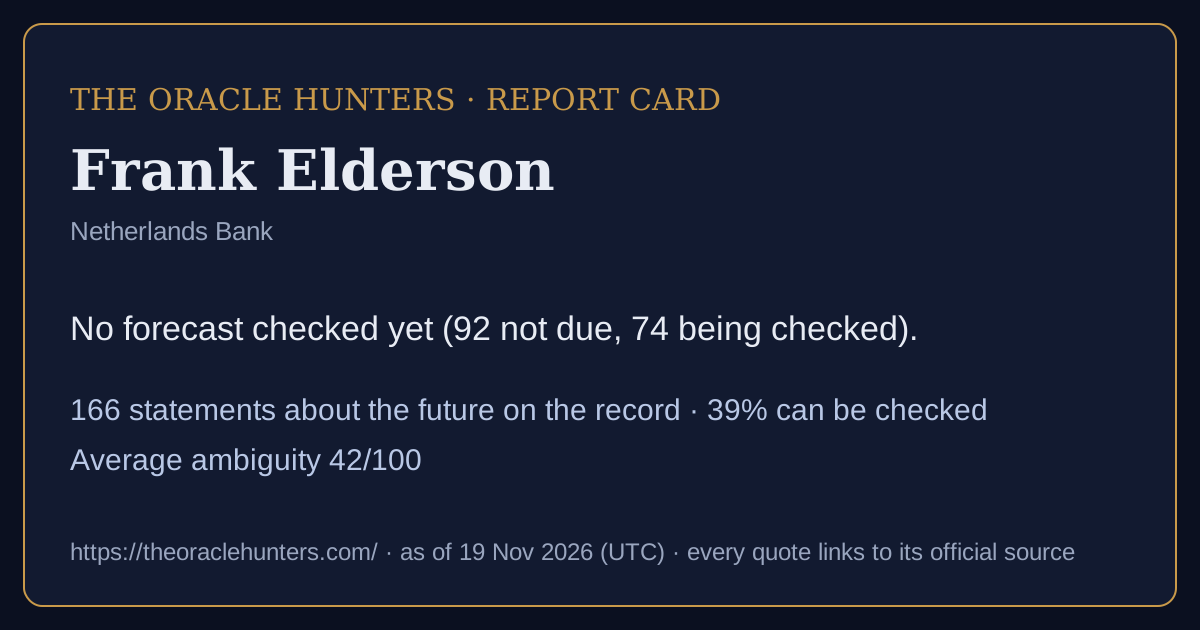
Frank Elderson
Netherlands Bank · EU
Track record: No forecast checked yet (92 not due, 74 being checked).
166forecasts & commitments on the record
39%can be checked as stated
42average ambiguity (0-100)
0goalpost moves recorded
0confirmed U-turns
Timeline
came true partly did not not due / being checked / too vague
Calibration score: shown after 10 checked forecasts with a stated likelihood (now 0).
How they speak about the future: based on data 116, stated on authority 40, educated guess 10.
Kinds of claim: forecast 100, mixed claim 46, scenario (if… then) 10, commitment 10. · Download this report card as a picture
In the nine words
πρόγνωσιςInference from evidence111 · 67%μαντείαInspired knowledge30 · 18%προαναγγελίαPublic pre-announcement10 · 6%πρόνοιαPreparing for the future10 · 6%εἰκασίαConjecture4 · 2%πρόβλεψιςSeeing the signs1 · 1%
How to read this
Each box is one sentence a public figure or institution said about the future, word for word, with a link to the official text. Can be checked means it names what will happen, by when, and how likely - so it can be compared with official figures later. Too vague to check means it does not. Ambiguity (0-100) is how many different ways the sentence can be read. When the date passes, the forecast is compared with official data and marked came true, partly or did not come true. Labels judge the sentence, never the person. Full guide and glossary.On the record (166)
Against this, implementation costs are expected to amount to around 0.7% of global GDP in the coming decade.
They could also reduce Germany's economic recovery by up to 0.2 percentage points of GDP in the third quarter.
Research involving the ECB, the London School of Economics and Oxford University has found that a 1-in-100-year drought event could put up to 24% of euro area economic output at risk. Clearly, too little water is only half of the story.
The European Commission estimates that, if current levels of PFAS pollution in Europe continue until 2050, the cost to society could reach €440 billion over that period.
These pressures are projected to reduce global food productivity by 12% by 2040, increasing food prices by up to 30%.
Moreover, the International Renewable Energy Agency (IRENA) reports that 91% of new renewable power projects commissioned in 2024 were more cost-effective than new fossil fuel alternatives.
The IEA estimates that around half of residential fuel consumption, half of oil-based road transport and almost 40% of fossil fuel-based low and medium-temperature industrial heat could be electrified cost-effectively.
A collaboration between the ECB, the London School of Economics and the University of Oxford revealed how an extreme episode of water scarcity could put as much as 24% of euro area output at risk.
Recent ECB research suggests that severe water scarcity alone could put up to 24% of the euro area’s economic output at risk.
If the cost-competitive potential were fully exploited, electricity could meet around one-third of global final energy consumption by 2035, compared with 23% in 2025.
The IEA finds substantial scope for further electrification across sectors and notes that, in a scenario where fuel-importing countries accelerate electrification significantly, their combined energy import bill could fall by more than USD 400 billion by 2035 compared with 2025 levels, highlighting the potential gains in resilience and energy security.
Quantum computing is already appearing on the horizon and could become widely available by 2030.
A recent study finds that food prices in Europe could rise by as much as 1.8 percentage points after an extreme summer in the climate that is expected to prevail in the 2060s, relative to a hypothetic scenario without any climate change (Chart 2, right-hand panel). Nature degradation also poses risks to food prices.
The June Eurosystem staff projections revised the baseline outlook for growth down in both 2026 and 2027 and revised inflation up over that same period compared with the March projections.
Further EU progress on pricing carbon emissions is expected via the introduction of ETS2, covering buildings, road transport and smaller industries, in 2028.
Barrier two: regulatory uncertainty and complexity Even with carbon pricing levelling the playing field, the estimated additional investment needs for the transition in the EU are massive – between 2.7% and 3.7% of EU GDP each year until 2030 – and will likely be greater still beyond that date. Yet investing in new technologies tends to be riskier than investing …
Indeed, the passthrough of gas prices to electricity prices in Spain has halved over recent years. According to one study, electric vehicles in Europe avoided 67 million barrels of oil consumption in 2025, lowering oil import costs by €4.1 billion. With higher oil prices and a greater share of electric vehicles, the benefit over the first half of this year …
Eurosystem research based on French data has found that an acute loss in the provision of ecosystem services, such as a decline in pollination, could increase headline HICP inflation by as much as 0.5 percentage points. Central banks therefore need to account for the ongoing climate and nature crises when preparing their inflation forecasts, or risk underestimating the degree of …
The digital euro project is expected to come to fruition in 2029.
One could consider, for example, increasing the scope of eligible small banks through an increase of the €5 billion threshold of the SNCI regime.
One could consider, for example, increasing the scope of eligible small banks through an increase of the €5 billion threshold of the SNCI regime as well as extending the scope of the simplified rules.
Consider that the green, digital and defence transitions will require an additional €1.2 trillion of spending per year between now and 2031. No single actor, no single sector and no single country can meet these challenges alone.
It finds that a one-off shock to major crop yields could raise food inflation by over 2 percentage points and add about 0.5 percentage points to headline CPI inflation (within one to two years) in France.
Surface water scarcity alone could put up to 24% of euro area economic output at risk.
To further support banks, we will also include good practices on nature-related risks in the updated compendium that will be published in May this year.
The Task Force plans to deliver its proposals for simplification to the Governing Council by the end of the year, after which they will be presented to the European Commission.
The high-level task force plans to deliver its proposals for simplification to the Governing Council by the end of 2025, after which they will be presented to the European Commission.
We expect this will bring the publication of the final Guide well into 2026.
SREP decisions are also being issued earlier.[In next year’s SREP, we will also implement a revised and simplified methodology to calibrate the Pillar 2 requirement.
Some recent research even suggests that the threshold of 3 degrees may already be reached by 2050.
C&N risks are not just appearing at distant time horizons but are becoming an increasingly immediate concern for financial stability and economic growth. Consider that, in the next five years, extreme weather events could account for a loss of up to 5% of euro area economic output.
Losses from the droughts, heatwaves and floods that hit the EU this summer are estimated at €43 billion; this figure could climb to €129 billion by 2029, and that is likely to be an underestimation.
Therefore, within our mandate, we remain committed to ensuring that the Eurosystem fully takes into account, in line with the EU’s goals and objectives, the implications of climate change and nature degradation for monetary policy and central banking.
Additionally, recent empirical research by Oxford University, one of the first of its kind, demonstrates that both domestic and international nature degradation could lead to an estimated 12% reduction in UK GDP in the years to come.
Pressures on farmland could reduce global food productivity by 12% and raise food prices by up to 30% by 2040 (see Noel, S. et al.
The Digital Operational Resilience Act (DORA), which became applicable in the EU earlier this year, will help further boost operational resilience as it provides a robust framework that requires banks to foster a culture of continuous IT and cyber risk management. Structural risk drivers Certain external risk drivers have a direct impact on the traditional risk categories in the prudential …
By thus further strengthening the rule of law, we will encourage investment, foster economic growth and enhance the international role of the euro. And by doing so we will further solidify the foundations for freedom, peace and prosperity that will ensure that Van Randwijk’s light will never fade but will shine more brightly than ever before.
All of us continuing to play our role – and we will play ours as much as we know that the courts will play theirs – will lead not only to the protection but to the growth of the quality and the depth of the rule of law.
This year’s drought is especially alarming: spring 2025 is on track to become the driest ever recorded in the Netherlands, likely surpassing the previous record set nearly 50 years ago.
We will also continue to reduce processing times by making better use of supervisory technology tools that use cutting-edge technologies, such as artificial intelligence.
Moreover, the Digital Operational Resilience Act (DORA), which became applicable in the EU earlier this year, will help to further boost operational resilience as it provides a robust framework that requires banks to foster a culture of continuous IT and cyber risk management. What’s more, neither cyber risks nor other risks stop at borders.
Last October the UN Emissions Gap Report concluded that the world is on track for an average increase of 3.1 degrees. And even that dramatic number will only be achieved if all governments stick with their current policies.
In the face of changing climates, be they macroeconomic, political or indeed at the level of our planetary ecosystem, we will continue to deliver on our mandate to keep prices stable and ensure Europe’s banks are safe and sound.
Our task is to prevent situations where welcome adjustments to bottlenecks translate into very unwelcome risks to medium-term price stability – such situations can arise when adjustments go beyond relative price alterations and temporary deviations of inflation from our 2% target.
This was far above the ECB Governing Council’s 2% target for inflation over the medium term, which we see as best maintaining our primary objective of price stability.
This is why we expect banks under our supervision to manage all material nature-related risks, consistent with the supervisory guide that we published in 2020 with expectations about banks’ risk management practices for both climate-related and environmental risks. It is also the reason the ECB has made nature one of the focus areas of its climate and nature plan for …
For instance, the EU will need an additional €5.4 trillion between 2025 and 2031 to advance our green transformation, accelerate the digitalisation of our economy and bolster our defence capabilities. Faced with this mammoth task, deepening the capital markets union to help guide the required financing flows should be our highest priority.
While we should continue to push for an orderly and full transition, it is becoming increasingly likely that we will ultimately see a combination of disorderly transition and further increasing physical damages due to the climate and nature crises.
To avoid any doubt, we will proceed in exactly the same way with respect to the third and final deadline at the end of this year.
But it is also relevant for the composition of the structural bond portfolio that will be part of our new operational framework, as announced earlier this year. Second, if there is a monetary policy need to reconsider targeted longer-term refinancing operations (TLTROs) for banks in the future, there are compelling reasons to seriously consider greening these TLTROs.
Showing the newest 50 - the ledger has all 166.
Also said - not checkable as stated (12 newest)
Remarks about the future with no date, figure or likelihood that could be checked. They are kept on the record and shown here, but not scored.
UNEP's State of Finance for Nature 2026 estimates that annual investment in nature-based solutions needs to reach $571 billion by 2030, compared with approximately $220 billion in 2023.
These estimates inform how banks price risk, set aside provisions for expected losses and determine how much capital they need to absorb any large, unexpected losses.
With heightened uncertainty, the objective of scenarios should not only be to explore baseline pathways, but also to investigate how vulnerabilities might be exposed under extreme yet plausible conditions.
And repeated surprises on the upside should make us cautious about assuming that what remains unknown will be benign.
For much of modern finance, risk management has rested on a simple but consequential assumption: with enough data, sufficient information about borrower behaviour, robust models and a solid understanding of historical patterns, banks can estimate the losses they may face with a reasonable degree of precision.
Physical damage could occur simultaneously with pressures on energy systems. And we know that nature degradation can affect economic activity through complex and interconnected channels.
Simplification has already been introduced in this respect: for low-severity findings, we expect banks to simply confirm that they have taken sufficient action to ensure compliance, without any need to submit further documentation. At the same time, high-severity findings and measures that remain open for years without meaningful progress do not strengthen resilience and do not contribute to simplification.
Building on this progress, ECB Banking Supervision will continue to sharpen its focus on the risks that are most relevant from a prudential perspective. Through a refocusing exercise to be launched in mid-October, we will critically review the stock of measures accumulated in recent years and tailor our supervisory engagement to the risk profile of the underlying weakness.
As part of this exercise, banks will receive further information on the implications for their individual stock of findings and measures, taking into account their severity, prudential relevance and remediation status, the time elapsed since they were identified and the likelihood of further supervisory intervention being required.
Importantly, this is not a one-off clean-up: these considerations will continue to guide the identification of and follow-up to findings and measures.
For banks, this more agile process will reduce the previously required supervisory engagement for low-severity measures, allowing them to focus their resources on addressing the matters that pose the greatest prudential impact.
In practical terms, this means that the least severe findings – what we call F1 findings – will in future be communicated as supervisory observations to banks rather than generating corresponding measures.