François Groepe
South African Reserve Bank
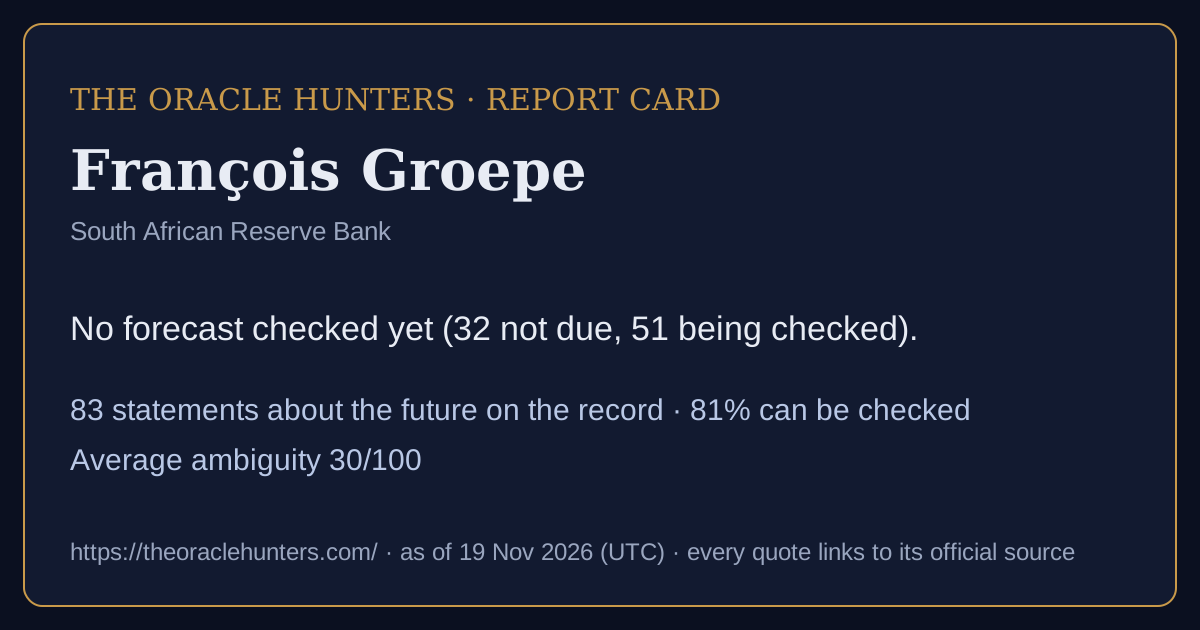
Track record: No forecast checked yet (32 not due, 51 being checked).
83forecasts & commitments on the record
81%can be checked as stated
30average ambiguity (0-100)
0goalpost moves recorded
0confirmed U-turns
Timeline
came true partly did not not due / being checked / too vague
Calibration score: shown after 10 checked forecasts with a stated likelihood (now 0).
How they speak about the future: based on data 72, educated guess 7, stated on authority 4.
Kinds of claim: forecast 69, mixed claim 9, scenario (if… then) 4, commitment 1. · Download this report card as a picture
In the nine words
πρόγνωσιςInference from evidence72 · 87%πρόνοιαPreparing for the future4 · 5%μαντείαInspired knowledge3 · 4%εἰκασίαConjecture3 · 4%προαναγγελίαPublic pre-announcement1 · 1%
How to read this
Each box is one sentence a public figure or institution said about the future, word for word, with a link to the official text. Can be checked means it names what will happen, by when, and how likely - so it can be compared with official figures later. Too vague to check means it does not. Ambiguity (0-100) is how many different ways the sentence can be read. When the date passes, the forecast is compared with official data and marked came true, partly or did not come true. Labels judge the sentence, never the person. Full guide and glossary.On the record (83)
There are anecdotal estimates that such efforts could contribute 0.5 - 1.5% to gross domestic product (GDP).
Aligned to Vision 2025 and centred on leveraging innovations in the fintech environment, the SARB will host a workshop next year for regulators, overseers, policymakers and government that will focus on unlocking any inefficiencies within our current processes and platforms to stimulate economic growth.
According to Financial Sector Deepening Africa, a development finance organisation, fintech is expected to contribute at least US$40-150 billion 3 to sub-Saharan Africa's economic output by 2022.
As outlined in Vision 2025 , we will pursue this objective by leveraging technological developments to extend the availability of digital payment services to all sectors of society while meeting domestic, regional and international requirements for the benefit of all members of South African society.
Furthermore, as the transitory shocks of 2018 fade, the low base that they would have established will support the 2019 growth rate somewhat.
Meanwhile, the so-called 'dot plot' published by the Fed's Federal Open Market Committee indicates that the measured pace of US interest rate increases is likely to continue in 2019.
Headline inflation is expected to increase from an average of 4.8% in 2018 to 5.7% in 2019 and 5.4% in 2020.
At the January meeting of the Monetary Policy Committee (MPC), we had forecast GDP growth of 1.4% for this year.
This trend is also reflected in the forecasts for South Africa's major trading partners where, on average, GDP growth is expected to slow slightly from 3.6% in both 2017 and 2018 to 3.5% in both 2019 and 2020.
The International Monetary Fund (IMF) projects growth in the eurozone, the United Kingdom (UK) and Japan to be slower in 2018 than in 2017, moderating to 2.0%, 1.4% and 1.1% respectively. 1 Meanwhile, US economic growth is forecast to accelerate this year to 2.9% from an already strong level of 2.2% in 2017.
However, if we could meaningfully lift the GDP growth rate, redistribution could take place more easily through the sharing of the additional gains.
Over time, the policy actions and communiqués of the SARB are expected to anchor inflation expectations (and inflation itself) closer to the 4.5% level.
South Africa's economy is expected to stage a gradual recovery over the next two years, as both domestic investment and export growth are forecast to rise.
The Vision 2025 process has and will continue to be consultative and collaborative.
Through this Payments Innovation Conference, we will also explore payment threats and security interventions in the digital age, with a focus on the analysis of emerging threats in the payments domain and counteracting threats (the tactics, tools, and techniques) in order to remain safe and secure in the digital age.
A study undertaken by the European Banking Authority estimated that the implementation of IFRS 9 would give rise to an average increase of 13% in loss provisions compared to the current levels under IAS 39; it is further expected that the Core Equity Tier (CET) 1 ratios will decrease by an average of 45 basis points.
And if wage negotiators and price setters believe that inflation will accelerate, they will adjust wages and prices accordingly, and in so doing bring about a self-fulfilling prophecy.
It follows then that if growth is above potential, there will be inflationary pressures and the role of monetary policy will be to moderate these pressures by reducing demand pressures to be consistent with price stability.
As interest rates fall below 0 per cent, economic agents may switch from central bank money or electronic cash to physical cash.
By way of an example, excessive price increases or bubbles in asset markets, including the housing market - particularly if financed by excessive leverage or borrowing against these assets - could pose a risk to the financial system at large should the prices of these assets collapse.
Bank forecasts 0 per cent growth this year and below-trend growth of just 1,1 per cent and 1,5 per cent in 2017 and 2018, respectively.
At the same time, inflation is outside our target range of 3 - 6 per cent and is expected to remain outside the range until the third quarter of 2017.
South Africa will have new, far-reaching and overarching, financial sector legislation by the end of 2016.
In May, the South African Reserve Bank revised its 2016 growth forecast to 0,6 per cent from 2,2 per cent a year earlier.
Despite a slightly improved forecast in May, inflation is still expected to remain above the upper end of the target range until the third quarter of 2017 - and the risks to this forecast were assessed to be on the upside.
Demand fell short of potential and our estimates show that the output gap remained negative in 2015 and is likely to widen somewhat this year.
In its latest Global Economic Perspectives, for example, the World Bank projects world GDP to expand by only 2,4 per cent this year, the same as in 2015, and by only 2,8 per cent next year.
The Bank estimates that potential GDP growth will be 1,5 per cent this year, down from 2,1 per cent in 2013.
At the same time, while public debt as a share of GDP is only expected to stabilise in 2017/18, the 2016 budget has put in place genuine elements of fiscal consolidation and the discipline shown by central government in recent years to stick to its expenditure targets should facilitate the achievement of these fiscal goals.
In a report released last month, the Institute of International Finance (IIF) projected that non-resident capital flows into emerging economies would fall to only US$548 billion in 2015, down from US$1,305 billion two years ago, with bank lending and bond portfolio flows likely to account for the bulk of the decline.
In 2011, the growth differential between the emerging and developed world was as high as 4,6 percentage points; in 2015, according to International Monetary Fund (IMF) projections, it will be as low as 2,0 percentage points, the narrowest gap in 15 years.
By the end of next year, market participants see Fed funds around 0,75 to 1,00 per cent, while the median projection of FOMC members currently lies at 1,4 per cent.
Addressing the House of Representatives on 4 November, Chair Janet Yellen remarked that ' if we were to move, say in December, it would be based on an expectation, which I believe is justified, that - with an improving labour market and transitory factors fading - inflation will move up to 2 per cent.' In the wake of recent Fed …
As I previously indicated, the Fed, if it begins to raise interest rates in the coming months, will not do so because of a strong, potentially inflationary acceleration in US gross domestic product (GDP) growth.
Indeed, despite some improvement over the past year or two, our current-account deficit still appears likely to remain elevated, at around 4,2 per cent of GDP in 2015, and around 4,6 per cent next year.
For the sub-Saharan Africa region as a whole, the IMF now forecasts average inflation to accelerate to 6,9 per cent this year and to 7,3 per cent in 2016 compared to 6,4 per cent in 2014.
The IMF forecasts sub-Saharan GDP growth of 4,3 per cent in 2016, up from the estimated 3,8 per cent in the current year but still below the 5,25 per cent average growth rate of the past five years.
In its October 2015 World Economic Outlook , the International Monetary Fund downgraded its global GDP growth forecasts by 0,2 per cent to 3,1 per cent and 3,6 per cent in 2015 and 2016 respectively.
The Bank further estimates that a part of this deterioration may be structural and that potential economic growth has slowed from around 3 to 3,5 per cent in 2010 5 to about 1,8 per cent this year.
Equally, the average budget deficit for the region is estimated to have risen to 4,2 per cent of GDP this year, up from 1,8 per cent three years ago; as a result, the public-debt-to-GDP ratio is likely to have reached its highest level since 2005.
The IMF forecasts that, in 2016, 30 of the 45 sub-Saharan countries will have a current-account deficit in excess of 5,0 per cent of GDP.
In 2014, real gross domestic product (or GDP) growth registered 1,5 per cent and the latest projections estimate that real GDP growth in 2015 will also be around 1,5 per cent.
However, due to base effects, 12-month inflation is expected to pick up notably in the coming months and to exceed 6 per cent in 2016.
Moreover, looking ahead, the National Development Plan projects that, by 2030, no less than 90 per cent of new jobs will be created in small and expanding firms.
The Bond Market Development Committee, chaired by National Treasury, and in consultation with the World Bank and bond market stakeholders, has made considerable progress and is currently at an advanced stage of the development of an electronic trading platform; it is envisaged that the platform will be introduced before the end of this year.
Efforts to expand and grow this number may, however, come under strain unless the South African growth trajectory can be lifted to the 5 per cent target set in the National Development Plan.
The World Bank defined sustainable economic development as a situation under which extreme poverty is reduced to such an extent that the number of people making a living on less than US$1,25 per day will eventually be lowered to less than 3 per cent of the total global population by 2030.
Core inflation is forecast to average 5,4 per cent and 5,2 per cent in the outer two years with the persistence in this measure largely being attributed to high levels of wage growth, currency depreciation and inflation expectations that are anchored at the upper end of the target range.
The Bank's model previously incorporated an increase of around 13 per cent, effective from 1 July 2015, but should a higher increase be granted, we will see further upside pressure on inflation.
The CPI inflation rate is expected to average 6,1 per cent and 5,7 per cent in 2016 and 2017, respectively.
Showing the newest 50 - the ledger has all 83.
Also said - not checkable as stated (12 newest)
Remarks about the future with no date, figure or likelihood that could be checked. They are kept on the record and shown here, but not scored.
It ceased to trade in December 2015, just a year and a half later. 3 We have to be vigilant of the new threats that may arise as a result of the application of novel technologies.
To nurture this technology, we would, however, need to be alive to the new threats that it may introduce.
We will continue to conduct further trials.
We will also continue to create an ever more enabling environment by creating innovation facilitators.
There is no doubt that we are facing a period of rapid technological advancement and innovative disruption, not least in the area of financial services, with financial technology (fintech) likely to disrupt and redefine both payments and banking value chains.
The emergence of fintech, the Fourth Industrial Revolution and the continuing shift from the industrial to the digital economy all hold significant benefits and could materially contribute towards lifting the growth potential of our economy.
In a similar vein, Accenture's Pivoting with AI report 4 states that embracing artificial intelligence, in-process automation and augmenting human capabilities could potentially double the size of South Africa's economy in a few decades.
The workshop will provide an opportunity for parties to gain deeper insights into the various innovations available, including open banking and APIs, and will take advantage of the SARB's relational capital to start a debate and craft a national strategy that will journey South Africa into the digital future.
Nevertheless, should the independence of the SARB come under threat for any reason, we will make full use of all the legal avenues available to protect the independence of the SARB as it is a very important pillar for monetary policy credibility.
Fintech is a key regulatory priority, but also a potential area of growth for the economy - we do not have to look further than Estonia and Singapore to realise the growth and transformational potential that the use of technology may hold.
In order to reach more transformative growth rates, as envisioned in the NDP, government will need to act decisively on the recent reforms.
This Innovation and Cybersecurity Conference will focus on the following five themes: