Fiona Clouder
Foreign & Commonwealth Office · GBR
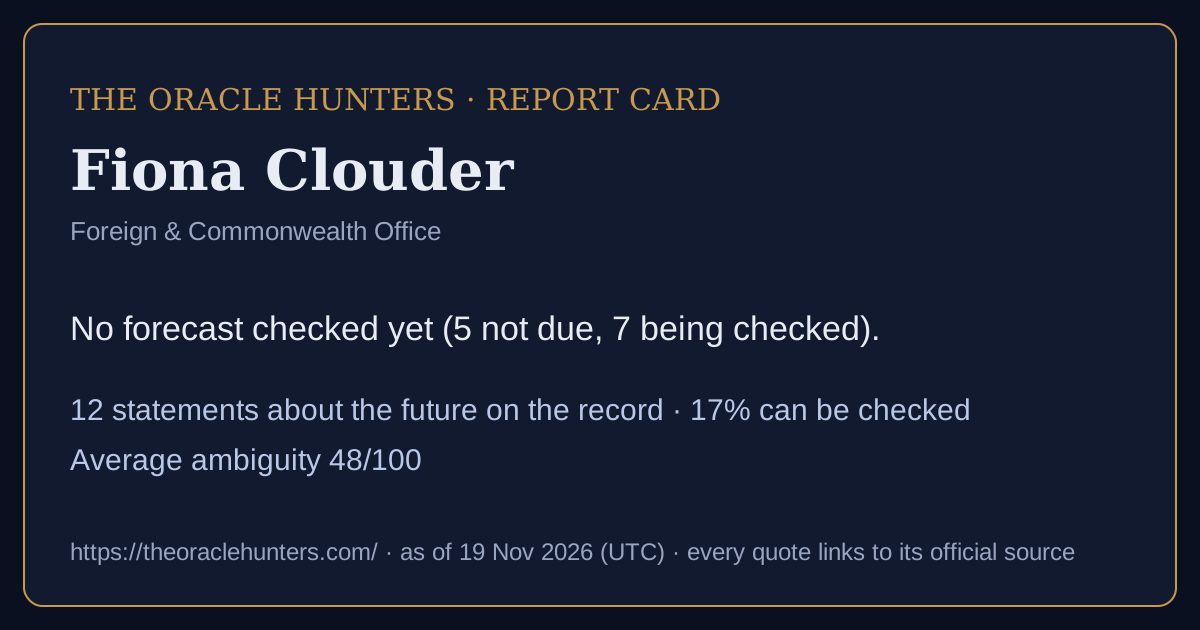
Track record: No forecast checked yet (5 not due, 7 being checked).
12forecasts & commitments on the record
17%can be checked as stated
48average ambiguity (0-100)
0goalpost moves recorded
0confirmed U-turns
Timeline
came true partly did not not due / being checked / too vague
Calibration score: shown after 10 checked forecasts with a stated likelihood (now 0).
How they speak about the future: based on data 10, stated on authority 2.
Kinds of claim: forecast 9, mixed claim 2, commitment 1. · Download this report card as a picture
In the nine words
πρόγνωσιςInference from evidence9 · 75%μαντείαInspired knowledge2 · 17%προαναγγελίαPublic pre-announcement1 · 8%
How to read this
Each box is one sentence a public figure or institution said about the future, word for word, with a link to the official text. Can be checked means it names what will happen, by when, and how likely - so it can be compared with official figures later. Too vague to check means it does not. Ambiguity (0-100) is how many different ways the sentence can be read. When the date passes, the forecast is compared with official data and marked came true, partly or did not come true. Labels judge the sentence, never the person. Full guide and glossary.On the record (12)
By 2020 we are committed to protecting around 4 million square kilometres of ocean.
Many of you have asked me about what will happen in the next two years now that Article 50 has been triggered.
In future years Chile will continue to be involved in regional Newton fund programmes, one of which we hope to launch this year on biodiversity.
Chile is expected to graduate from the OECD DAC list of ODA recipient countries this year, with retrospective effect from 1 January 2017, after exceeding the high income country threshold in 2012 and 2013.
This year we will launch four activities which reflect this new focus – broadening the impact of joint British and Chilean research to benefit developing countries.
So I agree, now is the time to encourage market entry to Chile, the Pacific Alliance and wider Latin America of UK companies that can support this streamlining and to be well positioned for the next anticipated growth period that some commentators are saying will be in 2018.
We saw many examples in Paris where businesses and investors made billions of pounds worth of commitments to a low carbon economy, including the insurance sector collectively investing over $100 billion in smarter risk and resilience projects.
Since 2007, Innovate UK has helped more than 5000 innovative companies, with projects adding £7.5 billion to the UK economy, and creating 35 000 extra new jobs.
Welcome to the Residence for this Innovation Networking event to celebrate the recently launched $3 million USD Corfo-InnovateUK Experimental Development Call supporting UK-Chile innovation projects through the Newton-Picarte Fund in the sectors of Solar Energy, Agrifoods and Sustainable Mining.
I should also say that as St. Andrews Day was celebrated earlier this week, the Scottish Government has recently announced that 2016 will be the year of Innovation, Architecture and Design with a series of exciting events to promote Scotland’s achievements in these areas.
Chile’s GDP grew 1.9% in 2014 and is expected to grow around 2.5% in 2015.
To help some of this, we have arranged a Credit line of £1 Billion with UK Export Finance for projects working with Codelco.
Also said - not checkable as stated (12 newest)
Remarks about the future with no date, figure or likelihood that could be checked. They are kept on the record and shown here, but not scored.
This work will yield important insights into climate change.
Sustainable use of resources, combined with demands of economic development, against a backdrop of global maritime trade and security means we are all going to need to develop innovative approaches, in partnership.
Tomorrow evening the Satellite Applications Catapult centre, will talk about some of their work to help combat illegal fishing – an economic problem and a global security problem.
This conference is of course focussed on marine conservation and protection, but part of the challenge is that we have to collectively take that agenda forward in a world where the ocean is also vital for global prosperity and global security.
It is great to see that the results and collaborations from this project remain sustainable not only through the Ministry of Housing’s sustainable construction strategy, but also through new collaboration opportunities set out between BRE and IDIEM from the University of Chile in the MOU that will be signed today.
And I hope we will also see many of you at Chile Day, 29/30 June in London.
These will be the final bilateral Newton programmes, which we will launch in Chile.
More importantly the fund has been the vehicle through which UK and Chilean researchers and universities have been able to establish partnerships, which we hope will continue for the long term.
The news that Chile Day will take place in London for the seventh year running, on 29/30 June, to promote Chile, free trade and investment, in London, as the best city in the world to do business.
At the same time we will also seize the opportunity to forge our own new trade deals and to reach out beyond the borders of Europe to build relationships with old friends.
I want us to build a new relationship with the EU that will give our companies the maximum freedom to trade with and operate in the European market – and allow European businesses to do the same with the UK.
Why should that be remembered in Chile, you might ask?