Ferenc Karvalits
Hungary
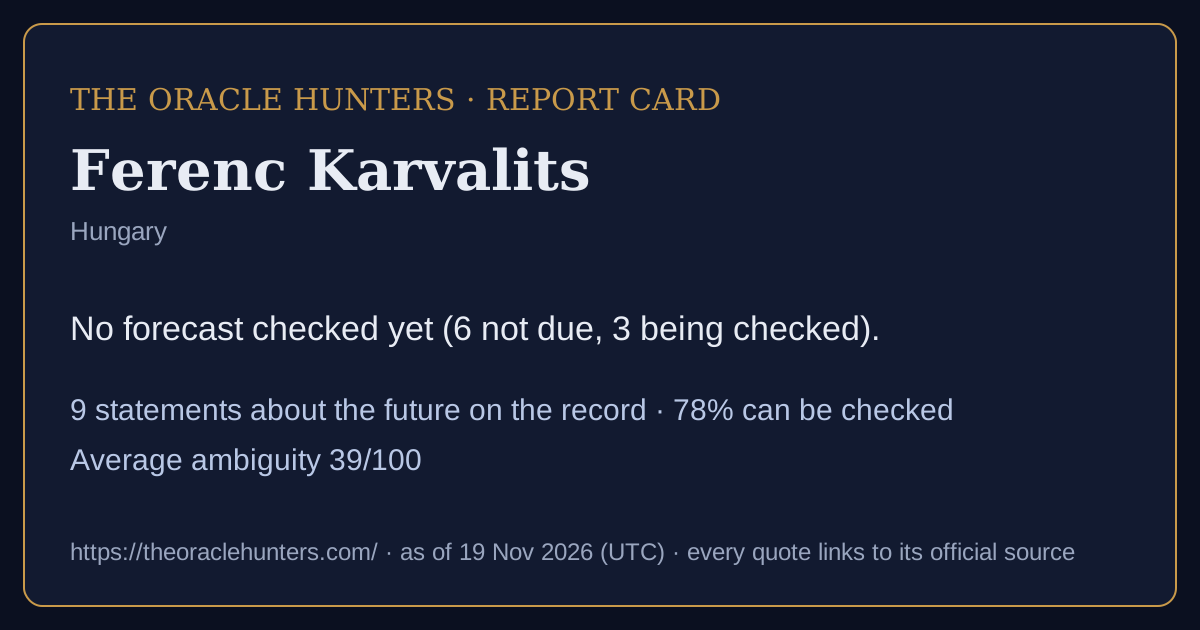
Track record: No forecast checked yet (6 not due, 3 being checked).
9forecasts & commitments on the record
78%can be checked as stated
39average ambiguity (0-100)
0goalpost moves recorded
0confirmed U-turns
Timeline
came true partly did not not due / being checked / too vague
Calibration score: shown after 10 checked forecasts with a stated likelihood (now 0).
How they speak about the future: educated guess 4, based on data 4, stated on authority 1.
Kinds of claim: forecast 5, scenario (if… then) 3, mixed claim 1. · Download this report card as a picture
In the nine words
πρόγνωσιςInference from evidence4 · 44%πρόνοιαPreparing for the future3 · 33%μαντείαInspired knowledge1 · 11%εἰκασίαConjecture1 · 11%
How to read this
Each box is one sentence a public figure or institution said about the future, word for word, with a link to the official text. Can be checked means it names what will happen, by when, and how likely - so it can be compared with official figures later. Too vague to check means it does not. Ambiguity (0-100) is how many different ways the sentence can be read. When the date passes, the forecast is compared with official data and marked came true, partly or did not come true. Labels judge the sentence, never the person. Full guide and glossary.On the record (9)
However, we are fully aware of possible upside risks to inflation stemming from imperfectly anchored long term inflation expectations and larger than expected increases in food and commodity prices, and will not hesitate to act if they materialize.
The other key vulnerability, the high level of public debt has already been addressed to some extent through a significant fiscal adjustment process that took place in the last couple of years; this year Hungary will register a cyclically adjusted primary balance of around +1.4 per cent of GDP.
Chances are that Hungary will meet the Maastricht fiscal criterion as early as this year.
According to the forecast published in our August Inflation Report, the 3 per cent inflation target will be met by 2010.
As a consequence, Hungary's external financing requirement is likely to decrease to close to 3 per cent of the GDP in 2009.
If the relative price changes remain permanent their effect will, on the one hand, appear directly in the consumer price index and may, on the other, lead to cost-push inflationary pressure on the relevant monetary policy horizon, due to the fact that the goods affected also serve as production input.
In Hungary, an agreement was reached in 2005 between the MNB and the Government, setting the medium-term inflation target at 3 per cent in terms of the headline consumer price index.
If economic agents do in fact expect higher inflation, it will lose all of its stimulating effects on the economy.
If it swims with the tide, it may later face larger losses of output, as it would simultaneously have to deal with disinflation and lower external demand.
Also said - not checkable as stated (12 newest)
Remarks about the future with no date, figure or likelihood that could be checked. They are kept on the record and shown here, but not scored.
Although we have to take all these factors into account when deciding about policy rate, I want to underline, I'm certain that households and banks can (have to and will) solve the loan problem on their own.
Neither monetary policy was in a position to act strongly against the sharp downturn, due to the high expected risk premium and the currency mismatch problem.
It is important to point out, that fiscal adjustment in and of itself will not necessarily do the trick.
The above measures make a permanent reduction in government debt more likely to happen.
To this end we will be focusing on managing risks to stability and sustainability, risks that we expect to be with us for a protracted period of time.
The sustainability of the debt path became uncertain, external financing resources dried up, the risk premium expected from Hungarian instruments dramatically increased, and we had to face a free fall in external demand in the real economy - all this happening at the same time.
Notwithstanding the importance of the monetary policy measures probably the most important development in this period was the deal reached with the IMF and the EU on the financial support package.
With the help of the package we could manage the roll-over risk of the Hungarian economy, and at the aggregate level there was no capital outflow from the banking sector, foreign investors only withdraw capital from the government securities market.
Our inflation forecasts indicated that, despite inflation persistence stemming from the high inflation history of Hungary, the fall in demand will bring CPI below the target over the monetary policy relevant horizon.
However, the funding had a much shorter maturity, as indicated by the FX liquidity shortage, and ultimately the balance sheet problems of unhedged borrowers could turn into significant bank losses, at times when collateral values were also falling.
We will assess the balance and come up with a baseline forecast in our November inflation report.
The Monetary Council of the Magyar Nemzeti Bank must consider the constant changes in the external environment, which influence the outlook for both economic growth and inflation.