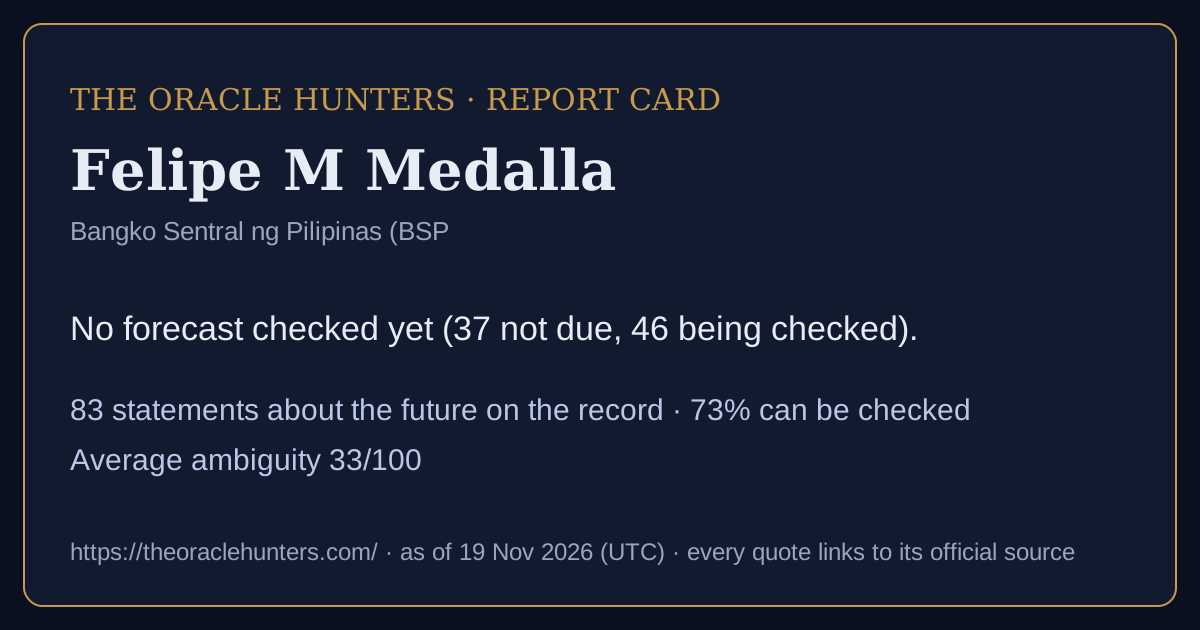
Felipe M Medalla
Bangko Sentral ng Pilipinas (BSP
Track record: No forecast checked yet (37 not due, 46 being checked).
83forecasts & commitments on the record
73%can be checked as stated
33average ambiguity (0-100)
0goalpost moves recorded
0confirmed U-turns
Timeline
came true partly did not not due / being checked / too vague
Calibration score: shown after 10 checked forecasts with a stated likelihood (now 0).
How they speak about the future: based on data 62, stated on authority 12, educated guess 9.
Kinds of claim: forecast 51, mixed claim 23, scenario (if… then) 7, commitment 2. · Download this report card as a picture
In the nine words
πρόγνωσιςInference from evidence58 · 70%μαντείαInspired knowledge12 · 14%πρόνοιαPreparing for the future7 · 8%εἰκασίαConjecture4 · 5%προαναγγελίαPublic pre-announcement2 · 2%
How to read this
Each box is one sentence a public figure or institution said about the future, word for word, with a link to the official text. Can be checked means it names what will happen, by when, and how likely - so it can be compared with official figures later. Too vague to check means it does not. Ambiguity (0-100) is how many different ways the sentence can be read. When the date passes, the forecast is compared with official data and marked came true, partly or did not come true. Labels judge the sentence, never the person. Full guide and glossary.On the record (83)
- 1 The market cap of the stock exchange is 13.46 billion as of end-May 2023, based on Philippine Stock Exchange (PSE) data.
After all, the [bank] owner, for every peso that you [the bank] will invest or lend, the owner owns no more than 20 percent.
The differential between our policy rate and the US policy rate, if it narrowed too much, could cause a very large fall in the peso.
That is why we are confident that, in the absence of new shocks, average inflation will be within-target, possibly below 3.0 percent.
That is why I am quite confident that we will be back to normal inflation next year.
By the way, we are revising this [forecast] with the newer numbers. [2023 full-year] inflation will probably be around below 6.0 percent in the revised numbers.
Of course, we are now seeing what, we think, will really be the trend next time, which is 0.3 percent from January to February and zero inflation from February to March.
At any rate, the private sector forecasts [of inflation] are, more or less, very close to ours, except that [these] are slightly higher than ours for 2024 and 2025. [For 2023], the private sector says [that inflation will be] 3.7 percent; we [at the central bank] say around 3.0 percent.
We will need negative inflation [during] the remaining part of the year to hit the 4.0 percent.
But, as you can see, for 2024, we are confident that we are going to be very close to the midpoint of our target [at 3.0 percent].
Since the number of people who use their mobile phones [for digital payments] has increased significantly, that is why we are actually quite confident that we will be able to succeed if we can improve the physical infrastructure-maybe we can even bring it [the proportion of Filipino adults that are financially excluded] below 30 percent.
As you might have already heard, our target is to increase the proportion of people who are included in the financial system-that is, they have a formal bank account or electronic wallet-to 70 percent this year.
It could happen, that [normalization] actually happens this August or September or it could also happen in January next year or February next year.
For next year, [the forecast is down] from 3.1 to 2.9 percent.
The average inflation as forecasted for this year is [down] from 6.1 to 6.0 percent.
If you look at the chart more closely, we will have below 4 percent inflation, if our forecasts are correct, by October .
We will do everything in our power so that inflation next year will be below 4 percent.
If not, then this is the first time that we [inflation] will be above target for longer than 15 months.
As to the current account, we forecast that it would be about a deficit of US$19.9 billion.
Since we have US$98.2 billion in forex reserves, the likelihood that it [forex reserves] will fall by more than 10 [billion dollars] this year is actually very high.
Our forecast is that by November or December, we will [inflation] be below 4.0 percent.
Our main forecast is by November or December this year, headline inflation-which is essentially the price index [this year], divided by the price index 12 months ago-will be back to below 4.0 percent, and it will be close to 3.0 percent by next year.
We missed the target last year, and we will miss it again this year.
As I said, our forecast is that inflation will be above target for 19 to 20 months, which means inflation will be below 4.0 percent, maybe, by November or December at the earliest.
Of course, there are disagreements on what the growth rate will be this year.
By the end of the year, inflation will be below target, either in November or December -or January at the worst.
What is worrisome is, although our forecast for 2024 is closer to 3.0 percent than to 4.0 percent, the private sector forecast is 4.0 percent.
One of the reasons, of course, is that, although the policy rate is 6.0 percent, our forecast [full-year] inflation-if it happens at the end of the year-will be about 4.0 percent.
However, what is evolving is our own [inflation] forecast. [It] is that maybe, this time, we will have 19 or 20 consecutive months where inflation will be above 4.0 percent, [the
If we can have the same success somewhere else [in different sectors of the economy]-mining has already been mentioned-then growth will continue.
The real problem is growth-sooner or later, unless met by rising exports-grinds to a halt because the current account deficit will get larger.
Now, what will happen this year is a contest of forecasts.
And if you say "do not import," you will have shortages because agriculture [is] growing at 1.0 or 2.0 percent.
If I were to bet my money, it is going to be 6.0 percent or higher this year.
Well, of course, if it keeps doing that, then the central bank FX reserves fall, confidence in the currency will fall, and we will have all sorts of problems that we have had historically.
By the way, I think we were abroad then [when the growth figures were released], and we were taking bets, and I lost the bet because I said it was going to be 7.4 percent.
Those who are old enough to remember know that [back then,] T-bills [Treasury bills, shorter-term securities] accounted for maybe 70 percent of the bonds issued by the government because nobody knows what inflation will be many years from now.
In the complex language of monetary policy, [there is a word known as] "sterilize." If the central bank buys assets, it will increase money supply.
For instance, who could have predicted just six months before that the Fed [United States Federal Reserve] will do four 75 basis points (bps) [policy rate increases]?
My own personal forecast, which is also the forecast of our forecasting team, is that headline inflation will be closer to 3.0 percent than 4.0 percent by the fourth quarter of this year.
The good news, of course, is by our own forecast, we should be able to go back to 2.0 to 4.0 percent [inflation] by the end of the third or fourth quarter [of 2023].
By 2024, we will have inflation very close to the midpoint of our target.
As shown by the green little bars at the bottom of the page, we were initially expecting to go back to 0.3 percent per month inflation, but that was delayed by two months because of shortages of vegetables and, of course, the big news in the Philippines-the shortage of onions.
It is already target-consistent at this point, but the year-on-year numbers will, of course, take time. [The effects will] most likely [manifest] by the end of the third quarter or the fourth quarter of this year.
If you look at the chart on the right, we will see that private sector forecasts of inflation are much higher than our [BSP's] forecast.
This year and hopefully beyond, we expect the economy to sustain this strong momentum.
By the fourth quarter, and hopefully for the rest of 2024, inflation is expected to approach the low end of the target range due to base effects.
Starting this year, we will exercise the authority conferred by the Financial Products and Services Consumer Protection Act or FCPA that was enacted last year and will soon issue the Rules of Procedure for Mediation and Adjudication by January of the current year.
And then, we hope that with the interest rate adjustments, inflation will come back to normal by the middle of next year, unless there are new supply shocks, new surprises.
Indeed, the growth rate of the economy this year is, of course, most likely to exceed the bottom of the target of the government, which is 6.5 percent or higher.
Showing the newest 50 - the ledger has all 83.
Also said - not checkable as stated (12 newest)
Remarks about the future with no date, figure or likelihood that could be checked. They are kept on the record and shown here, but not scored.
Unless there are new shocks, we should see inflation below 4.0 percent before the end of this year.
Eli, you will [have to] wait just a little bit more.
Our more stable exchange rate helps us avoid excessive depreciation that may dislodge inflation expectations and add to inflationary pressures.
This puts us on track to achieve our target of digitalizing half of domestic retail payments by the end of this year.
Speech by Mr Felipe M Medalla, Governor of Bangko Sentral ng Pilipinas (BSP, the central bank of the Philippines), at the inauguration of the Philippine Stock Exchange's new events hall, Manila, 28 May 2023.
We talk about all the issues, including tax reforms that we might want to propose to Congress.
I am very optimistic [that] this hall represents what could be in the future: an economy where capital markets are more developed; an economy where funding big projects and activities could be funded by thousands of, hopefully, ordinary people-a more developed capital market; a more developed economy, which, in turn, gives you a more developed capital market.
It is important to chronicle these changes [in banking laws] to see where we have come from and to chart where we will go.
Speech by Mr Felipe M Medalla, Governor of Bangko Sentral ng Pilipinas (BSP, the central bank of the Philippines), at the launch of the legal book "Banking Laws of the Philippines - Annotated", Manila, 25 May 2023.
Speech by Mr Felipe M Medalla, Governor of Bangko Sentral ng Pilipinas (BSP, the central bank of the Philippines), at the 23rd Financial Stability Board - Regional Consultative Group for Asia Meeting, Mactan, 16 May 2023.
But what must be seen is [inflation] in relation to month-on-month (m-o-m) changes.
So, all the payments to the government will also be easily tracked, including payments to local governments.