Executive Vice-President
European Commission · EU
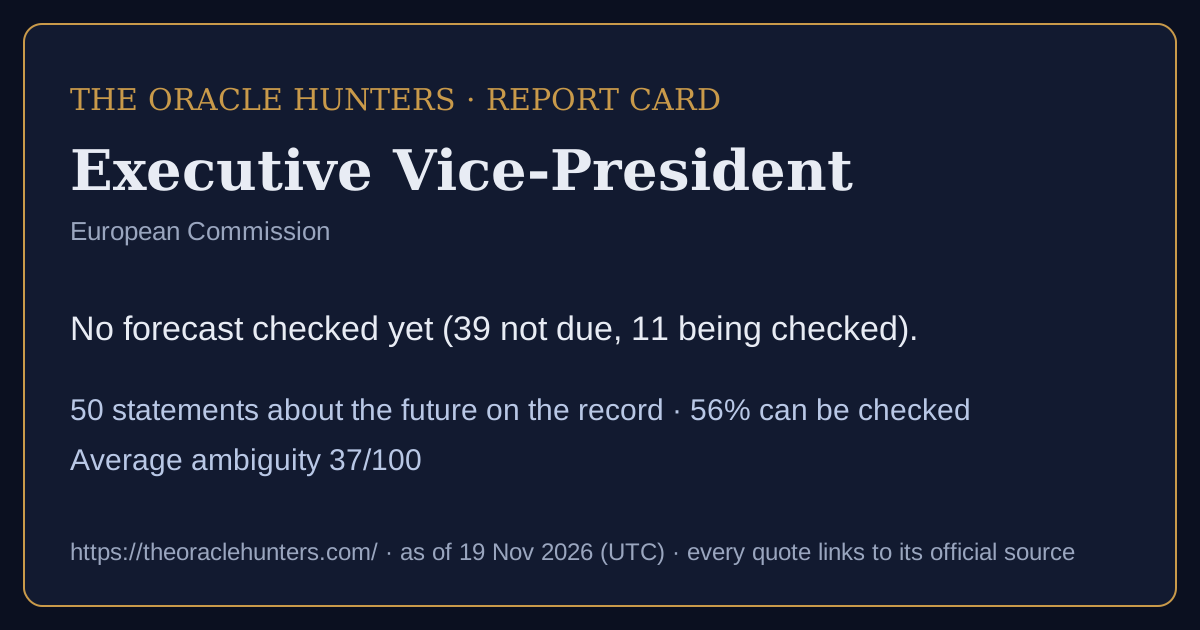
Track record: No forecast checked yet (39 not due, 11 being checked).
50forecasts & commitments on the record
56%can be checked as stated
37average ambiguity (0-100)
0goalpost moves recorded
0confirmed U-turns
Timeline
came true partly did not not due / being checked / too vague
Calibration score: shown after 10 checked forecasts with a stated likelihood (now 0).
How they speak about the future: based on data 45, stated on authority 4, educated guess 1.
Kinds of claim: forecast 34, mixed claim 13, commitment 3. · Download this report card as a picture
In the nine words
πρόγνωσιςInference from evidence43 · 86%μαντείαInspired knowledge3 · 6%προαναγγελίαPublic pre-announcement3 · 6%εἰκασίαConjecture1 · 2%
How to read this
Each box is one sentence a public figure or institution said about the future, word for word, with a link to the official text. Can be checked means it names what will happen, by when, and how likely - so it can be compared with official figures later. Too vague to check means it does not. Ambiguity (0-100) is how many different ways the sentence can be read. When the date passes, the forecast is compared with official data and marked came true, partly or did not come true. Labels judge the sentence, never the person. Full guide and glossary.On the record (50)
Under the Agreement, at least 51% of the ETS support will be invested in new renewable energy for the Greek islands – such as photovoltaic systems, or offshore wind farms.
It will kick off the Greek ETS Decarbonisation Fund, enabling access to up to 25 million allowances under the European Union's Emissions Trading System –estimated to be worth almost 2 billion euros – to finance the decarbonisation of the electricity supply on Greek islands.
The Agreement we have signed today will contribute to our European goal of reaching net-zero by 2050.
The leaders have spent a lot of time discussing this, and hopefully we will see concrete results by the end of the year.
While the World Bank estimates that the global food system will require 40-50% more water within the next three decades; municipal and industrial water demand will increase by 50-70%; and water demand for energy will increase by 85%.
According to the UN, global demand for clean water will surpass what is available by 40% in 2030.
In this case, we could expect the EU's adjusted GDP to increase by 15.5% by 2040, higher than that of the US, China or India.
Clean manufacturing projects requested 3.53 billion euros in funding, exceeding the available budget.
The 2023 Innovation Fund call launched last year had a dedicated budget envelope for manufacturing projects, with 1.4 billion euros allocated to those projects.
These projects are sufficient to meet 17% of the production capacity of photovoltaic panels needed under the Net-Zero Industry Act by 2030, 11% of electrolyser manufacturing, and 7% of battery manufacturing.
And, at the end of 2023, I was pleased to announce that 3 billion euros of Innovation Fund support will be provided over the next three years to European producers of sustainable batteries.
That is especially true for the cleantech industry, which will be worth €600 billion globally by 2030; triple the figure now.
The first-ever European Climate Risk Assessment – published by the European Environment Agency – provides a conservative estimate that worsening climate impacts could reduce the GDP of the European Union by about 7% by the end of this century.
In 2025, we will deploy the Galileo Emergency Warning Satellite service.
Later this year, the world will gather once more in Azerbaijan for COP29, focused on scaling up climate finance.
But if we approach this challenge the right way, we can build electricity grids in a decade that will be fit for climate neutrality by 2050.
Because if, by 2030, the EU is only responsible for 3% of global emissions, it will not matter very much if not enough is being done about the other 97%.
And the development of infrastructure is an essential condition for unlocking electrification – which will reach up to 70% by 2050 but which has stagnated at around 23% in the last decade.
At least 700 billion euros in additional investment each year will be needed to achieve the objectives of the European Green Deal and REPowerEU by 2030.
This represents an astronomical challenge given that Europe will have to at least triple its electricity generation by 2050.
This outreach – and received input – will also help the next Commission prepare legislative proposals for the policy framework beyond 2030 and deliver on the 2040 target, once agreed by the Member States and the new European Parliament, in a fair and cost-efficient manner.
We believe that this closer engagement will be instrumental to the implementation of the agreed 2030 framework.
And if we manage to do that, and I have addressed that in the plenary as well, we will also do a very important step in terms of energy independence and in terms of strengthening our strategic autonomy.
Following the two dialogues with hydrogen and energy intensive industries, we will soon hold additional ones on critical raw materials, clean tech, mobility, infrastructure, and forestry.
Because today, Europe is still too dependent on imported fossil fuels, but by 2040, this share will be reduced to 26%.
The share of electricity in energy consumption will double, from 25% in 2030 to 50% in 2040.
And we are ready to support it by financial means from the European budget, to the tune of more than 2 billion euros.
That will come on top of what we already promised in the past when talking about climate finance, to make sure that 100 billion dollars would flow from the developed to the developing world.
But also, something which is very important as I found in discussions with many leaders from developing countries, we will open the possibility to give access to electricity to an additional 800 million people on this planet.
We believe that by 2030, with our established policies, we will be approaching 80% of the electricity produced in Europe coming from renewable sources.
When it comes to energy – my field of responsibility – 70% of methane emissions from fossil fuel operations could be reduced with existing technology and 80% could be implemented at no net cost.
I am also pleased to see that the European financial institutions are also investing significantly on this international methane abatement: Almost €1.8 billion will be from the European Investment Bank, and more than €200 million from the European Bank for Reconstruction and Development will go in support of our partners.
For instance, as of 2024, separate collection of organic waste will be compulsory in all EU Member States.
Let me also highlight the role that the European Investment Bank has been playing only this year, investing over €1.7 billion in methane related projects.
Finally, from the beginning of 2030, imports into the EU of oil, gas, and coal will be required to meet a methane intensity threshold.
For instance, on food waste: from 2024, the separate collection of bio-waste will be compulsory across the EU.
For a start, subsequent auctions for the rest of the 3 billion-euro budget under the Innovation Fund will depend on the success of this first pilot.
This Thursday, we will launch the first pilot auction under the Bank's umbrella, supporting innovative and competitive companies to the tune of 800 million euros in EU funding.
And this trend is only going to accelerate, with demand for lithium, for example, expected to be 12 times higher by 2030 and 21 times by 2050, and demand for rare earth metals set to be 5 times greater by 2030 and 6 times by 2050.
In addition, at COP28 next month, we will launch the Critical Raw Material Club to strengthen this international cooperation at the highest level.
The trends confirm, I could say once again, that climate action and economic growth go hand-in-hand: because the GDP growth in 2022 was 3.5% while our emissions actually decreased by 3%
We will also double the next Innovation Fund call for clean technology manufacturing projects in November to 1.4 billion euros.
The EU target of at least 42.5% renewable energy by 2030 will require a massive increase in installed renewable capacity.
We will support the necessary build-out of electricity grids with a Grids Action Plan next month.
For example, while Europe's battery ecosystem is booming, it is set to be a battleground for European competitiveness, with China's share of the EV market expected to triple to 18% by 2025.
The Commission will present the impact assessment and Communication on this early next year, in line with the European Climate law.
The Social Climate Fund: we hope it will be operational in 2026 and there should be something around €86 billion for structural measures and investments and short-term measures, in particular helping vulnerable households, micro-enterprises and supporting transport users.
I am glad to report that the targets which we set for 2030, to reduce our greenhouse gas emissions by 55%, will be overachieved.
We are going to introduce zero emission rules for new cars and vans as of 2035, and further enlarge the scope of the EU Emissions Trading System.
Now, we want to build on the success of the GSP scheme and take it further – especially since the current set-up will expire by the end of 2023.
Also said - not checkable as stated (12 newest)
Remarks about the future with no date, figure or likelihood that could be checked. They are kept on the record and shown here, but not scored.
Afterward, our moderator, Ms Armida Salsiah Alisjahbana, will guide a panel discussion, then we will open the floor for brief interventions before concluding with panellists' final reflections.
Fiscal policy should be better aligned with social goals.
This will help to improve climate adaptation and resilience to extreme weather events.
However, revenues from carbon pricing – including other programmes, such as the Modernisation and Innovation Fund – will not be enough on their own to finance our ambitious climate targets.
Underlining that climate policy and industrial competitiveness are mutually reinforcing and must go hand in hand.
So making Europe's decarbonisation agenda work for the new global outlook, ensuring the conditions for our economy and industry to prosper, should be a focus as we move forward.
Among the key takeaways from the dialogues have been the need to address energy prices – which remain much higher than in some of our economic competitors.
Second, we need to complete the Capital Markets Union.
So making Europe's decarbonisation agenda work for the new global outlook, ensuring the conditions for our economy and industry to prosper, should be a focus for the coming mandate.
So keep talking to us – we are here to help you, and we will listen to you.
The results of the European elections held last week will shape many conversations in the coming days and months.
For young people, who not only want a planet that will be liveable in the future, but who will also still need a good education and quality jobs.