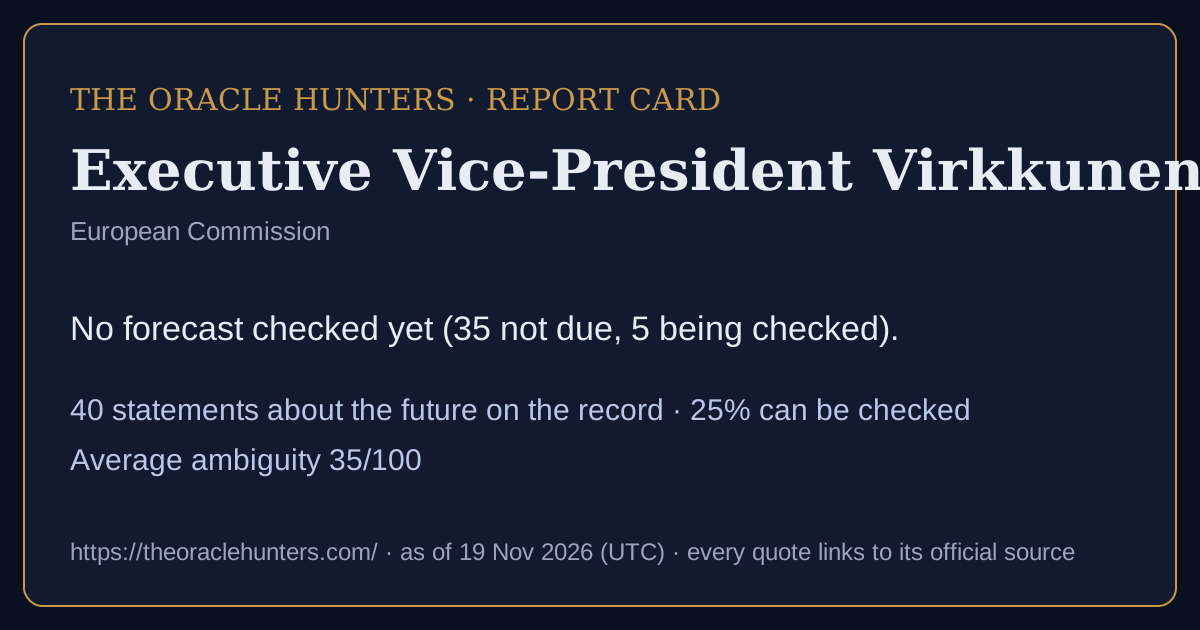
Executive Vice-President Virkkunen
European Commission · EU
Track record: No forecast checked yet (35 not due, 5 being checked).
40forecasts & commitments on the record
25%can be checked as stated
35average ambiguity (0-100)
0goalpost moves recorded
0confirmed U-turns
Timeline
came true partly did not not due / being checked / too vague
Calibration score: shown after 10 checked forecasts with a stated likelihood (now 0).
How they speak about the future: based on data 28, stated on authority 12.
Kinds of claim: forecast 25, mixed claim 12, commitment 3. · Download this report card as a picture
In the nine words
πρόγνωσιςInference from evidence28 · 70%μαντείαInspired knowledge9 · 22%προαναγγελίαPublic pre-announcement3 · 8%
How to read this
Each box is one sentence a public figure or institution said about the future, word for word, with a link to the official text. Can be checked means it names what will happen, by when, and how likely - so it can be compared with official figures later. Too vague to check means it does not. Ambiguity (0-100) is how many different ways the sentence can be read. When the date passes, the forecast is compared with official data and marked came true, partly or did not come true. Labels judge the sentence, never the person. Full guide and glossary.On the record (40)
A first group of Member States will begin operations in 2030 and other will follow gradually, with all Member States connected by 2036.
And – to strengthen the rule of law further – before the end of this year the Commission will present a series of anti-corruption initiatives in the coming months:
And, we will build on the administrative agreement on advanced electronic signatures and seals from January this year.
This is why the Commission will set up a secure platform to test AI for cybersecurity already by the end of 2026.
To build expertise, the EU will launch a call to boost its AI evaluation capacity—especially in cybersecurity—aiming to be operational by 2027.
By 2030, we expect this demand to more than double.
With these actions, we will help our Member States grow their digital economies without raising energy costs for local consumers or other sectors.
These licenses are now set to expire in May 2027.
It will be a good opportunity to test Agile, in order to continue it with much bigger financial resources during the next MFF period from 2028 to 2035.
We hope that Agile will demonstrate its success in the one short year of 2027.
Since we are able to use only €115 million for 2027, we can expect that only 20-30 European SMEs will be able to enjoy the benefits of the Agile programme in 2027.
We need to remember that Member States, if they implement NATO pledges by 2035, they will have the possibility to spend 50-100 times more for defence, than we will spend on the EU level through the next MFF.
Because for 2027 we shall be able to use only €115 million for this program.
On employment and access to talent, the Fair Labour Mobility Package will digitalise procedures and explore 100 % telework cross-border, helping start-ups hire, for instance, digital nomads under familiar rules.
The security aspects of online gaming will also be a key part of the overall strategy on video games the Commission will present later this year.
We will put forward later this year an Action Plan on the Protection of Children against Crime, which will include measures to address radicalisation and recruitment into crime both online and offline.
But our proposal later this year, will address compliance gaps, particularly for small, camera-equipped drones.
This year we will also carry out a progress review of our Drone Strategy 2.0.
Therefore, we will launch a new Counter-Drone Centre of Excellence in 2027.
By 2028, fully digital visa procedures will make travel easier for those who need a visa.
ETIAS will transform travel for visa-free visitors starting later this year.
I'll be in India next month for the AI Summit and, together with Magnus, we will kick off the important work ahead on the Legal gateway office, starting with the ICT skills.
Copper switch-off should start by 2030 and will be driven by mandatory national plans to support fibre roll out by 2035.
We will build a new European Civil Society Platform in 2026 — a space where civil society organisations can engage directly with the Commission on EU values and rights.
The plan is to increase joint procurement from 20% to 40% by the end of 2027.
Roadmap has a promise - Reparation Loan will be realised before the end of 2025.
Roadmap indicates: Europeans are going to invest till 2035 - 6.8 trillion euro.
Today, the college has adopted a vital roadmap that will guide us to European defence readiness by 2030, thanks to very concrete goals and milestones.
And I am sure that we shall deliver Defence Readiness 2030.
Our objective is, that by end 2027, we will have an EU-wide military mobility area, with harmonised rules and procedures and a network of land corridors, airports, seaports, and support elements for troops and military equipment to move swiftly across the EU.
This Commission takes re-armament of Europe very seriously: in the new MFF proposal, defence and space spending will increase fivefold to 131 billion euros.
Member States will receive tailored implementation strategies that allow them to publish localised age verification apps by early 2026.
Later this year, the Commission will present the European Democracy Shield – an important initiative to support resilient democracies in the EU.
By 2040, this sector is projected to create thousands of highly skilled jobs across the EU and exceed a global value of €155 billion.
The Commission's ReArm Europe Plan/Readiness 2030 initiative will help mobilisation of an unprecedent volume of resources: up to €800 billion for additional defence spending over the next four years.
Further to the European Council call on the European Commission to accelerate the work on all strands to decisively ramp up Europe's defence readiness within the next five years, this Defence Readiness Omnibus will support Member States' efforts to strengthen the defence industrial base and the EU's overall defence readiness and agility by 2030.
The Action Plan also announces the opening of an AI Service Desk, as of July this year, to answer questions that stakeholders might have on the AI Act.
Our citizens expect us to act: 64 per cent are troubled about the EU's security.
In parallel, we will continue to enforce the Digital Services Act - we will hold platforms accountable for their role in online security.
We will revise the Cybersecurity Act, help Member States implement the new rules on critical infrastructure, and strengthen transport security.
Also said - not checkable as stated (12 newest)
Remarks about the future with no date, figure or likelihood that could be checked. They are kept on the record and shown here, but not scored.
We will also create an Online monitoring and response centre to monitor publicly accessible social media content, detect developments relevant for external border management, and support action against illegal online content linked to border-security risks.
In addition, we will also make sure that Frontex has state-of-the-art equipment and technology at its disposal.
And we will have a clearer picture of what happens to people staying illegally in the EU.
And by the way, we are planning to do the same for our asylum procedures – more on that next year.
For the first time, Frontex will have an explicit mandate to monitor social media for content that endangers people or border security.
And very important: if there is a threat to our borders and therefore our security – there will be a quick reaction force to intervene very quickly -> we want Frontex to be there in hours, not in weeks!
Europe will keep working with like-minded partners on model evaluation, early warning and AI security.
Building on this report and the work of the Apply AI Strategy, we will soon launch dedicated industrial AI alliances in strategic areas, to steer deployment and address persistent bottlenecks.
We will accelerate our work towards international rules for responsible development.
This includes risks from losing control of models, biological weapons, mass manipulation that could affect elections, and cyberattacks.
The Cloud and AI Development Act, once adopted, will complement this, tripling Europe's computing capacity over the next 5-7 years and streamlining the conditions for the deployment of sustainable data centres.
Nearly 100 events in over 15 European countries are part of this initiative, and I will have the honour to conclude the Month on 17 November at the Apply AI Summit in Brussels.