Executive Vice-President Mînzatu
European Commission · EU
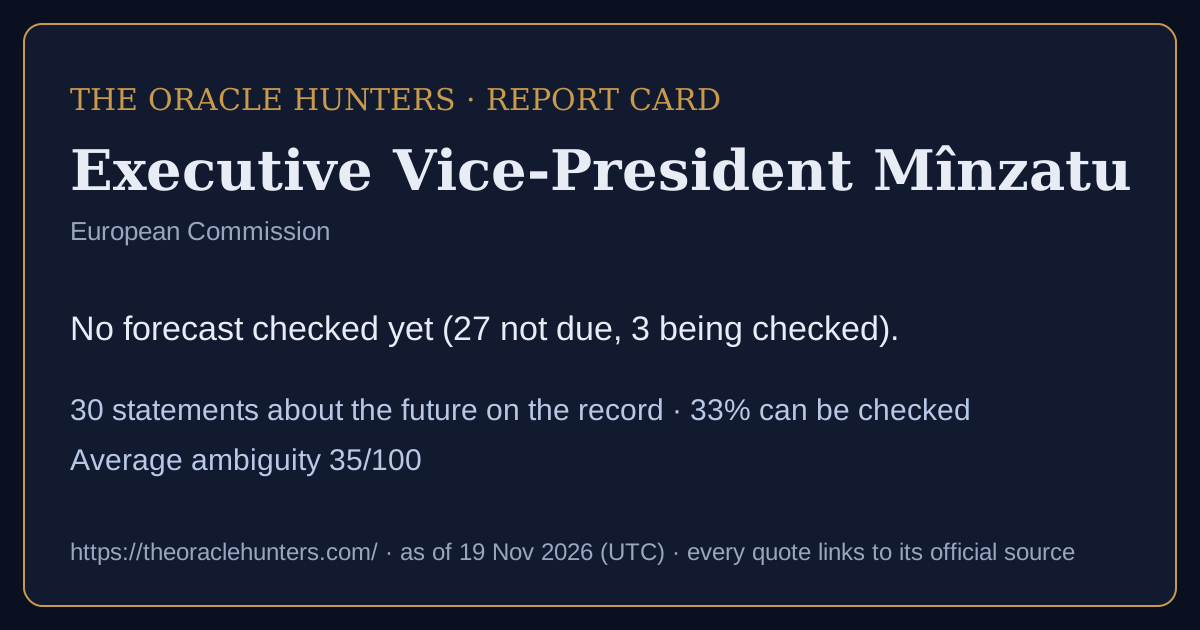
Track record: No forecast checked yet (27 not due, 3 being checked).
30forecasts & commitments on the record
33%can be checked as stated
35average ambiguity (0-100)
0goalpost moves recorded
0confirmed U-turns
Timeline
came true partly did not not due / being checked / too vague
Calibration score: shown after 10 checked forecasts with a stated likelihood (now 0).
How they speak about the future: based on data 17, stated on authority 13.
Kinds of claim: forecast 18, mixed claim 10, commitment 2. · Download this report card as a picture
In the nine words
πρόγνωσιςInference from evidence17 · 57%μαντείαInspired knowledge11 · 37%προαναγγελίαPublic pre-announcement2 · 7%
How to read this
Each box is one sentence a public figure or institution said about the future, word for word, with a link to the official text. Can be checked means it names what will happen, by when, and how likely - so it can be compared with official figures later. Too vague to check means it does not. Ambiguity (0-100) is how many different ways the sentence can be read. When the date passes, the forecast is compared with official data and marked came true, partly or did not come true. Labels judge the sentence, never the person. Full guide and glossary.On the record (30)
From 2028, the proposed European Competitiveness Fund could support vocational training for the first time.
Next year, we will launch a European Care Deal.
Within the existing cap of 1.5% of GDP, a dedicated annual cap of 0.3% of GDP could apply specifically for these energy support measures.
This entails a clear risk of no effective action for this year and could require a stepping up of its excessive deficit procedure at a later stage.
However, for Hungary, the net expenditure growth rate is projected to be at risk of material non-compliance with the Council's recommendations this year.
Then, Malta reduced its general government deficit below 3% of GDP in 2025 and it is projected to remain below 3% of GDP both this year and next.
Later this year, the Commission will launch a new Coalition Against Poverty, bringing together businesses and philanthropic organisations around concrete commitments to reduce poverty.
The scale of what is possible is clear: investing an additional 0.25% of the EU's GDP could help 18.5 million people leave poverty behind.
Later this year, the Commission will launch the first-stage consultation of European social partners – that is, the first step towards tabling a Directive on effective activation measures for those excluded from the labour market.
Closing the gender gaps in employment and pay could increase EU GDP per capita by up to 10% and create up to 10 million additional jobs by 2050.
Also this year we will adopt the first-ever EU Anti-Poverty Strategy, a Council recommendation on fighting housing exclusion, and a strengthened Child Guarantee.
Let me invite you to imagine what Europe could look like in 2030 if we truly invest in digital skills.
Next year, we will go one step further: with an Education Package and a Roadmap on the future of digital education and skills.
These will be complemented, in 2027, by a new EU citizenship competence framework, with updated EU guidelines on democratic citizenship education.
To support this, the Commission will introduce, as part of the 2026 Education package, a Basic Skills Support Scheme for schools, with a strong focus on citizenship and digital skills.
As part of the same Education Package, we will have a 2030 Roadmap focused on digital education and skills to empower learners, teachers and institutions.
The 2026 European Semester will be driving the reforms and investments at national and regional levels, consistent with the Competitiveness Compass
Let me recall that this year the Semester is key for the next MFF, since the country-specific recommendations will form the basis of Member States' national plans.
Of course, we will remain vigilant in monitoring the emergence of imbalances, especially in areas like house prices and cost competitiveness, as well as external imbalances.
This is particularly important for Member States under an excessive deficit procedure, where a lack of effective action, if confirmed in spring next year, may entail procedural and financial consequences.
Next week we will put forward a Quality Jobs Roadmap and next year a Quality Jobs Act.
In AI alone we will need around 7 million workers by 2027.
The final decisions will be taken by the end of 2027.
The Commission will come forward with its final assessment based on outturn data for 2025 next year, as part of the European Semester Spring 2026 Package.
Our Spring Forecast projects unemployment falling to a historic low of 5.7% next year.
As you might remember, President von der Leyen announced in the press conference on the first hundred days of the mandate that we will hold a College of Commissioners regularly dedicated to security.
A real Union of Skills is one where skills can circulate freely, and that is why we will put forward a skills portability initiative next year, in 2026.
The pilot will start with a budget of EUR 10 million this year.
And we have such an important package of EU legislation that has been recently adopted, the directives that need to be transposed and implemented, and we will come with a gender equality strategy for 2026-2030, the next generation with new measures, new actions, and we need to think about how we mainstream the gender dimension in our funding policies, in …
This Basic Skills Scheme we will first of all pilot, starting this year, learn from the lessons of the pilot and then scale it up with the funds that we have, with the national budget, with the resources that we can gather.
Also said - not checkable as stated (12 newest)
Remarks about the future with no date, figure or likelihood that could be checked. They are kept on the record and shown here, but not scored.
From next school year, we will pilot an AI literacy certificate.
The Commission will support them through European funding, practical cooperation and closer monitoring of progress.
Teachers will be able to train together on AI tools that protect pupils' data.
Pupils could show, for example, that they can spot a mistake in an AI answer and explain how they checked it.
Small firms could share trainers, arrange placements abroad and test ways for apprentices to practice tasks using AI and virtual reality.
Thanks to AI, we will also allow citizens to upload their documents in any EU language and translation will be automatically provided.
With the Skills Portability Act we will digitalise all qualifications from secondary school to PhD to the benefit of all European citizens.
And, finally, we have identified 10 new professions, such as civil engineers, biomedical laboratory technicians or electricians, for which we will work with member states so they will be covered by automatic recognition.
We will create common rules across the EU to get their titles recognised: same timelines in all member states, rights to appeal, adaptation measures and same document requirements.
When ELA performs its controls, they need to be able to inspect the working conditions of migrant workers.
We will help companies, especially SMEs, implement the Pay Transparency Directive.
And we will adopt a new strategy to make vocational education and training more attractive.