Executive Vice-President Fitto
European Commission · EU
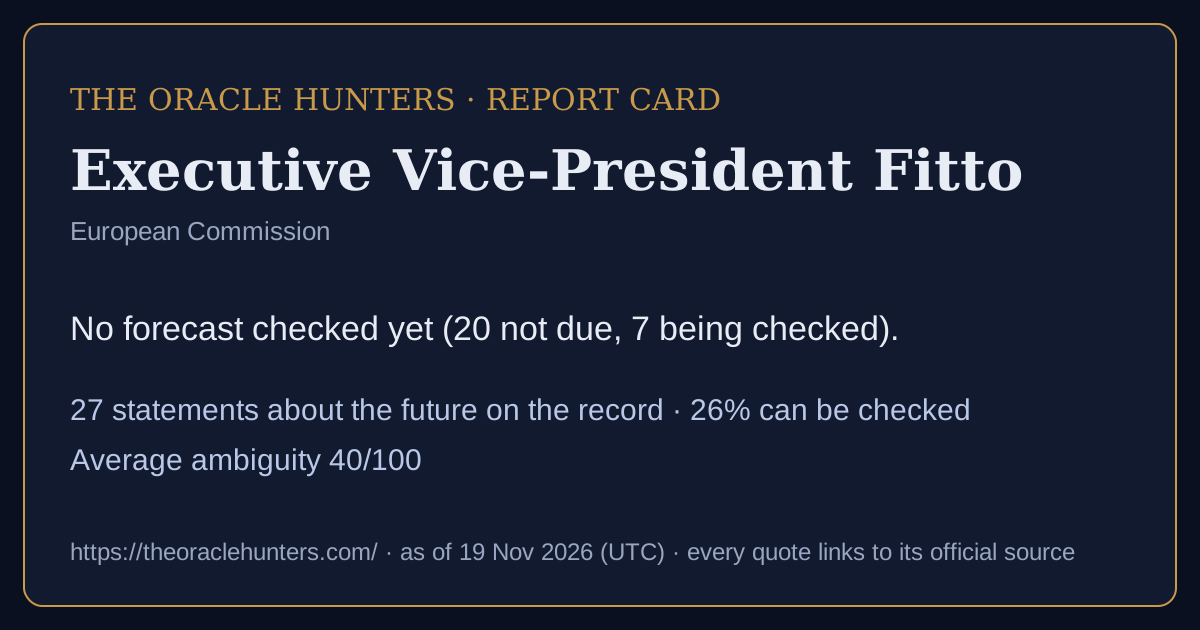
Track record: No forecast checked yet (20 not due, 7 being checked).
27forecasts & commitments on the record
26%can be checked as stated
40average ambiguity (0-100)
0goalpost moves recorded
0confirmed U-turns
Timeline
came true partly did not not due / being checked / too vague
Calibration score: shown after 10 checked forecasts with a stated likelihood (now 0).
How they speak about the future: based on data 16, stated on authority 11.
Kinds of claim: forecast 16, mixed claim 9, commitment 2. · Download this report card as a picture
In the nine words
πρόγνωσιςInference from evidence15 · 56%μαντείαInspired knowledge9 · 33%προαναγγελίαPublic pre-announcement2 · 7%πρόβλεψιςSeeing the signs1 · 4%
How to read this
Each box is one sentence a public figure or institution said about the future, word for word, with a link to the official text. Can be checked means it names what will happen, by when, and how likely - so it can be compared with official figures later. Too vague to check means it does not. Ambiguity (0-100) is how many different ways the sentence can be read. When the date passes, the forecast is compared with official data and marked came true, partly or did not come true. Labels judge the sentence, never the person. Full guide and glossary.On the record (27)
By the end of the year, I will sign a new Cooperation Framework with UN Tourism to advance the sector's competitiveness, sustainability and resilience.
All these valuable inputs will inform the Strategy, which will be adopted at the beginning of next year —
In 2027, the Commission will present a Blue Generational Renewal Strategy to help attract and retain a new generation across the blue economy.
All of this will inform the Strategy, which will be adopted at the beginning of next year.
A proposal on pigs will follow next year.
We will extend the Clean Energy for EU Islands initiative through 2030.
And fifth: energy infrastructure. 1.1 billion euros will support interconnectors and industrial decarbonisation.
Third: affordable housing. 3.3 billion euros will support projects such as the acquisition and renovation of existing housing.
Second: defence. 11.9 billion euros will support dual-use investments — drones, space assets and military mobility.
In total 3.3 billion euro have been re-directed to Housing projects.
And, by the end of the year, we will also deliver a strategy on the right to stay.
Member States have until the end of the year, and we will have a full picture in the coming weeks.
And by 2035, another example, Sofia and Athens will be just six hours apart by train, instead of almost 14 today.
In addition, together with the Member States, we will launch an eSAF Early Movers Coalition pilot project to mobilise at least €500 million for synthetic fuel projects.
We will make greater use of our TEN-T coordinators, elevate to the political level the expert group on the competitiveness of the rail supply industry, and very important, strengthen the role of ERA.
Investment decisions and construction must start by 2027, or we will miss the 2030 targets.
We will therefore review public procurement rules next year, and encourage our industry to produce more standardised high-speed trains, enabling faster, cheaper production with lower maintenance costs.
We will propose legislation to improve cross-border rail ticketing and booking systems, it is coming at the beginning of 2026 making it easier for passengers to plan and book seamless cross-border journeys just with one click.
And with the ambitious EU agenda for cities, which we intend to approve by the end of the year, we will enhance their role – and give them a stronger voice in EU policies.
We will carry these lessons forward, as we reflect on potential successors to the Talent Booster Mechanism, when it concludes in mid-2026.
The study finds that between 2020 and 2030, the total impact of the RRF can be anticipated to amount to around 890 billion Euro, with all Member States benefitting.
By the end of December 2025, we expect to receive 19 additional payment requests4 to be disbursed in 2026, accounting for around 118 billion Euro, of which 56 billion Euro in grants.
Looking ahead, between now and the end of 2025, we expect to disburse payments to 18 countries3 totaling more than 34 billion Euro, of which 18 billion Euro in grants.
The Commission's Work Programme for this year outlines a long list of proposals that will focus on simplification.
Later this year, we will introduce further packages, including for the defence and digital sectors.
For Eastern border regions, this pre-financing will be 10%, with an EU co-financing rate of up to 100%.
The reprogramming process is expected to be completed by the end of 2025, allowing for updated program implementation from 2026 onwards.
Also said - not checkable as stated (12 newest)
Remarks about the future with no date, figure or likelihood that could be checked. They are kept on the record and shown here, but not scored.
So, we will establish an EU Tourism Academy to provide essential training, help businesses and destinations develop the right skills, attract talent to tourism professions, and improve working conditions in the sector.
We will help them through a more business-friendly environment with fewer unnecessary burdens, including an EU Simplification Initiative involving Member States and the sector itself.
We will also provide guidance and technical support and help businesses finance their clean and digital transitions.
Europe , as you know remains the world's leading tourism destination, but we cannot and we will not take that position for granted.
We will deepen tourism partnerships and dialogues with many parts of the world, including Japan and India, and very soon the Gulf countries.
We will now have 27 National and Regional Partnership Plans.
We will also keep the three categories of regions and preserve the fundamental principles of Cohesion policy:
People should have real opportunities where they live — jobs, adequate infrastructure and quality public services.
The Commission will work on a legislative proposal to ensure a coherent and simplified regulatory legislative framework for aquaculture across the EU to unlock its full potential.
International labour standards in fisheries must be ratified and implemented by all nations, and we will support non-EU countries to match these standards.
Finally, as far as the energy transition roadmap is concerned, the transition will take place in two phases:
In the first phase, the focus will be on energy efficiency, research and innovation, and pilot projects and demonstrators.