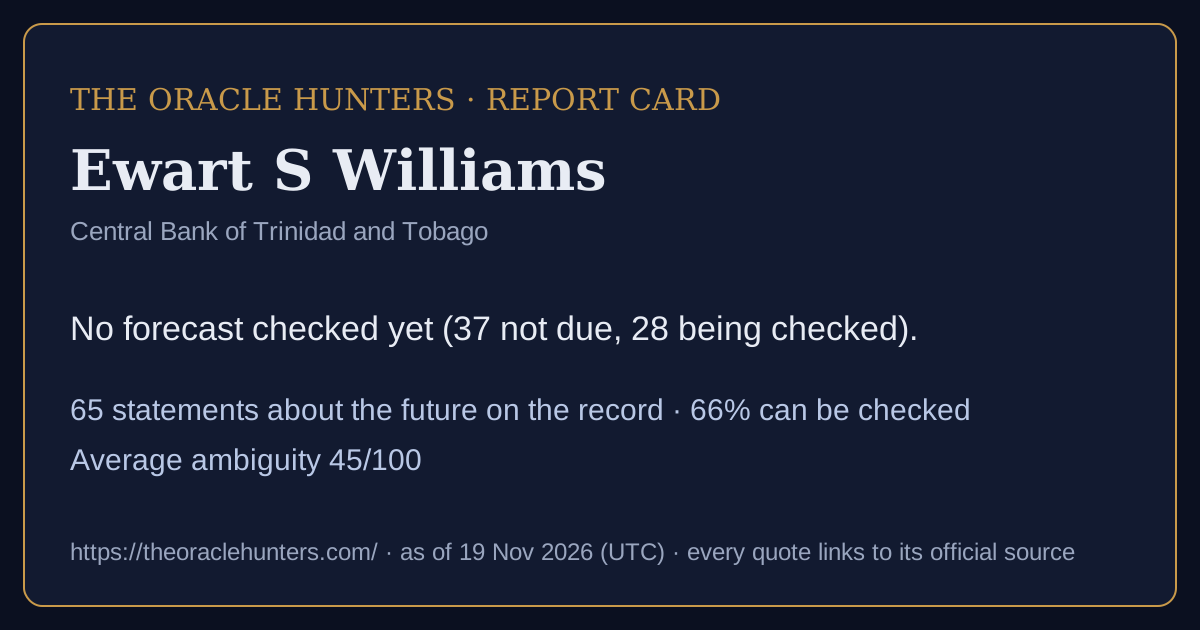
Ewart S Williams
Central Bank of Trinidad and Tobago
Track record: No forecast checked yet (37 not due, 28 being checked).
65forecasts & commitments on the record
66%can be checked as stated
45average ambiguity (0-100)
0goalpost moves recorded
0confirmed U-turns
Timeline
came true partly did not not due / being checked / too vague
Calibration score: shown after 10 checked forecasts with a stated likelihood (now 0).
How they speak about the future: based on data 51, educated guess 8, stated on authority 6.
Kinds of claim: forecast 47, scenario (if… then) 11, mixed claim 6, commitment 1. · Download this report card as a picture
In the nine words
πρόγνωσιςInference from evidence45 · 69%πρόνοιαPreparing for the future11 · 17%μαντείαInspired knowledge6 · 9%φρόνησιςPractical wisdom1 · 2%πρόβλεψιςSeeing the signs1 · 2%προαναγγελίαPublic pre-announcement1 · 2%
How to read this
Each box is one sentence a public figure or institution said about the future, word for word, with a link to the official text. Can be checked means it names what will happen, by when, and how likely - so it can be compared with official figures later. Too vague to check means it does not. Ambiguity (0-100) is how many different ways the sentence can be read. When the date passes, the forecast is compared with official data and marked came true, partly or did not come true. Labels judge the sentence, never the person. Full guide and glossary.On the record (65)
The bill is still accumulating but for the region as a whole, the cost could be somewhere in the vicinity of 10-15 per cent of regional GDP.
If current trends in the energy sector persist, the transformation of the non-energy sector will become all the more urgent , if sustainable growth is to be achieved.
Based on these underlying assumptions and a modest turnaround in the energy sector, the Central Bank's projection is for real GDP growth of around 1.5 per cent in 2012, although the balance of risks are tilted on the downside.
The Caribbean region is projected to grow modestly at around 3 per cent in 2012, with Guyana and Suriname being the only countries showing robust growth.
Without action by Congress, the OECD projects that economic growth would be barely measurable at 0.3 per cent next year, and 1.3 per cent in 2013.
The OECD projects that the US economy will grow at a 2 per cent rate next year.
For 2012 as a whole, the Eurozone economy is projected to grow by at most 0.2 per cent and about 1 per cent in 2013.
Real GDP in the Eurozone is projected to contract at an annualized rate of 1 per cent in the last quarter of 2011 and by a further 0.4 per cent in the first three months of 2012.
Work to upgrade financial legislation has picked up pace in recent months and it is now expected that the Insurance Bill would be presented to Parliament before the end of this year; and new credit union legislation by early next year; and a separate law for contributory pension schemes, later in the year.
Then there is the need for building organizational capacity to prepare for the new regulatory paradigm that is expected to be in place later this year.
I also hope we could continue to work together to bring the Credit Union Legislation and the regulatory framework into operation this year.
We therefore project that energy sector value added would increase by 3.2 per cent in 2011, slightly more than last year.
There is now, however, heightened concern about a global oil and food price shock which could have a significant impact on domestic food prices (corn prices are 94 per cent higher than June 2010 lows: soya beans are up 50 per cent and wheat is up 80 percent).
However, the nature of the expected fiscal stimulus in 2011 would imply some increase in employment in the construction sector which should, at least, contain the unemployment rate at about 7 percent.
The continued stagnation in the non-energy sector could, however, have adverse consequences for unemployment which could easily rise to the 6 - 6.5 per cent range.
When these are factored in, the projected overall deficit for the year as a whole could be about $5.8 billion or about 4 per cent of GDP, compared with the budgeted deficit of 5.3 per cent of GDP.
In this context the FY 2011 budget will be challenged to secure the right balance between the need for maintaining an adequate level of capital expenditure and stimulating business activity, on the one hand, and the medium term objective of fiscal consolidation on the other.
Moving forward, a strong recovery of the non-energy sector will be the key to a faster rate of growth of output and employment in 2011.
An effective licensing and supervisory regime for money remitters is being developed and is expected to be implemented by June 2010.
Dear Members of the 2009 Graduating Class; as many of you may know, my job requires me to do a fair amount of public speaking, but 99 per cent of the time, my remarks are in the realm of the dismal and boring arena of economics.
Now in the US, UK and Eurozone there are signs of recovery - green shoots, we are told but we are advised not to rule out the possibility of a double-dip recession, meaning another likely downturn in 2010, or an L-shaped recession, meaning that we may just face a prolonged period of slow, tepid growth or virtual stagnation.
On January 30, 2010 the National Financial Literacy Programme will be officially three years old.
There is not a scrap of evidence of economies of scale or scope in banking - of bigger or broader being better beyond a low size threshold. 12 At least during this crisis, big banks have if anything been found to be less stable than their smaller counterparts, requiring on average larger-scale support. 13 It could be argued that big …
For that reason, I am happy to announce that the EAA will incorporate non-financial estimates from 2010 onwards.
To assist budding entrepreneurs, the project is currently finalizing three booklets, which are expected to be launched before the end of the year.
To this aim, by mid 2010 the central banks of the Eurosystem will start reducing the transmission time lag of their input for financial accounts by one month, from 110 days to 80 days.
If the slowdown is prolonged and is accompanied by a significant increase in unemployment, one would expect that non-performing loans will rise .
The non-energy fiscal deficit is projected at around 12 per cent of GDP while the overall deficit is projected to widen to around 1-1.5 per cent of GDP.
In terms of our outlook for 2009 we anticipate that energy sector growth will probably remain flat in 2009 while non-energy sector growth could be about 3 per cent less than one-half that of 2008.
Yesterday the Government announced that as a result of the continuing fall in energy prices the revenue shortfall is likely to be some $2.3 billion greater than originally envisaged .
Thus, on November 30, 2008 in response to an expected shortfall in energy sector revenues of TT$5.3 billion, the Government announced expenditure cuts of TT$5.0 billion.
Emerging markets and developing countries are expected to fare slightly better with real GDP growth projected at about 3 per cent, much of which will come from China and India.
There is now a consensus that growth in some of the major economies will be negative in 2009, with recovery not expected until 2010 .
Over the last few days, you would have seen that all three US automakers , one of the flagship sectors in the US economy, are on the verge of bankruptcy and could go down if they do not receive US$25 billion of support from the Government.
As a result of these factors, government revenues are now projected to decline by about 15 per cent, compared with the budget.
In a worst case scenario, this could put as many as 3 million people out of jobs.
In the Overview, we make the point that a quick return to single-digit inflation is critical for reversing inflation expectations and bringing inflation down to 6-7 per cent in the medium term.
- The Central Bank's projection is for a slowing of real GDP growth to 3.5 per cent in 2008, down from 5.5 per cent in 2007.
In terms of policy responses, during the fiscal year ended September 2008, while fiscal policy may have resulted in a larger overall surplus, permitting an increase in transfers to the HSF, it made little dent in the non-energy fiscal deficit which currently stands at 14.7 per cent of GDP.
Against this background, our projection is for real GDP to decline further in 2009 to about 2 per cent.
Even so, the entire increase in global growth in 2009 is expected to come from these economies.
If this occurs, the reduction could prompt a fall in international oil and energy prices.
If this goes beyond a certain level, our manufacturing sector which contributes US$1 billion in exports, but provides substantial employment, could be affected.
President Bush, in making the case for the US$700 billion rescue package warned that 'the entire US economy was now in danger': he cautioned that the current crisis could wipe out banks, empty retirement nest-eggs, send home-values into a free-fall and create millions of new jobless.
We are hoping to have a new FIA in place before the end of the year and we expect to have a new Insurance Act and perhaps new Credit Union legislation by the middle of next year.
In the Caribbean, for instance, inflation has moved from an average of around 5 per cent in 2002-2006, to 6.8 per cent in 2007, and is expected to reach close to double digits in 2008 (Charts 5 and 6).
In Jamaica, for instance, headline inflation for the 12-month period ended March 2008 was 20 per cent ; here at home, our latest data show headline inflation at 10 per cent and an IMF mission that just left Barbados projected a rise in inflation to 9 per cent this year from 4 per cent last year.
In my view, it is an instrument that could go a long way to helping Trinidad and Tobago achieve its Vision 2020.
"Back of the envelope" calculations suggest that it will take an average annual deposit of about US$800 million, (or about 20 per cent of projected annual energy tax collections) to reach a balance of around US$25 billion by 2023 (i.e. after 15 years).
Countries like ours, that are heavily dependent on primary products, also hold reserves for precautionary purposes - so that we could avoid any disruption to international trade if there is a sudden fall in oil and gas prices.
Showing the newest 50 - the ledger has all 65.
Also said - not checkable as stated (12 newest)
Remarks about the future with no date, figure or likelihood that could be checked. They are kept on the record and shown here, but not scored.
He believed strongly that the Central Bank had a sacred responsibility to the people and should be free of political influence
The rules specify that the complaint must first be referred to the financial service provider for resolution and only if the complainant is not satisfied, could the Ombudsman be approached.
Feature address by Mr Ewart S Williams, Governor of the Central Bank of Trinidad and Tobago, at the 9th Annual Breakfast Meeting, Office of the Financial Services Ombudsman, Port-of-Spain, 3 May 2012.
Since the Ombudsman keeps a record of complaints, the Office could potentially provide an impetus for reforming banking practices .
Giving statutory backing to the Ombudsman scheme will also facilitate the introduction of appropriate sanctions for non-compliance .
However, the rules specify that the complaint must not be related to interest rates, fees and charges and other pricing decisions.
This approach says that traditional regulatory and supervisory frameworks adopted by oversight bodies are not sufficient for financial stability but rather should be complemented by 'strengthened, dedicated and proportionate policy action geared to enhance financial consumer protection'.
Coming on the heels of the global financial turmoil, it was a clear reminder of the need to strengthen our financial and regulatory systems, so that they could withstand exogenous shocks and it underscored the idea that a co-ordinated regional approach was needed.
The project is being funded mainly by the Inter-American Development Bank (IDB) that has partnered with the University of the West Indies (UWI) and Caribbean Centre for Money and Finance (CCMF) to make this initiative possible.
This is an important initiative and I hope that over time these kinds of exercises could become routine examples of regional regulatory cooperation.
Deposit insurance schemes could contribute significantly to the maintenance of regional financial stability, as they protect lower-income depositors and prevent bank-runs.
A regional crisis management plan is another indispensable part of a regional financial stability, but it is the element that is likely to present the greatest challenges .