Ewald Nowotny
Republic of Austria (Oesterreichische Nationalbank/OeNB)
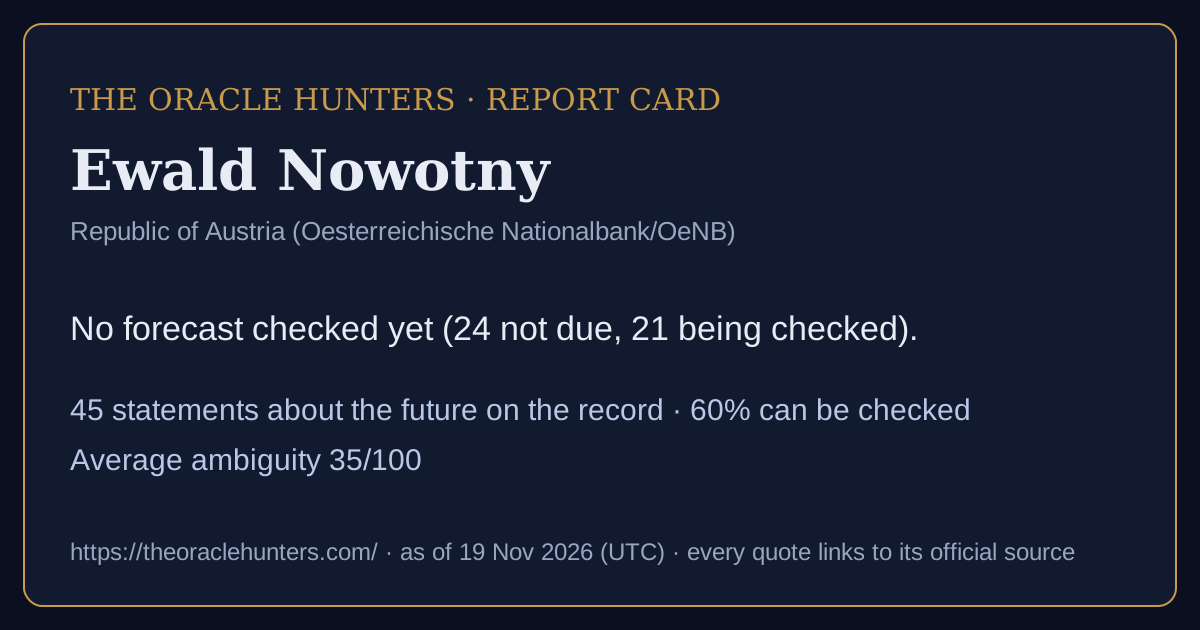
Track record: No forecast checked yet (24 not due, 21 being checked).
45forecasts & commitments on the record
60%can be checked as stated
35average ambiguity (0-100)
0goalpost moves recorded
0confirmed U-turns
Timeline
came true partly did not not due / being checked / too vague
Calibration score: shown after 10 checked forecasts with a stated likelihood (now 0).
How they speak about the future: based on data 32, stated on authority 12, educated guess 1.
Kinds of claim: forecast 32, mixed claim 10, commitment 2, scenario (if… then) 1. · Download this report card as a picture
In the nine words
πρόγνωσιςInference from evidence32 · 71%μαντείαInspired knowledge10 · 22%προαναγγελίαPublic pre-announcement2 · 4%πρόνοιαPreparing for the future1 · 2%
How to read this
Each box is one sentence a public figure or institution said about the future, word for word, with a link to the official text. Can be checked means it names what will happen, by when, and how likely - so it can be compared with official figures later. Too vague to check means it does not. Ambiguity (0-100) is how many different ways the sentence can be read. When the date passes, the forecast is compared with official data and marked came true, partly or did not come true. Labels judge the sentence, never the person. Full guide and glossary.On the record (45)
In any case, the Euro Summit on June 29 agreed that the Banking package will be adopted before the end of the year and the ESM will provide the common backstop to the Single Resolution Fund.
And this will become manifest in an even broader perspective when we celebrate the centenary of the establishment of the Republic of Austria next year.
To tackle inequality, the IMF reminds us that we will have to envisage policies which strengthen the position of those at the bottom of the income and wealth distribution in the labor market, and more substantial redistributive measures. v Otherwise, we risk losing public support
And indeed, the EU's share in global economic activity has been declining, namely from 26% in 2004 to 22% in 2015, and it is expected to fall below 20% by 2030.
Largely due to migration, Austria's population is expected to grow by as much as 12% until 2040 according to the latest forecasts. iii
For 2015 our inflation forecast for the euro area is 0.1%, for 2016 it is 1.1%.
In particular, I would like to caution against those voices arguing that EMU needs to be fundamentally re-built, or even re-established from scratch, within the next two years and arguing that 'otherwise it will fail'.
While an annual real growth rate of 2% might at first sight seem modest and inconsequential, it generates tremendous energy if it
My particular welcome goes to State Secretary Sonja Steßl , who will address this year's conference as our first speaker.
This year we are going to discuss the 'Long-Term Perspectives for Economic Growth' - and I would like to invite all of you to take part in this important discussion.
Having said that, one should not forget that because the level of economic activity differs widely between the euro area average and the CESEE region, the latter has the best longterm growth prospects in Europe - even if convergence will, most likely, proceed more slowly than in the past (with the annual growth differential dropping from up to 4 to …
Accordingly, in its recent World Economic Outlook the IMF revised downward the 2014 and 2015 GDP growth forecasts for several emerging market economies (among others, Argentina, Russia and Turkey).
It is only this year that the euro area is expected to move out of recession to a constellation of positive, albeit still very weak, growth, and we still see substantial differences in the economic performance of various EMU member countries - and also of neighboring countries.
I really do hope that this year's CEEI, which will discuss all these questions (and many others I had no time to mention), will help us shed new light on several of these issues and, at the same time, strengthen the case for dealing with them from a European rather than from a national perspective.
Although the heterogeneity of economic performance across the euro area remains a cause for concern, recent forecasts expect some rebalancing in 2014 on the back of a rather broad-based improvement in the macroeconomic outlook.
To assure banks that refinancing will always be available if needed, limiting the incentives for banks to hoard liquidity and hold back lending, the Eurosystem switched to a new tender procedure, in which all demands for liquidity were satisfied at the set policy rate as long as banks can provide sufficient eligible collateral.
The guidance (…) would cease to hold if any of the following three 'knockouts' were breached: (i) in the MPC's view, it is more likely than not, that CPI inflation 18 to 24 months ahead will be 0.5 percentage points or more above the 2% target;
7 China will be contributing foreign exchange reserves worth USD 41 billion, Brazil, India and Russia USD 18 billion each, and South Africa USD 5 billion.
Specifically, it is stressed that interest rates could be increased once inflation is expected to be above 2.5% or inflation expectations no longer remain well anchored.
But anyhow, it is expected that the roughly 130 banks participating in the SSM will cover more than 80% or more than 25 trillion euro of the euro area's banking assets.
Chart 3 shows that the medium-term growth differential between the CESEE EU Member States and the euro area has decreased from 3-4 percentage points before the crisis to less than 2 percentage points now.
In fact, OeNB simulations show that if the growth differential remains below 2 percentage points, it will take more than 50 years for the CESEE region to reach the income level of the euro area (compared with only 37 years if the growth differential would regain its pre-crisis level of 3 percentage points) 3 .
In December 2010, it was decided to replace these temporary mechanisms by a permanent one, the European Stability Mechanism, which will become effective already in the second half of this year.
It is now a great pleasure for me to welcome, once again, Governor Erkki Liikanen from Suomen Pankki, who - if I may say that much - will also have a special announcement to make ( CEEI 2012 in Helsinki ).
And we will do so at this year's CEEI, which is dedicated to European integration in a global economic setting.
My particular welcome goes to Federal Minister Rudolf Hundstorfer , who will address the participants of this year's conference as our first speaker.
- Inflation expectations firmly anchored: below, but close to 2% over the medium term;
(In Austria, the decline will start around 2020.)
The output loss, with average GDP decline amounting to -3% in new EU Member States and to -6% in all CESEE countries in 2009 (IMF, 2010), was deeper than we expected.
After the accession of Estonia in January 2011, the euro area will consist of 17 countries with an overall population of approximately 330 million.
In turn, countries have to introduce structural policies aiming at reducing vulnerabilities: Although the new Member States already reduced their external deficits to an estimated 1.7% of GDP in 2010, these deficits are expected to rise slightly in 2011 (IMF, 2010).
At the same time, the measures are expected to translate into a sizeable positive effect on employment, creating close to 25,000 jobs (+0.7%) in more than two years (calculated cumulatively, not reflecting job support initiatives and not adjusted for short-term work schemes).
For bank deposits of retail customers, a 100% state guarantee was put in place retroactively from October 1, 2008; this guarantee will be
As of January 1, 2010, protection for retail customers' deposits will be limited to EUR 100.000 (previously EUR 20.000 per account holder/per bank).
As you all know, the Eurosystem has defined price stability as an increase of the Harmonised Index of Consumer Prices of close to, but below 2% in the euro area over the medium term.
After all, euro area GDP growth is forecast to shrink by 4% in 2009, and output growth in Germany by 6%.
This difference is probably most visibly reflected in the volume of outstanding bank loans to the private sector, which currently amounts to 120% of GDP in Austria and to only 60% in the U.S.A.
We will keep the interest rate very low for as long a time as is required, and we stand ready to use unconventional measures of quantitative easing to assure European firms and consumers access to credit at appropriate conditions.
As countries in that region on average have higher trend growth rates than the 'old' EU Member States, because they are still in the process of convergence towards higher GDP per capita, Central and Eastern Europe will remain a driver of economic growth in Europe for the foreseeable future.
It should be broad-based as the crisis will hit each economy as a whole; it should be fairly long-term as this crisis won't go away next quarter; and it should be supported by as many countries as possible as this is a global crisis and it is not the time for beggar-my-neighbor policies.
Italy continues to struggle in growth terms; about -2% are expected for 2009. 4 Even world growth is going to be below +1% (recent projection by World Bank of +0.9% for 2009).
We expect Austrian GDP to shrink by slightly less than -1% in 2009, which means a downward revision of about 2.5 percentage points since the official June 2008 forecast of the OeNB. 3 Forecasts for Germany are between -2% and -3%.
1 According to figures from the BIS, the overall exposure of Austrian banks to CESEE amounted to about EUR 191 billion at the end of Q2 2008 or 66.5% in terms of AT's GDP forecast for 2008.
- As of January 1, 2010, protection for retail customers will be raised to EUR 100.000 (previously EUR 20.000 per account holder/per bank).
However, Austrian banks expect net income to have been still clearly positive in 2008 - as of the 3rd quarter 2008 they expected a net income of EUR 3.6 billion for 2008, which is 25% down compared to year-end 2007; additional write-downs expected in the 4th quarter will, however, have depressed income even further.
Also said - not checkable as stated (12 newest)
Remarks about the future with no date, figure or likelihood that could be checked. They are kept on the record and shown here, but not scored.
But we will go nowhere unless we catch that wind,' as President Juncker said in his 2017 State of the Union address.
Important dossiers have to be finalized before the European elections in spring 2019.
During Austria's EU Presidency, we will strive to help master these challenges.
For 2018, GDP growth is expected to remain strong, based on strong private consumption as well as increased investment and exports, and unemployment rates are receding toward pre-crisis levels.
If we take a medium-term view EU and EMU have been able to achieve substantial progress in important fields - progress that may have been considered utopian just 10 years ago.
I wish all of us two days of lively and productive discussion, and I hope we will succeed in strengthening confidence in the future ahead of us.
I am very honored to welcome my colleague Erkki Liikanen, Governor of the Bank of Finland, who will give a lecture here tomorrow.
Hopefully, it will provide plenty of opportunities today and tomorrow for policymakers and academics to discuss some of the most pressing questions in present-day monetary policy.
Even if the European project faces some headwinds today, we should never forget about these fundamental achievements of the past.
When turning to our hopes and plans for the future, I would therefore like to draw your attention to two developments which have shaped and will continue to shape the evolution of central banking.
The probably biggest change in monetary policy regimes in the past half century - the end of Bretton Woods and the move from fixed to floating exchange rates - resulted from this very tension between the wish to manage domestic economies autonomously on the one hand and a world of increasing capital mobility on the other.
The world is changing, and so must central banking in order to make sure that we can continue to fulfil our stability mandate.