EVP Valdis Dombrovskis
European Commission · EU
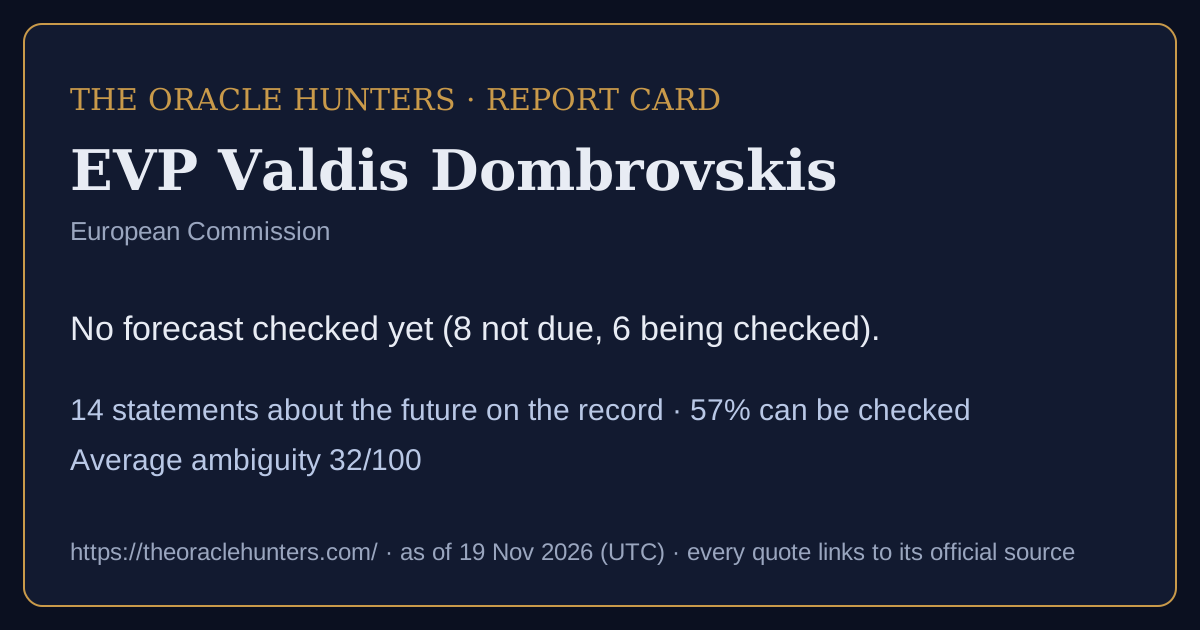
Track record: No forecast checked yet (8 not due, 6 being checked).
14forecasts & commitments on the record
57%can be checked as stated
32average ambiguity (0-100)
0goalpost moves recorded
0confirmed U-turns
Timeline
came true partly did not not due / being checked / too vague
Calibration score: shown after 10 checked forecasts with a stated likelihood (now 0).
How they speak about the future: based on data 8, stated on authority 6.
Kinds of claim: forecast 9, mixed claim 3, commitment 2. · Download this report card as a picture
In the nine words
πρόγνωσιςInference from evidence8 · 57%μαντείαInspired knowledge4 · 29%προαναγγελίαPublic pre-announcement2 · 14%
How to read this
Each box is one sentence a public figure or institution said about the future, word for word, with a link to the official text. Can be checked means it names what will happen, by when, and how likely - so it can be compared with official figures later. Too vague to check means it does not. Ambiguity (0-100) is how many different ways the sentence can be read. When the date passes, the forecast is compared with official data and marked came true, partly or did not come true. Labels judge the sentence, never the person. Full guide and glossary.On the record (14)
We estimate that real GDP in the EU will be boosted by up to 2% over the RRF years.
Our current forecast points to the clause staying active in 2022 and no longer in 2023.
We can expect a recovery to take hold during the second half of this year.
Still, we will need to watch out for increased risks of insolvencies and their fall-out in terms of unemployment and non-performing loans.
Looking to the future, we know that 85% of global growth will take place outside the EU in the next decade.
Based on current forecast, it looks set to remain active in 2022 but no longer so as of 2023.
The Commission expects a recovery to take hold during the second half of this year.
To make our trade policy more assertive, we will strengthen our autonomous tools for implementation and enforcement.
This will be important, especially with the new programmes starting this year that will further boost the recovery of Europe's regions.
And we need to keep building on this foundation, given that 85% of global growth will take place outside the EU in the next decade.
We remain committed to the idea that trade between nations, underpinned by strong rules, drives peace and prosperity.
Looking forward, 85% of the world's GDP growth is expected to come from outside the EU in the coming decade.
In that regard, the EU long-term budget for 2021-2027 together with the recovery package NextGenerationEU will provide the largest stimulus package ever financed through the EU budget, €1.8 trillion.
We expect growth to resume in the spring and the EU economy should return to pre-pandemic GDP levels in 2022, earlier than previously expected.
Also said - not checkable as stated (12 newest)
Remarks about the future with no date, figure or likelihood that could be checked. They are kept on the record and shown here, but not scored.
This should allow containment measures to ease gradually over the coming weeks and months.
When the time is right, Member States will need to refocus their budgets towards achieving prudent fiscal positions in the medium term.
In the coming weeks, the Commission will continue to work intensively with Member States and guide them towards making their plans ready for submission as soon as possible.
This will be important, because we need to put social progress at the heart of our policies.
Member States will need to explain in their Plans the consultations carried out and how their plans reflect stakeholder contributions.
It will maximize the capacity of trade to support our recovery.
The Paris Climate Agreement will now be an essential element for new negotiating mandates.
For example, the target for employment is that at least 78% of people aged 20 to 64 should be employed.
We will work with our partners to update the global rulebook, which will help to provide Baltic exporters with the stability and predictability they need to plan for the future.
But our new trade strategy is not limited to imports and exports – it will help to make Europe better in a wider sense.
We are also determined that trade will contribute to the digital transformation of our economies.
This will immediately help our exporters, and give us the space to find a definitive negotiated solution to this long-running dispute.