EVP Timmermans
European Commission · EU
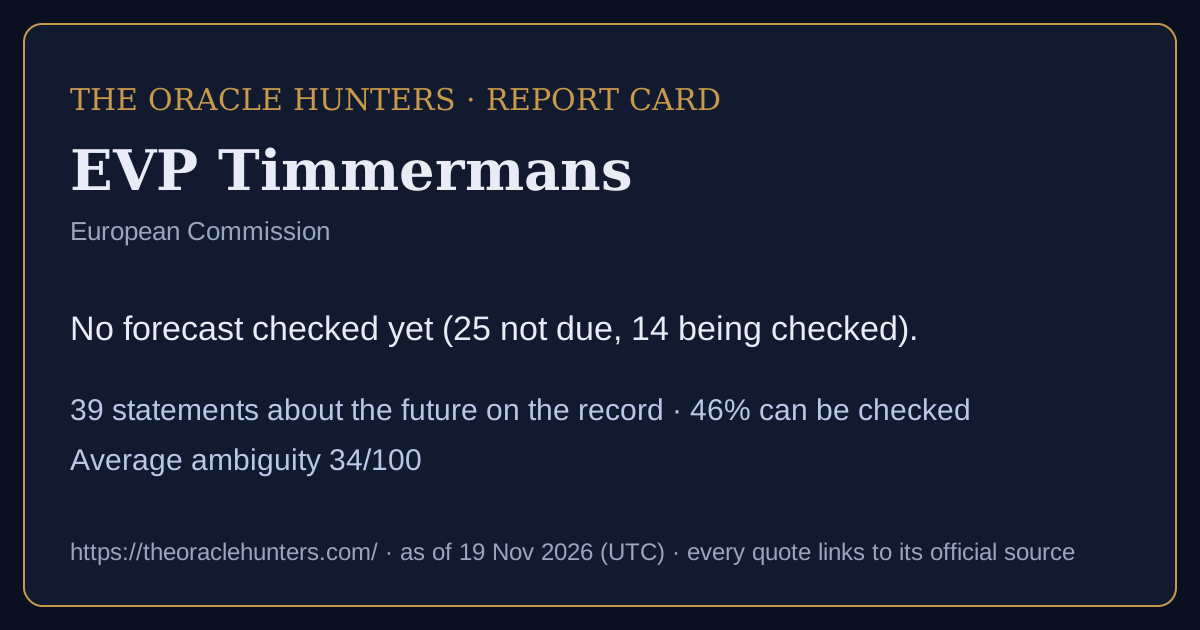
Track record: No forecast checked yet (25 not due, 14 being checked).
39forecasts & commitments on the record
46%can be checked as stated
34average ambiguity (0-100)
0goalpost moves recorded
0confirmed U-turns
Timeline
came true partly did not not due / being checked / too vague
Calibration score: shown after 10 checked forecasts with a stated likelihood (now 0).
How they speak about the future: based on data 23, stated on authority 12, educated guess 4.
Kinds of claim: mixed claim 18, forecast 16, commitment 3, scenario (if… then) 2. · Download this report card as a picture
In the nine words
πρόγνωσιςInference from evidence20 · 51%μαντείαInspired knowledge11 · 28%εἰκασίαConjecture3 · 8%προαναγγελίαPublic pre-announcement3 · 8%πρόνοιαPreparing for the future2 · 5%
How to read this
Each box is one sentence a public figure or institution said about the future, word for word, with a link to the official text. Can be checked means it names what will happen, by when, and how likely - so it can be compared with official figures later. Too vague to check means it does not. Ambiguity (0-100) is how many different ways the sentence can be read. When the date passes, the forecast is compared with official data and marked came true, partly or did not come true. Labels judge the sentence, never the person. Full guide and glossary.On the record (39)
Just imagine: Europe, which is now responsible for about 7 to 8% of global emissions… if we would, by some miracle, go down to 0% in 10 years' time – which is impossible, but just imagine – it will not have any impact on the climate crisis if our partners in the G20 did not likewise reduce their emissions.
There is a lot of work to be carried out this year in the Transitional Committee, and Ministers will have an important role to play as well.
If we manage to agree where we need to be by 2030, we will also give long-term visibility to investors about the future size of the clean energy sector and help drive investments where they are needed most.
China also expects its greenhouse gas emissions to grow further over the coming years until they peak sometime before 2030.
If we do not make these targets, we will see a further significant and widespread increase in adverse impacts of climate change, including in extreme weather events.
In fact, later this year we will officially update our National Determined Contribution, the target that each party to the Paris Agreement has to provide to the UN.
We will reduce our emissions by at least 55% compared to 1990 levels.
It again confirmed the urgency of climate action, saying that global emissions should be decreased already and that emissions will need to be cut by almost half by 2030 if warming is to be limited to 1.5 degrees Celsius.
You may know that missions as a novelty in the Horizon Europe program are being evaluated before the end of the year and I'm convinced that the city missions will show its full worth and EU added value.
Meanwhile, we will continue working with partners in the Global Alliance on Circular Economy and Resource Efficiency, we will keep pushing for an ambitious global plastics agreement, and we will advocate for sustainable and circular economic growth for all in the context of the G7 and G20.
If we do not manage to change this negative trend, the Fitfor55 carbon removals part is at risk and a higher burden will fall on the other sectors.
We are now in the month of May, and the summer in the northern hemisphere will soon put our preparations for this year to the test.
Which is why wildfire risks will feature prominently in the European Climate Risk Assessment, which we expect to publish in the spring of next year.
If it did, with the slow burn, slow rolling climate changes, it will certainly do when it happens so fast and is so profound.
What we need to do is to sketch a path, step by step, that will take us to 2050 in a realistic and feasible way.
This includes 10 billion euros under the Resilience and Recovery Fund and 10.7 billion euros in public aid from two Important Projects of Common European Interests.
This is a way forward that will bring the world together and I hope that at COP28 in Dubai later this year, we can be more concrete or what can be done by all those in involved in this at the end of the day.
The final negotiations between the European Parliament and Council on this will start next month.
I really believe that the Innovation Fund can play a very important role here, especially through the Hydrogen Bank's public auctions that will be launched later this year.
Before the end of the year, we will have a complete picture on the final legislative framework, public funding, and the emerging infrastructure.
So if we remain committed towards more ambitious climate action to reach climate neutrality by 2050, as set out in the climate law, then we have to act.
The compromises you will vote tomorrow are therefore key to deliver on our objective to become Climate Neutral by 2050.
The effort sharing regulation will ensure that member states cut their emissions by 40% by 2030 in sectors currently responsible for 60% of the EU's emission.
The overwhelming majority of them want this and they will be even faster than 2035 with electrifying their fleet.
Let me just remind you that between last year and the end of this year, China will bring 80 – eight zero – models of electric cars to the international market.
So even if in the short-term this leads to high use of coal or gas, at the end of the day it will not take us off our targets to reduce our emissions by 55%.
I say to the Minister of South Africa: even if because of this war-like situation, some of our Member States have to increase the use of fossil fuels now, because of our REPowerEU plan we have put on the table, this will not take us away from the goals we have set.
The European Parliament has agreed on a position and we have already started the negotiations to hopefully conclude this legislative programme before COP27 so that we have something concrete to share for ourselves, something which will take us to reducing our emissions to at least 55% by 2030, regardless of the very, very negative effects that Putin's war is causing …
Only if we mess up the reskilling of people who leave industries that will slowly decline, then we will have unemployment.
Last month we announced these 100 European cities that will be climate neutral by 2030.
This will allow us to get a to reduction of at least 55% of our emissions by 2030 and this will really set us on a trajectory to climate neutrality by 2050.
So the faster we transit into renewables, the faster we will be stronger, we will have higher energy sovereignty in Europe and we will put the competitiveness of European industry on a much much higher scale.
The proposal that we will debate today does one thing: keep the 24% intake rate of emission allowances for the Market Stability Reserve also beyond 2024, and let me explain again why.
We really have to take care of our forests, it is not enough to say that we will plant 3 billion trees, we need to make sure our forests stay healthy and this is going to be a monumentous task.
We will reinforce our energy efficiency and renewable energy targets, and we will continue to strengthen CO2 standards for cars.
We will provide guidance to the Member States this year on addressing energy poverty.
We are going to build on that success and the market momentum by coming out with the offshore energy strategy later this year.
Over the next year we will spend an enormous amount to rebuild our economies in response to this terrible pandemic and its economic consequences.
Our assessment of those plans shows that, based on existing policies, we will overachieve our current 2030 greenhouse gas reduction target of at least 40% percent.
Also said - not checkable as stated (12 newest)
Remarks about the future with no date, figure or likelihood that could be checked. They are kept on the record and shown here, but not scored.
So, the efforts in skilling and re-skilling the labour force are going to have to be part of our climate agenda if we want that agenda to be successful.
We will continue channelling climate finance to developing countries through different programmes and projects and mobilising the private sector to invest in climate action.
However, we will not collectively be able to pursue efforts towards keeping the 1.5°C within reach and adapt to a warmer world if we are unable to discuss how to shift from billions to trillions in finance flows for climate action.
Getting where we need to be will still require a tremendous amount of work and political courage.
But I am confident that we will succeed because together we have already achieved a number of huge successes in the Green Deal.
I think it's been a good day for citizens, for cities, for businesses across every possible sector – finance, renewables, extractives, food, consumer goods – who've urged to move forward with the Nature Restoration Law.
It will set the EU on a path to restore nature, a path to make nature our ally in our efforts to tackle climate change and to show our international partners, those in COP28 as well as in COP15, that Europe means business and that we mean to lead.
If we look at the next generation and make plans for them, then I believe the next election will be less of a problem.
We need horse and carriage because otherwise too many grooms will lose their jobs".
That is why the IPCC has been clear that [global] emissions need to decrease by 43% in the decade to 2030.
Of course, you have many options of what to do, but there's no denying that you will have to do it.
The latest IPCC reports show that in Europe, as a continent, we need to up our game to become the climate neutral continent we want to be by 2050.