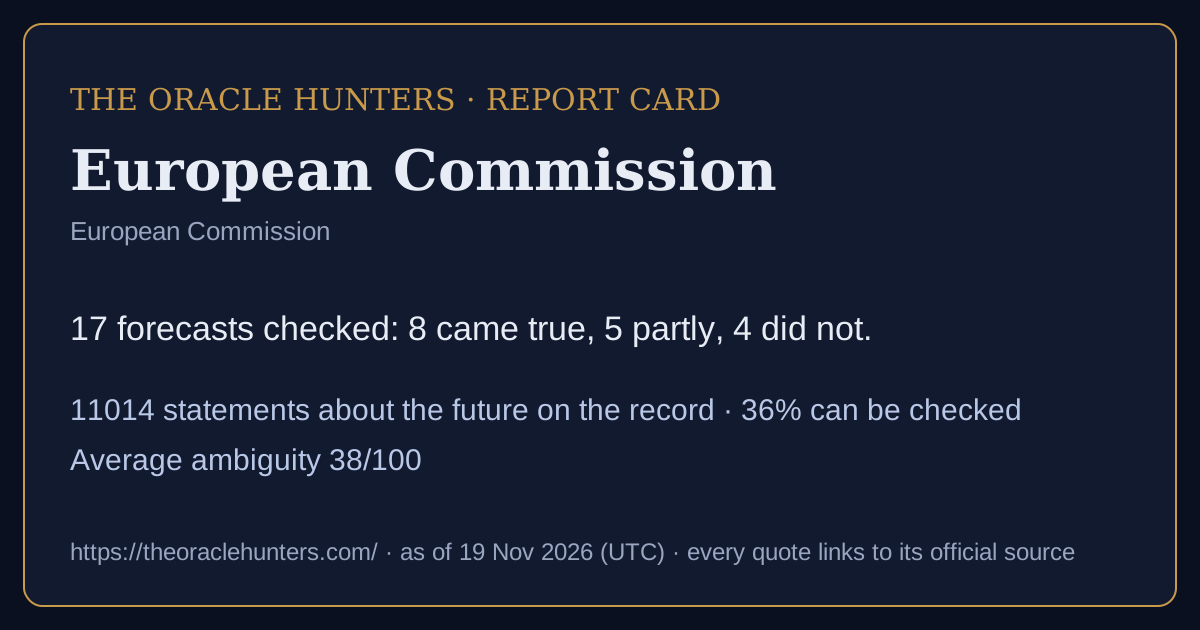
European Commission
Institution - official statements with no named speaker · EU
Track record: 17 forecasts checked: 8 came true, 5 partly, 4 did not.
11013forecasts & commitments on the record
36%can be checked as stated
38average ambiguity (0-100)
0goalpost moves recorded
0confirmed U-turns
Timeline
came true partly did not not due / being checked / too vague
Calibration (Brier score, 0 is perfect, 0.25 is a coin toss): 0.189 over 17 checked forecasts.
How they speak about the future: based on data 8082, stated on authority 2563, educated guess 368.
Kinds of claim: forecast 8078, mixed claim 2193, commitment 468, scenario (if… then) 273, speculation 1. · Download this report card as a picture
In the nine words
πρόγνωσιςInference from evidence7,773 · 71%μαντείαInspired knowledge2,252 · 20%χρησμοδοσίαInstitutional delivery467 · 4%πρόνοιαPreparing for the future272 · 2%εἰκασίαConjecture174 · 2%πρόβλεψιςSeeing the signs65 · 1%φρόνησιςPractical wisdom10 · 0%
How to read this
Each box is one sentence a public figure or institution said about the future, word for word, with a link to the official text. Can be checked means it names what will happen, by when, and how likely - so it can be compared with official figures later. Too vague to check means it does not. Ambiguity (0-100) is how many different ways the sentence can be read. When the date passes, the forecast is compared with official data and marked came true, partly or did not come true. Labels judge the sentence, never the person. Full guide and glossary.Checked
The Italian growth rate is expected to ease to 1.3% in 2018 [-0.2pp] and 1.1% in 2019 [-0.1pp].
Partly came true. Said: economic growth around 1.1% in 2019. Official figure for Italy: 0.4% (World Bank open data). Close: outside the margin, but within one more half point. Off by 0.7 points. official data · checked 14 Nov 2026 · automatic check against official data (rules v3)
In the EU, the debt-to GDP ratio is expected to fall to about 79% in 2019.
Did not come true. Said: government debt around 79% of GDP in 2019. Official figure for European Union: 77.4% of GDP (Eurostat - government deficit and debt). Missed. Off by 1.6 points. official data · checked 17 Nov 2026 · automatic check against official data (rules v4)
After 1.5% in 2017 as a whole, inflation is forecast to remain stable in 2018 before edging up to 1.6% in 2019.In 2019, with above-trend growth, the diminishing slack in the labour market should lift domestic price pressures, resulting in a gradual increase in euro area inflation to 1.6%.
Came true. Said: inflation below 1.6% in 2019. Official figure for Euro area: 1.4% (World Bank open data). On target. official data · checked 14 Nov 2026 · automatic check against official data (rules v3)
And not unrelated to this is the still low inflation rate in the euro area, which is expected to moderate from 1.5% in 2017 to 1.4% in 2018, before rising slightly to 1.6% in 2019, which proves that there is overall stability.
Came true. Said: inflation around 1.4% in 2018. Official figure for Euro area: 1.7% (World Bank open data). On target. Off by 0.3 points. official data · checked 14 Nov 2026 · automatic check against official data (rules v3)
Euro area GDP growth is then forecast to slightly moderate to 2.1% in 2018 and to 1.9% in 2019.
Came true. Said: economic growth around 2.1% in 2018. Official figure for Euro area: 1.8% (World Bank open data). On target. Off by 0.3 points. official data · checked 14 Nov 2026 · automatic check against official data (rules v3)
In Spain, GDP is forecast to slow but to remain very strong, growing 2.3% in 2017 and 2.1% in 2018.
Came true. Said: economic growth around 2.1% in 2018. Official figure for Spain: 2.4% (World Bank open data). On target. Off by 0.3 points. official data · checked 14 Nov 2026 · automatic check against official data (rules v3)
The unemployment rate in the euro area is projected to fall from 10.9% in 2015 to 9.9% next year.
Partly came true. Said: unemployment around 9.9% in 2017. Official figure for Euro area: 9.0% (World Bank open data). Close: outside the margin, but within one more half point. Off by 0.9 points. official data · checked 14 Nov 2026 · automatic check against official data (rules v3)
GDP in the euro area is projected to be 1.2% this year and 1.8% in 2015.
Came true. Said: economic growth around 1.8% in 2015. Official figure for Euro area: 2.1% (World Bank open data). On target. Off by 0.3 points. official data · checked 14 Nov 2026 · automatic check against official data (rules v3)
EU GDP is now expected to grow by 1.5% this year and by 2.0% next year.
Came true. Said: economic growth around 2% in 2015. Official figure for European Union: 2.4% (World Bank open data). On target. Off by 0.4 points. official data · checked 14 Nov 2026 · automatic check against official data (rules v3)
Estonia, which adopted the euro two years ago, is forecast to grow above average with 3% next year and almost 4% in 2015 and unemployment is on a firmly declining trend.
Did not come true. Said: unemployment around 4% in 2015. Official figure for Estonia: 6.4% (World Bank open data). Missed. Off by 2.4 points. official data · checked 14 Nov 2026 · automatic check against official data (rules v3)
This is why it is encouraging that the Irish economy is forecast to record positive GDP growth of 0.6% this year and 1.9% in 2012.
Did not come true. Said: economic growth around 1.9% in 2012. Official figure for Ireland: -0.4% (World Bank open data). Missed. Off by 2.3 points. official data · checked 14 Nov 2026 · automatic check against official data (rules v3)
The EU's GDP is expected to fall by 4% this year.
Came true. Said: economic growth around -4% in 2009. Official figure for European Union: -4.3% (World Bank open data). On target. Off by 0.3 points. official data · checked 14 Nov 2026 · automatic check against official data (rules v3)
we know that unemployment in the EU could near 10% in 2010.
Came true. Said: unemployment around 10% in 2010. Official figure for European Union: 9.9% (World Bank open data). On target. Off by 0.1 points. official data · checked 14 Nov 2026 · automatic check against official data (rules v3)
Average GDP growth in the euro area is projected to rise to 1.8% in 2004 and to reach 2.3% in 2005.
Partly came true. Said: economic growth around 1.8% in 2004. Official figure for Euro area: 2.3% (World Bank open data). Close: outside the margin, but within one more half point. Off by 0.5 points. official data · checked 14 Nov 2026 · automatic check against official data (rules v3)
Headline inflation is expected to remain just above 2% in 2003 in the euro area, only falling below 2% next year.
Did not come true. Said: inflation below 2% in 2004. Official figure for Euro area: 2.2% (World Bank open data). Missed. Off by 0.2 points. official data · checked 14 Nov 2026 · automatic check against official data (rules v3)
On year average, consumer price inflation in the euro area is forecast to reach 2.3% this year (up from 1.1% in 1999).
Partly came true. Said: inflation around 2.3% in 2000. Official figure for Euro area: 3.0% (World Bank open data). Close: outside the margin, but within one more half point. Off by 0.7 points. official data · checked 14 Nov 2026 · automatic check against official data (rules v3)
GDP growth will probably reach 3.4% this year in the EU, which represents the best performance since 1989.
Partly came true. Said: economic growth around 3.4% in 2000. Official figure for European Union: 3.9% (World Bank open data). Close: outside the margin, but within one more half point. Off by 0.5 points. official data · checked 14 Nov 2026 · automatic check against official data (rules v3)
On the record (11013)
The European Investment Bank estimates that the European civil and defence drone market could reach almost 35 billion euros by 2035.
The Hub was already active this summer, supporting firefighting activities in Europe, and we expect that, by next year, it will be ready to support the Southern Mediterranean as well.
In conclusion, this work programme will help us deliver for Europe in 2027.
It is a pleasure to present to you the Commission work programme 2027, adopted by the College today alongside the Annual Overview Report on Simplification, Implementation and Enforcement, which Valdis will cover shortly.
Closing the gender employment gap could raise the GDP of the whole region by as much as 60%!
It is expected to create 500,000 jobs, boosting women's employment by 5% by 2030 through public-private partnerships.
We launched the first version in May, but we are updating it next month.
To connect bankable energy projects with the capital they need, raising a total of 25 billion euro.
Just last month, in New York, I launched the first two projects for early recovery in Gaza, worth 43 million euro.
This importance will only increase as we approach next year, when Greece will hold the rotating presidency of the Council of the European Union.
And next month, we will have the Syria Partnership Coordination Forum, for the first time in Damascus.
Because the annual cost of cardiovascular disease in European Union right now is more than 280 billion euro, which will double by 2050 if we do not act.
And we have 675 million euro available for migration management actions until the end of next year.
The next version will come out next month – and it will be an opportunity to strengthen the territorial dimension of the Pact.
And it is backed by 7 million euro in technical assistance that will help us reach more than 136,000 people, promoting jobs, gender equality and environmental sustainability.
We know from our Demography Report launched last July that urban regions are projected to continue growing – by 3.6% by 2050.
The EU AI Act anticipated precisely these kinds of systemic risks — from loss of control to cyber offence and bio-misuse.
Overall, T-MED brings to the table 5 billion euro in guarantees, supporting an expected 25 billion euro in expected investment in renewables and infrastructure across the region.
And convening the Palestine Donor Group – our next meeting will be in early 2027.
This is why, last May, we committed 310 million euro for 2026 and 2027 through PEGASE.
Closing the gender employment gap could raise the region's GDP by 60%.
Together with UNICEF, the “Gaza Water and Wastewater Early Recovery” project will provide improved water and sanitation for approximately 1 million people in Gaza.
The International Energy Agency expects data centres worldwide to consume around 950 terawatt-hours of electricity a year by 2030.
In Africa alone, the urban population will double to 1.4 billion by 2050.
E-commerce operators will have access to the Hub as of 1 July 2028, with other operators able to start using it by 2031.
We remain committed to the rules-based multilateral trading system, with the World Trade Organization its central guarantor.
We also expect cities to host 3,6% more population by 2050.
Last May, we committed 310 million euro for 2026 and 2027 through PEGASE.
We take this opportunity to congratulate the countries who will present voluntary national reviews this year, including two EU Member States.
Just over ten years ago, when the 2030 Agenda was adopted, it carried the promise that global cooperation could deliver concrete benefits for people.
By 2035, we expect to mobilise at least 25 billion euro in investments, generating 15 Gigawatts in renewable power – from solar and wind to liquid hydrogen.
The finalisation of the Corridor Work Plans this year will mark an important milestone.
The next step will be an impact assessment, followed by a legislative proposal in 2027.
However, unless we address the remaining bottlenecks at Border Crossing Points, our ambition for seamless connectivity will remain just that – an ambition.
Our assessment suggests that restoring even 80% of pre-warsupply levels is unlikely before the end of the year.
And we expect these investments to generate at least 15 Gigawatts of additional renewable energy capacity by 2035.
A 2% increase in our internal trade could completely offset the impact of tariffs put in place by the U.S., something which underlines the unused power of the Single Market.
The latest US update means that a substantial tranche worth several billion of EU exports will now fall under the 15% all-inclusive tariff – down from 25% plus.
President von der Leyen will present it later this year.
As of July, we will apply 47-percent cut in tariff-free imports, alongside a 50-percent tariff on volumes exceeding the newly established quotas.
I updated the U.S. administration on the latest EU measure to defend our industry from global overcapacity, now reaching critical levels and projected to hit 721 million tonnes next year – more than five times the EU's annual steel consumption.
At the same time, the EU is advancing its leadership on ocean observation, through the OceanEye Initiative, which will be operational by 2030.
Next year, together with European partners, they will start to produce new anti-ballistic systems.
Our industries need to understand, that if they will not find the ways how to radically increase their production, than Europe will start to look how together with Ukraine to outproduce Russia.
We are talking about 3.2 trillion dollars today – but the size of these funds is expected to grow to 8.8 trillion dollars by 2030.
This could rise to 43 billion euro by 2030.
As we move closer to 2040, I expect hydrogen solutions to come increasingly to the fore.
As we move closer to 2040, hydrogen solutions are expected to play a greater role.
Despite increased efficiency, by 2050, the aviation fuel needed in Europe could grow by almost 50%.4
This is why later this year we will launch the ScaleUp Europe Fund.
Showing the newest 50 - the ledger has all 11,013.