Eugenio Domingo Solans
European Central Bank · EU
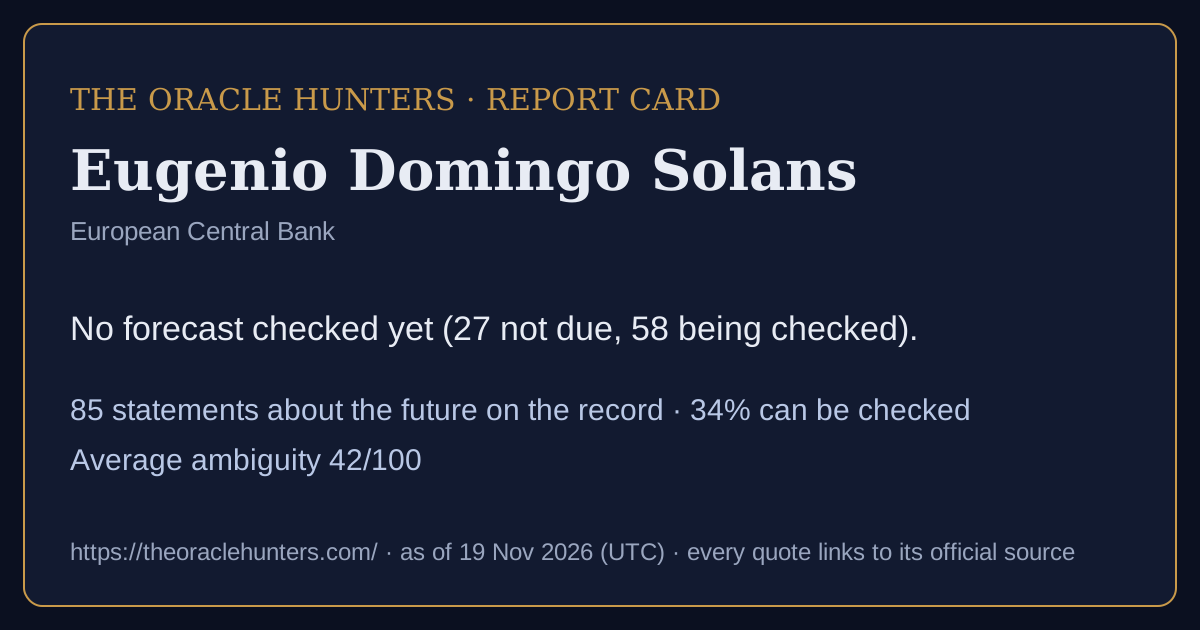
Track record: No forecast checked yet (27 not due, 58 being checked).
85forecasts & commitments on the record
34%can be checked as stated
42average ambiguity (0-100)
0goalpost moves recorded
0confirmed U-turns
Timeline
came true partly did not not due / being checked / too vague
Calibration score: shown after 10 checked forecasts with a stated likelihood (now 0).
How they speak about the future: based on data 71, educated guess 7, stated on authority 7.
Kinds of claim: forecast 61, mixed claim 18, scenario (if… then) 6. · Download this report card as a picture
In the nine words
πρόγνωσιςInference from evidence70 · 82%μαντείαInspired knowledge7 · 8%πρόνοιαPreparing for the future6 · 7%εἰκασίαConjecture2 · 2%
How to read this
Each box is one sentence a public figure or institution said about the future, word for word, with a link to the official text. Can be checked means it names what will happen, by when, and how likely - so it can be compared with official figures later. Too vague to check means it does not. Ambiguity (0-100) is how many different ways the sentence can be read. When the date passes, the forecast is compared with official data and marked came true, partly or did not come true. Labels judge the sentence, never the person. Full guide and glossary.On the record (85)
Some of the ten acceding countries which will obtain the EU membership as of next year have already announced their ambitious goals of introducing the euro banknotes and coins as early as 2006 or 2007.
I may now highlight some elements of the Euro-2002-Information Campaign that had a budget of EURO 80 million: We faced the challenge to get our messages across to a broad public as well as to the professional cash handlers.
Next year, ten additional countries will join the Union, and two are currently negotiating membership.
As you may be aware, eight countries in central and eastern Europe and two island nations in the Mediterranean are expected next year to join the European Union.
While the total gross domestic product (GDP) of the ten countries joining the EU next year will not substantially increase the total GDP of the European Union or of the European Monetary Union, accession will pose serious challenges and will require the full commitment of all of us who are involved in this process.
It will be some time before the accession countries become part of the Monetary Union, even if they join the Union European next year.
In 2003 the ECB’s Governing Council decided upon a final step; those NCBs not owning a mint or having access to a public one will, after 2007, use a common tender process for the production of their share of the overall banknote production.
While the total gross domestic product (GDP) of the ten countries joining the EU next year will not substantially increase the total GDP of the European Union or of the European Monetary Union, accession will nevertheless pose serious challenges and require the full commitment of all those of us who are involved in the process.
The idea is that, as a general rule, this procedure should apply to all the NCBs by 2012, although those NCBs with their own mint or access to a public one will be able to opt out.
A review of the SNA 93 was recently initiated and conclusions are expected around 2008.
Before outlining these main medium-term priorities, I would like to announce that the ECB and the NCBs of the euro area will release a new set of bank interest rate statistics before the end of this year.
Price stability is defined as a year-on-year increase in the Harmonised Index of Consumer Prices – the HICP – for the euro area of below 2% and it is to be maintained over the medium term.
The Governing Council of the ECB has defined price stability as a "year-on-year increase in the Harmonised Index of Consumer Prices of below 2%", over a medium-term horizon.
Both professional forecasters surveys carried out independently by the ECB and Consensus Economics as well as the ten-year "break-even" inflation rate for the euro area suggest that the long-term expected inflation is currently below 2% and, most importantly, it has been quite stable below that benchmark over the last four years.
Concerning financial statistics, new statistics on investment funds and insurance corporations and pension funds were recently published, while further harmonised interest rate statistics and more detailed bank balance sheet statistics will first be published in the course of this year.
The European Commission, for instance, published recently an economic paper on financial market integration, corporate financing and economic growth [], which estimates that full integration of the EU financial markets could boost value added in the manufacturing sector by 0.75 to 0.94 percentage point per year.
While per capita income remains well below the EU average, economic growth was, on average, 1.5 percentage points higher in ten out of the twelve accession countries than in the euro area in 2001-2002 and is expected to remain so over the medium term.
Accession negotiations with ten countries are about to be completed and this will pave the way for these countries to become members of the EU from early 2004.
The ECB agrees that this is the case when the year-on-year increase in the Harmonised Index of Consumer Prices (HICP) for the euro area as a whole stays below 2% over the medium term.
Next year, in six months' time, the ECB and the Eurosystem will be five years old.
Strictly speaking, this does not meet the figure stated in the definition of price stability, although there are good reasons to expect that "over the medium term" – to use the same wording which accompanies the definition –, i.e. in 2003, the inflation rate of the euro area will break through the 2% level and remain below it, unless certain …
The initial frontloading of euro banknotes outside the euro area plus cumulated net shipments, i.e. euro banknotes sent abroad minus euro banknotes received, amounted to some EUR 23 billion by the end of June 2002, around 7.5% of the euro's total circulation.
In June next year the European Central Bank (ECB) and the European System of Central Banks (ESCB) will be five years old.
It is also of utmost importance to bear in mind that only if integration results in a genuine increase in competition will its economic benefits be reaped.
The euro cash changeover, which will be implemented by more than 300 million Europeans across twelve countries in less than four weeks, will in itself be an extremely important fiduciary operation involving trust in our currency, in our financial and banking system and in the role of the Eurosystem as the guardian of the euro.
This year's meeting will take place in Berlin in December.
The banknotes of the legacy currencies of the euro may be returned at the beginning of 2002 to be exchanged at the counters of commercial banks, bureaux de change and central banks.
First, by the end of 2001, the Eurosystem will have produced around 16 billion euro banknotes, some 15 billion of which will already have been produced by the end of November, i.e. far more than the approximately 10 billion requested to replace the national banknotes currently in circulation.
This year, the focus will be more on the review of the developments that have occurred since last year in this field of statistics and on some issues that are currently under discussion in various fora such as the Working Group on Balance of Payments and External Reserves Statistics, the Statistics Committee of the ESCB, the Working Group of Eurostat …
The euro area public can rest assured that it will receive complete information about the new euro banknotes and coins and the changeover process and that it will therefore be ready for the new currency as of 1 January 2002.
By 1 January 2002 we will have distributed six different press kits to more than 3,000 media representatives. 200 million copies of an information leaflet on the euro banknotes and coins and their security features are currently being sent to every household in the euro area.
Earlier this year we reached a satisfactory solution for the part relating to non-resident holdings of money-market fund shares and units – the results, published in May, reduced measured growth of M3 over the last 12 months by some ¾ percentage point.
First of all, as already mentioned earlier, the large number of banknotes that will be available as of 1 January 2002 via the frontloading and subfrontloading will help to smooth the changeover.
In addition, I am sure that all of you have heard about the case in which some new euro banknotes have already "slipped into circulation"; if the subfrontloading of banknotes to the general public had been agreed for any time before 1 January 2002, we would obviously have to expect an uncontrolled use of these banknotes, resulting in considerable confusion.
As an alternative measure, cash dispensers – which, on average, distribute around 70% of banknotes in the euro area – will provide low-denomination euro banknotes from 1 January 2002.
It is expected that in Italy 90% of the cash dispensers will have been switched to euro banknotes within the first week of 2002.
From 1 January 2002 credit institutions will supply the public with euro via their counters, and via their cash dispensers as far as technically possible.
From 1 March 2002 the lira will no longer be in circulation and should not be accepted for settling transactions.
Focusing on Italy, it should be stressed that euro banknotes and coins will enter into circulation on 1 January 2002 and, from this moment onwards – and only from this moment onwards – they will have legal tender status, that is to say, they will have to be accepted for any transaction.
In particular, those travelling frequently between euro area countries should be aware of this, since, for example, although the dual circulation period when both the national currencies and the euro will be accepted as legal tender will end on 28 February 2002 in Italy, it will end earlier in some countries.
Two winners from each country will be the first to receive the euro banknotes once they become legal tender on 1 January 2002.
Building that confidence has therefore been the most important motivating force behind everything we have done and will continue to be a driving force throughout the Euro 2002 Information Campaign.
At the end of the year, the ECB, together with the national central banks of the euro area, will distribute 200 million copies of an information leaflet to be used as a euro guide for the general public.
To illustrate this general interest, I will, if you allow me, recall the strategic goal for the European Union decided by the EU Council in Lisbon last year and re-affirmed in Stockholm a few weeks ago: "to become the most competitive and dynamic knowledge-based economy in the world, capable of sustainable economic growth with more and better jobs and greater …
The clearer evidence to that effect is the wording of the press release issued by the Irish government on February 26th of this year, announcing the approval of a draft legislation - I quote - "which will provide for the introduction of new financial instruments in the Irish market - mortgage and public credit bonds similar in nature to the …
Nonetheless, credit institutions, which will be prepared to exchange escudos for euro free of charge from 1 January 2002, will continue to do so until 30 June 2002.
In Portugal, for example, escudos may continue to be exchanged for euro free of charge until 30 June 2002 in credit institutions and, with regard to banknotes, for up to twenty years in the Banco de Portugal.
From 1 March 2002 the escudo will no longer be in circulation and should not be accepted for settling transactions.
Focusing on Portugal, it should be stressed that euro banknotes and coins will enter into circulation on 1 January 2002 and, from this moment onwards - and only from this moment onwards - they will have legal tender status, that is to say, they will have to be accepted for any transaction.
In particular, those travelling frequently between euro area countries should be aware of this, since, for example, although the dual circulation period when both the national currencies and the euro will be accepted as legal tender will end on 28 February 2002 in Portugal, it will end earlier in some countries.
Showing the newest 50 - the ledger has all 85.
Also said - not checkable as stated (12 newest)
Remarks about the future with no date, figure or likelihood that could be checked. They are kept on the record and shown here, but not scored.
Statistical information is so powerful that regardless of the good will of the people involved – which I take for granted – institutional arrangements should make it impossible to speculate on what, how much and when statistical information is disclosed.
As the Executive Board member of the European Central Bank (ECB) in charge of the Directorate General Statistics, I should like to begin by thanking the organisers and all the participants in this conference for their valuable contributions.
Statistics independence The business area in charge of statistics at a central bank – the Directorate General Statistics, in the case of the ECB – should be responsible for the statistics relevant to all functions and tasks of the central bank.
Besides monetary policy, which is certainly our main “customer”, the statistical department should also provide services to other areas within the central bank (financial stability and banking supervision, payment systems, international, etc.) and to users outside the central bank (market players, researchers, the general public).
While there are many national and international users, the most important users must be actively involved in this decision-making process.
Moreover, producers must be given a higher degree of flexibility to respond to new and substantial political priorities, such as the single monetary policy.
Furthermore, it should be noted that spreads between MFI lending and deposit interest rates may contain important information regarding the soundness of the banking system.
These new statistics will significantly improve the analysis of the monetary policy transmission mechanism resulting from changes in key ECB interest rates.
From now on, these new interest rate statistics will be issued on a monthly basis and announced in an ECB press release.
It is vital for central banks and other organisations to be regularly and rapidly informed of changes in interest rate levels and the business volumes of the retail banking market, so that they can assess the effects of changes in key ECB interest rates.
Thirdly, if bank services are offered across national borders, prices should become similar.
The widespread pre-distribution already four months prior to the introduction date 1 January 2002 should ensure that the resources of the NCBs and the cash-in-transit companies could be more evenly allocated and thus bottlenecks in the cash supply be minimised.