Ernst Welteke
Deutsche Bundesbank
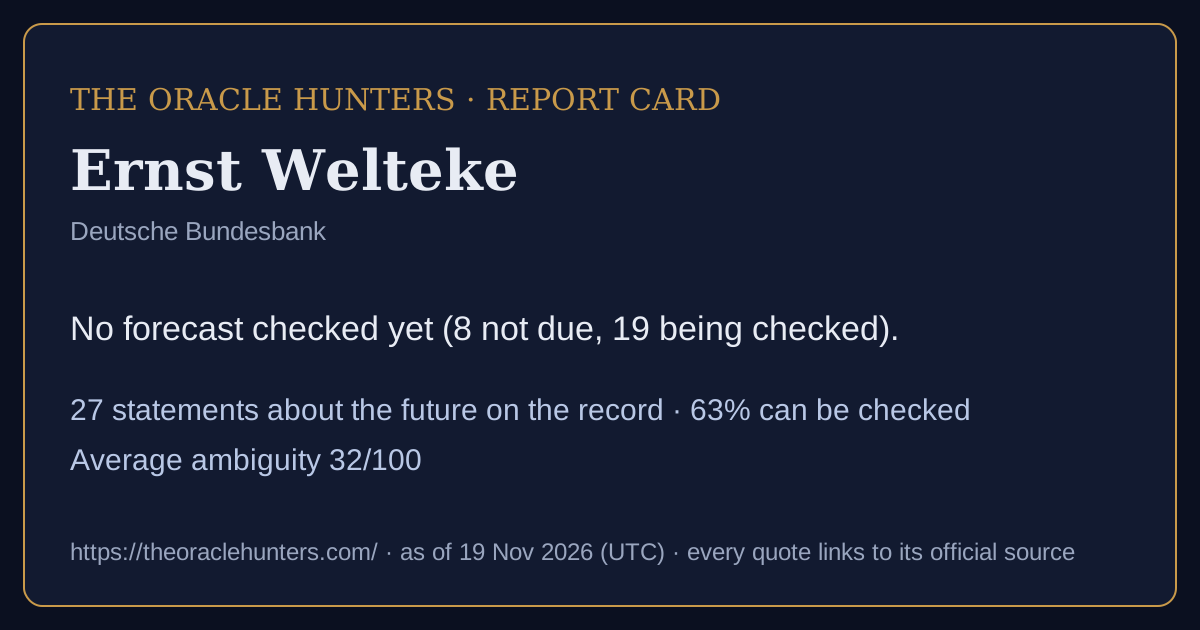
Track record: No forecast checked yet (8 not due, 19 being checked).
27forecasts & commitments on the record
63%can be checked as stated
32average ambiguity (0-100)
0goalpost moves recorded
0confirmed U-turns
Timeline
came true partly did not not due / being checked / too vague
Calibration score: shown after 10 checked forecasts with a stated likelihood (now 0).
How they speak about the future: based on data 21, stated on authority 6.
Kinds of claim: forecast 24, mixed claim 2, scenario (if… then) 1. · Download this report card as a picture
In the nine words
πρόγνωσιςInference from evidence20 · 74%μαντείαInspired knowledge6 · 22%πρόνοιαPreparing for the future1 · 4%
How to read this
Each box is one sentence a public figure or institution said about the future, word for word, with a link to the official text. Can be checked means it names what will happen, by when, and how likely - so it can be compared with official figures later. Too vague to check means it does not. Ambiguity (0-100) is how many different ways the sentence can be read. When the date passes, the forecast is compared with official data and marked came true, partly or did not come true. Labels judge the sentence, never the person. Full guide and glossary.On the record (27)
Irrespective of the question of which economy will be in pole position in 2015, unwinding global imbalances and strengthening economic growth pose difficult challenges for the international community.
By no later than 2010, East Asia, including Japan, might account for more than one-third of world trade and thus become the world's most important trading area, ahead of the European Union.
According to this es-timate, the euro area can expect GDP growth of 1.1%, while Germany should brace for a third year in a row with significantly sub-par growth of 0.5%.
Nevertheless, the ECB Governing Council expects growth rates to pick up and to return to potential in the course of 2003.
The unwinding process is taking longer than was expected in the rather optimistic assessments early this year.
This weakness will be overcome step by step: The European Commission's Financial Services Action Plan provides 42 proposals to frame legislation aimed at establishing a uniform European capital market by 2004.
This process will accelerate even more because capital gains from the sale of corporate shareholdings will be tax-free as of 2002.
Growth rates diminished, employment gains came to a halt, and the prospects for next year have worsened over the past few months.
This year, after peaking in May, at 3.4 percent, the inflation rate has been decreasing.
Adjustments are taking place and will reinvigorate growth during the next year.
Global trade growth will probably slow down to only 1.3 percent this year, after 12 percent last year.
Growth of global trade will probably diminish this year to two percent after 12 percent last year.
The two countries have decided to set up a currency union from 2005 onwards; at first, the Russian rouble will be their currency.
If international trade were liberalised completely, they could see an increase of three percent in their annual GDP or - more impressive three times the foreign aid they receive annually.
It is envisaged that negotiations with the first group of countries will be complete as early as the end of next year.
Inflation in the euro area has been falling since reaching its peak in May [3.4%].
And time and again, as a European, I experience a real sense of regret that Denmark will not be one of the countries to make full use of the common European currency from 1 January 2002.
The waning food crises will no longer weigh on consumption and this year's tax cuts are to come into effect in some euro-area countries.
For the period 2000-2006, Ireland will be granted a total of 4.2 billion euros via both the Structural Funds and the Cohesion Fund.
Precise statistical data for this category of instrument are still being collected by the ECB and will be published at the end of the year.
Transparency is higher and will take another leap once the euro is legal tender and all over the euro area prices are quoted in the home currency of more than 300 million people.
Priorities set in the Lamfalussy plan will bring us an integrated and competitive European securities market as early as 2003.
We expect this to change during the course of this year.
However, on May 10, the Governing Council decided to lower official interest rates by 25 basis points.
Thus, we are confident that the HICP will drop below the 2 % threshold during the course of the next year.
Thus, from today's point of view, it looks probable that in 2001 we will not be able to meet our target of holding inflation below the 2 % ceiling.
I am optimistic that the Basel Committee will resolve all outstanding issues by autumn 2000 and propose a harmonised regulatory framework which will be appropriate for capital market-oriented as well as bank-based financial systems.
Also said - not checkable as stated (12 newest)
Remarks about the future with no date, figure or likelihood that could be checked. They are kept on the record and shown here, but not scored.
With respect to the United States, we have recently observed relatively high productivity growth rates, which might contribute to higher-than-expected GDP levels in the US, but the risks arising from the twin deficits in the medium term should not be underrated.
As benefits paid out in the pay-as-you-go pension system will have to be cut back for future retirees, private provisioning should be expanded.
Over-use of what, up to now, have been regarded as 'free' health care services might thus be contained to a certain extent.
A general broadening of the scope for non-centralised wage settlements at the individual company level might also help to improve labour market flexibility.
This reclassification may open the door to assigning objectives other than price stability to the ECB.
Furthermore, meeting the Maastricht criteria will require adjustments in fiscal policy.
Price stability must not be dropped from the list of objectives of the EU.
Therefore, the Constitution must guarantee the independence not only of the ECB but also of the national central banks.
In my view, it is imperative for the European member states - prominent among them, unfortunately, my own country - to stick to the sound fiscal policies required by the Stability and Growth Pact.
In the ECB Governing Council we are ready to support the economic recovery as long as this is compatible with our mandate of maintaining price stability.
This will provide an opportunity which must be seized to fully implement the ongoing reforms.
A medium-term fiscal framework could help to overcome these problems.