Erik Thedéen
Sveriges Riksbank
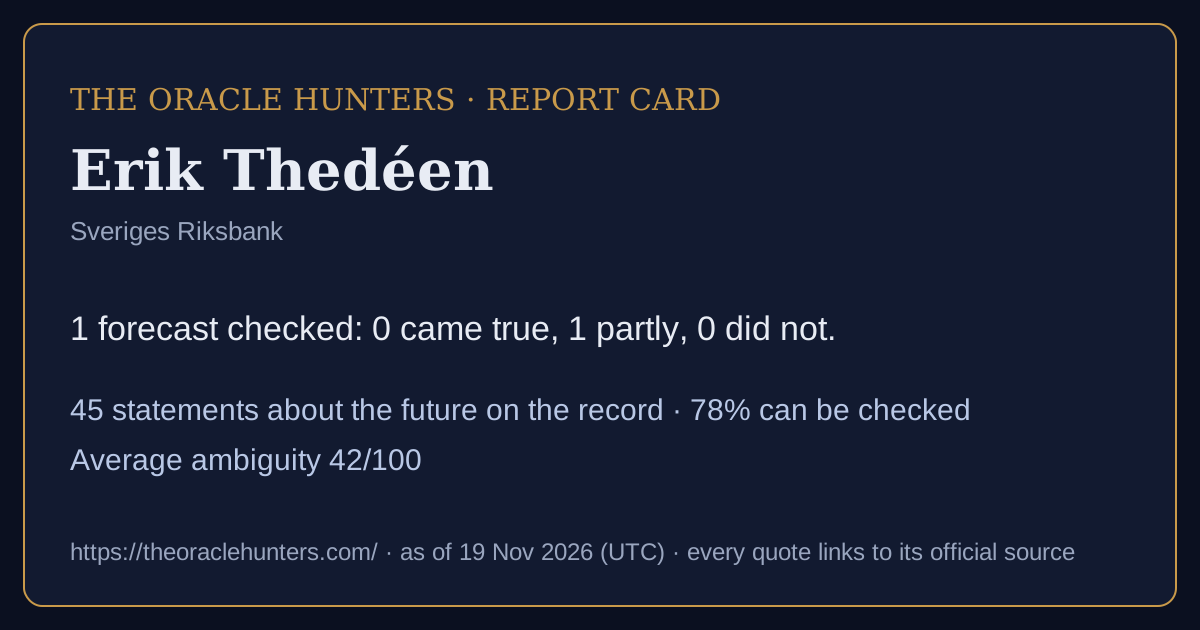
Track record: 1 forecast checked: 0 came true, 1 partly, 0 did not.
45forecasts & commitments on the record
78%can be checked as stated
42average ambiguity (0-100)
0goalpost moves recorded
0confirmed U-turns
Timeline
came true partly did not not due / being checked / too vague
Calibration score: shown after 10 checked forecasts with a stated likelihood (now 1).
How they speak about the future: based on data 29, educated guess 10, stated on authority 6.
Kinds of claim: forecast 20, mixed claim 11, scenario (if… then) 11, commitment 3. · Download this report card as a picture
In the nine words
πρόγνωσιςInference from evidence26 · 58%πρόνοιαPreparing for the future11 · 24%μαντείαInspired knowledge4 · 9%προαναγγελίαPublic pre-announcement3 · 7%εἰκασίαConjecture1 · 2%
How to read this
Each box is one sentence a public figure or institution said about the future, word for word, with a link to the official text. Can be checked means it names what will happen, by when, and how likely - so it can be compared with official figures later. Too vague to check means it does not. Ambiguity (0-100) is how many different ways the sentence can be read. When the date passes, the forecast is compared with official data and marked came true, partly or did not come true. Labels judge the sentence, never the person. Full guide and glossary.Checked
Our assessment is that inflation will fall back rapidly in 2023 and that it will be around 2 per cent next year, see Figure 1.
Partly came true. Said: inflation around 2% in 2024. Official figure for Sweden: 2.8% (World Bank open data). Close: outside the margin, but within one more half point. Off by 0.8 points. official data · checked 14 Nov 2026 · automatic check against official data (rules v3)
On the record (45)
If the central bank increases its holdings at each QE without unwinding in between, it will end up with a very large stock.
If QE contributes to weakening this mechanism, there is a risk that the central bank's actions will ultimately lead to rising government debt and increasingly unsustainable public finances.
If interest rates have risen, it is therefore uncertain whether the increase will be sustained.
Then we will need to have a good idea of how the quantitative easing programmes that central banks carried out last time worked and what their advantages and disadvantages were.
One problem with this strategy is that if the shock has already subsided and inflation has begun to fall back before the interest rate increase has an impact, there is a risk that monetary policy will be sharply contractionary in a situation where the economy instead needs support.
The series in the figure end in the second quarter of 2028, which is the last quarter of the Riksbank's three -year forecast horizon.
The fact that the banks retain a surplus of reserves in this way may be due to the existence of a too low opportunity cost, that is, the cost of 10 basis points that a bank incurs by placing central bank liquidity as reserves compared with placing it in certificates.
The banking system's liquidity surplus is also declining and is expected to be around 400 billion by 2030
Wicksell argued that the costs and possible losses that the application of an interest rate corridor of 0 basis points could entail for the central bank should be covered by the seigniorage and that the government should cover the central bank's losses, see Wicksell (1919).
3 This threshold will be doubled next year.
If the Riksbank makes the right assessment of the economic situation, if key assumptions about the economy hold and if future developments are not affected by new "shocks" -then the interest rate forecast reflects how we would probably conduct monetary policy in the future.
If the central bank can then adjust expectations that interest rates will remain low for a long time, it will stimulate the economy now, without cutting interest rates further.
The US Federal Reserve does not have a straightforward interest rate forecast, but publishes the various committee members' assessments of the appropriate level of the federal funds rate at the end of the next three years.
But if -or rather when -any of this changes, we will need to change the interest rate forecast so that it once again reflects a well-balanced monetary policy where inflation is lastingly around our target of 2 per cent at the same time as monetary policy contributes to a balanced development of production and employment.
If the outlook for inflation and economic activity remains the same, we can continue to cut the policy rate in December and during the first half of 2025, in line with what we communicated in September.
We believe that this is a temporary effect and that inflation will stabilise at around 2 per cent in the future.
## Since May, the Riksbank has cut its policy rate by 1.25 percentage points
The entire holding of Swedish bonds built up via the Riksbank's previous purchases of securities will therefore not be wound down; instead we will retain a portfolio of government bonds totalling SEK 20 billion.
At the current rate of maturities and sales of government bonds, we will, in principle, reach that level by the end of next year.
The Riksbank will monitor developments closely and we are prepared to adjust monetary policy if necessary to ensure inflation around 2 per cent in the long term.
At the end of 2022, for example, both the Riksbank and the NIER expected GDP to fall by just over 1 per cent in 2023, assuming that the policy rate peaked at 2.5-3.0 per cent, i.e. considerably lower than was actually
Inflation has thus come down and is expected to stabilise around 2 per cent.
Model estimates show that it would likely have peaked somewhere around 14 per cent instead of around 10 per cent if we had only raised interest rates very little or not at all in 2022. 22
According to estimates of the indirect effects, one could therefore have expected, as a rule of thumb, that CPIF inflation would have been pushed up by a further 2.5 percentage points overall in 2022-2024.
As the rise in CPIF inflation was mainly due to energy prices, and the Riksbank assessed that their contribution would decline in 2022, the forecast was that inflation would fall back towards the end of the year.
In February 2022, the Riksbank assessed that inflation was likely to fall back towards the end of the year, but as is well known, the opposite was the case.
The Riksbank Committee's assumption of a long-term real interest rate of 1 per cent may seem cautious from a longer historical perspective.
The Riksbank Act therefore stipulates that the Riksbank's equity may amount to a maximum of SEK 60 billion, unless the Riksdag decides otherwise, and that this target level shall be adjusted upwards with CPI inflation each year so that the capital retains its real value. 16 An amount corresponding to two-thirds of the target level, i.e. SEK 40 billion, shall …
In the law, as I mentioned, the main rule is that equity must be restored to an inflation-adjusted base level, which, with indexation according to the CPI for December 2023, means SEK 41.8 billion. 19 This will be the starting point for the amount in the Riksbank's petition on equity restoration.
If this is all that happens in the economy, inflation will automatically fall again after a year and return to the previous level.* It will then look like Figure 2.
However, if one believes that inflation has been entirely supply-driven and will fall back on its own, this is definitely a possible interpretation.
This indicated that, if monetary policy was not tightened, inflation would exceed the inflation target throughout the forecast period, although not by much.
For example, if the Riksbank had signalled more clearly in February 2022 that such a scenario was not entirely unlikely, we would have provided a better basis for the policy rate increases that then followed."
This argument has been made in connection with virtually every increase in the policy rate, from the increase from 0 to 0.25 per cent in May 2022 until today.
However, they also expected the upturn to be highly temporary and inflation to be back on target or even slightly below by 2023.
Under the assumption of sales for SEK 3.5 billion every month, and of other bonds being held until maturity, the asset holdings will amount to just under SEK 200 billion at the beginning of 2026, see Figure 6.
This could become relevant if monetary policy needs to become more expansionary and the policy rate would then need to be cut below what is deemed to be the lower bound.
The target for the consolidated gross debt should be 35 per cent of GDP in the medium term.
If the Riksbank forecasts an inflation rate close to 2 per cent in the longer term, inflation expectations should also be at this level.
Our most recent assessment is that inflation will be close to the target next year, but it is of course difficult to be sure, and new information about developments will - as always - be decisive for monetary policy going forward.
Our assessment is that inflation will fall back rapidly in 2023 and that it will be around 2 per cent next year, see Figure 1.
Partly came true. Said: inflation around 2% in 2024. Official figure for Sweden: 2.8% (World Bank open data). Close: outside the margin, but within one more half point. Off by 0.8 points. official data · checked 14 Nov 2026 · automatic check against official data (rules v3)
However, if interest rates directed to companies begin to rise, conditions for loans tighten, asset prices fall and credit volumes decline as a result of the bank unease and the risk of contagion effects, this in itself will have a cooling effect on the economy.
Households and companies assume that inflation will remain around the 2 per cent target going forward, even if it happens to be higher or lower at the moment.
The inflation target is the Riksbank's overriding target and we will do what is necessary to bring inflation back to low and stable levels.
In addition, we will then be able to have real wage increases again.
Also said - not checkable as stated (12 newest)
Remarks about the future with no date, figure or likelihood that could be checked. They are kept on the record and shown here, but not scored.
I see a number of key issues which we will have the opportunity to discuss today and on which I hope to have the opportunity to give my views.
Stablecoins and other innovations could play a similar role in the payments market.
They are unlikely to replace traditional bank money or central bank money, but they may challenge existing players by offering payments that are faster, cheaper or easier to send between countries.
The question, therefore, is perhaps not whether stablecoins will take over the market, but how they will shape the entire payment system.
For example, certain groups may find it more difficult to make payments, and the payments system becomes more vulnerable because digital payments rely on electricity and telecommunications.
Every banking crisis clearly demonstrates the scale of what is at stake and why we must be cautious.
If so, the likelihood that policy rates will need to be lowered to very low levels again -and that central banks will need to resort to other measures, such as asset purchases -diminishes.
Let us assume that we cannot rule out that at some point in the future we will once again find ourselves in a situation of very low global normal interest rates.
Overall, this should have contributed to underlying upward pressures on inflation, which are likely to be less pronounced
This is probably an important reason why we did not need to raise the policy rate very much compared with many others in the context of the previous inflationary upswing.
If there is an increased risk of high inflation and a sustained deviation from the target, monetary policy may need to act to prevent this.
The economic impact of the war in Iran, the prolonged disruption of key global supply chains and the continued political tensions in the region may prove to be more significant.