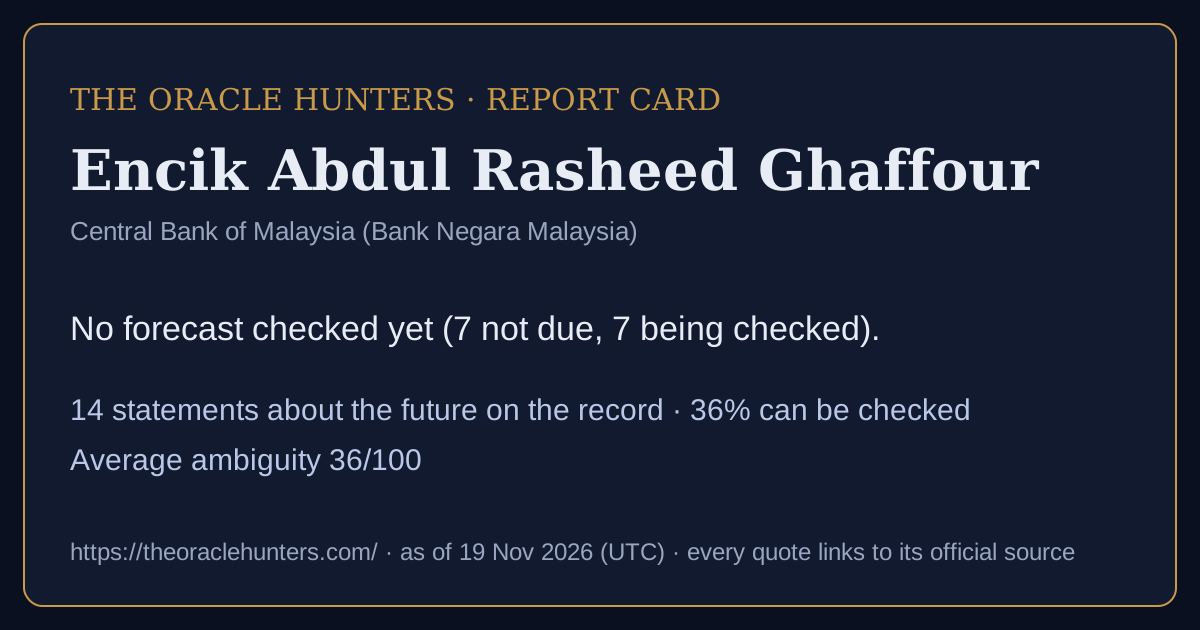
Encik Abdul Rasheed Ghaffour
Central Bank of Malaysia (Bank Negara Malaysia)
Track record: No forecast checked yet (7 not due, 7 being checked).
14forecasts & commitments on the record
36%can be checked as stated
36average ambiguity (0-100)
0goalpost moves recorded
0confirmed U-turns
Timeline
came true partly did not not due / being checked / too vague
Calibration score: shown after 10 checked forecasts with a stated likelihood (now 0).
How they speak about the future: based on data 11, stated on authority 3.
Kinds of claim: forecast 13, commitment 1. · Download this report card as a picture
In the nine words
πρόγνωσιςInference from evidence10 · 71%μαντείαInspired knowledge3 · 21%προαναγγελίαPublic pre-announcement1 · 7%
How to read this
Each box is one sentence a public figure or institution said about the future, word for word, with a link to the official text. Can be checked means it names what will happen, by when, and how likely - so it can be compared with official figures later. Too vague to check means it does not. Ambiguity (0-100) is how many different ways the sentence can be read. When the date passes, the forecast is compared with official data and marked came true, partly or did not come true. Labels judge the sentence, never the person. Full guide and glossary.On the record (14)
We remain committed to tackle frictions surrounding climate data reporting.
The United Nations has even declared the start of the Era of Global Boiling - with a 98 percent chance that the world will experience a new temperature record at least once in the next five years . 1
By 2026, we expect to see at least half of new financing by banks to be aligned with climate supporting or transitioning activities, as set in the Financial Sector Blueprint.
By 2030, about 25 percent of Malaysia's population could be displaced due to the impacts of climate change . 3
It is estimated that Malaysia's economy could lose 5.9 percent of its GDP by 2030 due to heat-related productivity loss
But given the evolving landscape, we have also commenced a renewed risk assessment and will share our findings in the first half of 2024.
These factors will continue to support the Malaysian economy in 2024.
This will be illustrated in the Bank's "Enforcement Approach", which is expected to be published at the end of this year.
Going into 2024, growth will continue to be driven by resilient domestic expenditure underpinned by continued employment and wage growth.
While this may appear as a staggering figure, this is equivalent to only around 1% of the USD379 trillion of the total financial assets held by banks, institutional investors and asset managers.
We also expect to enhance the current Regulatory Sandbox this year to facilitate testing of more innovative digital financial solutions.
By 2026, we expect this to rise to over 400 transactions per capita.
Digital developments are expected to increase labour productivity and create up to 500,000 jobs by 2025.
We expect new digital banks to begin operations over the next couple years, while the licensing regime for digital insurers and takaful operators will be finalised this year.
Also said - not checkable as stated (12 newest)
Remarks about the future with no date, figure or likelihood that could be checked. They are kept on the record and shown here, but not scored.
This afternoon, we will also hear more pilot projects to spur the adoption of sustainable and low carbon practices in the agriculture sector and industrial parks in Malaysia.
The Bank will engage the industry in the next few months before we finalise these policies.
We will continue to monitor potential risks to its outlook, arising mainly from changes to domestic policy on fuel subsidies.
These early signs are very encouraging, and I trust we will see further reductions going forward.
Inflation has remained low and stable, with headline and core inflation are expected to moderate to its long-term average.
Looking ahead, we expect that further clarity on the end of monetary policy tightening cycle by major central banks will also provide support to the ringgit and emerging market currencies in general.
With VBI principles being universal, our hope is that going forward, we will see wider adoption of value-based finance beyond the Islamic finance community of institutions, so as to further promote a more inclusive and sustainable financial ecosystem in Malaysia.
At the Bank's end, we are committed to provide a conducive regulatory environment for innovation to take place.
Yet, within the same timeframe, almost half of the workforce will need reskilling as jobs become replaced or obsolete.
As policymakers and practitioners, the research of the sort we will be deliberating today is exciting because it introduces valuable insights into designing and evaluating effective interventions, tailored to the needs of those in our population.
In rebuilding financial resilience, it will be important to have a well-textured understanding of issues such as how the pandemic has affected the economic livelihood of Malaysians, trends in digitalisation and digital financial literacy, as well as short-term attitudes toward finance among Malaysians.
But while these measures are necessary, they will not be sufficient without the first line of defence - that is, for consumers to remain vigilant, knowing how to avoid getting duped.