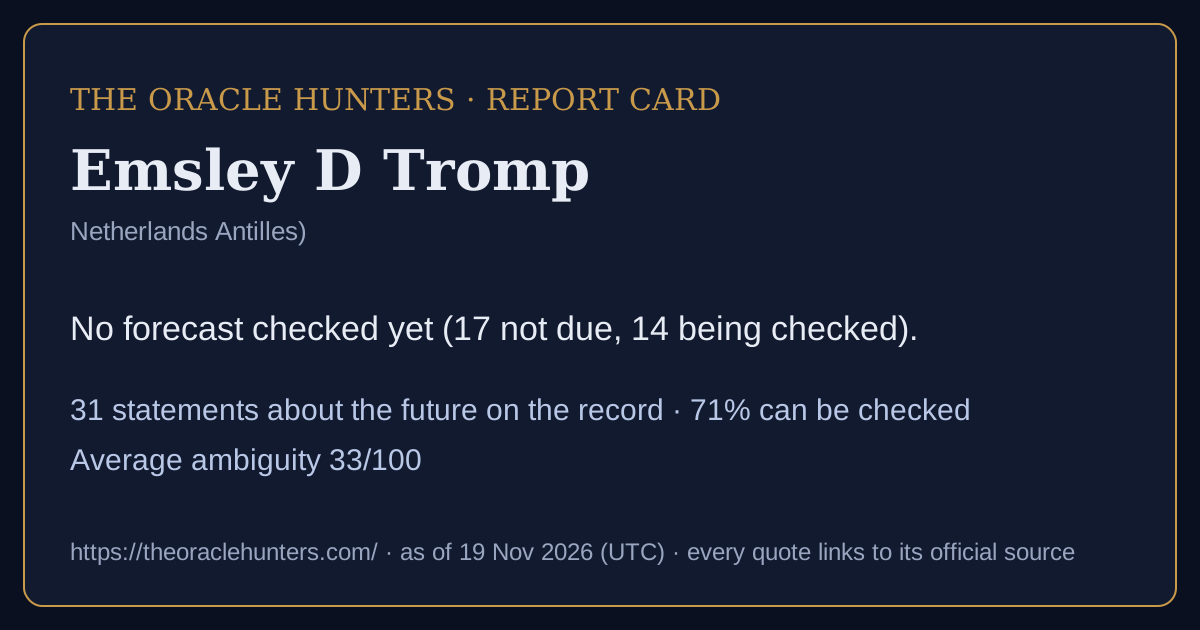
Emsley D Tromp
Netherlands Antilles)
Track record: No forecast checked yet (17 not due, 14 being checked).
31forecasts & commitments on the record
71%can be checked as stated
33average ambiguity (0-100)
0goalpost moves recorded
0confirmed U-turns
Timeline
came true partly did not not due / being checked / too vague
Calibration score: shown after 10 checked forecasts with a stated likelihood (now 0).
How they speak about the future: based on data 23, stated on authority 5, educated guess 3.
Kinds of claim: forecast 23, commitment 3, mixed claim 3, scenario (if… then) 2. · Download this report card as a picture
In the nine words
πρόγνωσιςInference from evidence23 · 74%προαναγγελίαPublic pre-announcement3 · 10%μαντείαInspired knowledge2 · 6%πρόνοιαPreparing for the future2 · 6%εἰκασίαConjecture1 · 3%
How to read this
Each box is one sentence a public figure or institution said about the future, word for word, with a link to the official text. Can be checked means it names what will happen, by when, and how likely - so it can be compared with official figures later. Too vague to check means it does not. Ambiguity (0-100) is how many different ways the sentence can be read. When the date passes, the forecast is compared with official data and marked came true, partly or did not come true. Labels judge the sentence, never the person. Full guide and glossary.On the record (31)
In a worst case scenario, Curacao will end up with a deficit of NAf.170 million in 2008 instead of a balanced budget, contributing to a further increase in the debt.
In the case of Curacao, this rule prescribes that the interest expenses in the budget may not exceed 5% of the average revenues of the preceding three years.
Ladies and gentlemen, in addition to the threats emanating from the current international developments, preparing Curacao for its new constitutional status will dominate our policy agenda in 2008 and the years ahead.
If we fail to comprehend this, we will not be able to create a stable monetary environment conducive to growth and stability.
Recent information suggests that the 'Algemene Maatregel van Rijksbestuur' regulating the supervision of Curacao's budgetary process will be approved by the end of this year, meaning that the debt relief will not become effective until 2009.
If the debt relief starts in 2009, the deficits accumulated after 2005 will have added approximately NAf.550 million to Curacao's outstanding debt.
Nevertheless, an aboveaverage economic growth of 4 percent is projected for the region.
Based on current construction and intended projects in the years ahead, an average 1,000 rooms per year will be added between 2009 and 2111.
Economic growth increased to 1.4% in 2006 and a further acceleration is expected in 2007.
Together with the changes taking place to prepare the island for its new constitutional status, providing an excellent opportunity to correct the economic and social imbalances in our society with substantial financial and technical Dutch support, we will be able to create a solid foundation for strong sustainable growth in the years ahead of us.
Applying the common multiplier in the hotel sector that each room creates 2.5 direct and indirect jobs, approximately 10,000 jobs will be created from now until 2011, enough to
Since the origin of the current international financial instability lies in the United States, this economy is expected to go through a brief recession this year, affecting also countries that rely significantly on exports to the US market.
If we fail to comprehend this, we will not be able to create a stable monetary environment conducive to growth and stability.
The maximum allowed outstanding debt will be bound to an interest burden rule, prescribing that the interest expenses in the budget may not exceed 5% of the average revenues of the preceding three years.
By December 2008, it is expected that the Antillean constellation will cease to exist and Curaçao will become an autonomous country within the Dutch Kingdom.
For now, the Bank will continue to monitor the situation, and will act as needed to foster the further development of SMEs and sustainable economic growth.
Ladies and gentlemen, the tourism industry will only remain an important driving force of our regional economic growth, if we address certain issues in our economies.
Since interest rates are now much higher than in 2003, when the debt commission recommended this, refinancing our debt (with the 0% bond as collateral) will not yield the then envisioned interest savings.
By December 15, 2008, the Netherlands Antilles will cease to exist.
By December next year, it is expected that the Antillean constellation will cease to exist and Curaçao will
Therefore, given that the debt of the Netherlands Antilles should be re-allocated among the islands of the Netherlands Antilles, Curaçao's actual debt will increase to NAf.3.9 billion, leading to a debt-to-GDP ratio of 93 percent.
The outlook remains bright, as a growth rate of 4.2 percent is expected for 2008.
Moreover, inflation is projected to moderate to 1.5%, but this outcome depends heavily on developments in world oil prices.
The strong growth prospects for St. Maarten's economy will contribute significantly to the projected further expansion of the Netherlands Antillean economy by 1% in 2004.
With a share of 17 percent of the Antillean economy, an eventual division and distribution of assets and liabilities means that St. Maarten's share in the nation's outstanding stock of debt will be well over Naf 500 million.
The government debt is expected to rise considerably in 2002 by approximately NAf 700 million to reach a record NAf 4.1 billion.
It is only through this strategy that we will be able to break this contractionary spiral in the economy and set the stage for a sustainable economic growth.
Ladies and gentlemen, our balance of payments is expected to show a surplus of NAf 109 million this year after a record surplus of NAf 420 million in 2001, which was dominated by transitory capital and financial transactions.
On the other hand, the construction of the GLYPH<147>build-own-operateGLYPH<148> energy plant at the refinery made considerable progress and is expected to be fully operational in 2003.
- (1) The government of the Netherlands Antilles buys US Treasury zero coupon bonds to the amount of, say, half of the projected domestic debt at the end of this year of NAf 3.5 billion with a term to maturity of, say, 20 years.
The debt increase is likely to raise interest costs by NAf 50 million in 2003, crowding-out funds for policy areas such as the much needed investments in education, crime reduction, poverty alleviation, and infrastructure.
Also said - not checkable as stated (12 newest)
Remarks about the future with no date, figure or likelihood that could be checked. They are kept on the record and shown here, but not scored.
We will have to transform our regimes to provide this sector with a world-class regulatory framework that will allow it to prosper in the face of current and future challenges.
Coming back to the Caribbean, I have to say that on our own, we as Caribbean countries and our companies will fall rapidly behind and will marginalize ourselves given the current trends in globalization.
This will also make comparison of cross-border investment decision easier.
This borderless world pressures regulatory regimes to compete with each other because capital flows to where investors expect to achieve the greatest risk-adjusted return.
In fact, privacy will become one of the more important issues that we as insurance regulators deal with, especially as it relates to the transfer of medical information.
I hope this will be the beginning of a lasting and fruitful cooperation among us Caribbean nations and the rest of the world - a cooperation that will lead to strong partnerships, creative investment opportunities, and sustainable economic growth for all of us.
In this context, we must realize that cooperation and integration will be effective only if countries complement each other in terms of trade.
By assessing our advantages and disadvantages, we will be able to select those areas and industries where regional cooperation will be most likely to stimulate trade.
First, regional integration has proven an important contributor to economic growth, especially in the case of small open economies such as ours, and second, Curaçao will become an autonomous country within the Dutch Kingdom in the near future.
As you may know, free trade agreements reduce trade barriers considerably and ultimately may result in trading blocks with unrestricted trade among the members of the block.
For 2008, the IMF expects economic growth in the Caribbean to decelerate due to the global economic slowdown.
As a result, local investors will not have to rely solely on bank financing, which is more expensive because of the intermediation costs involved.