Emma Howard Boyd
Environment Agency · GBR
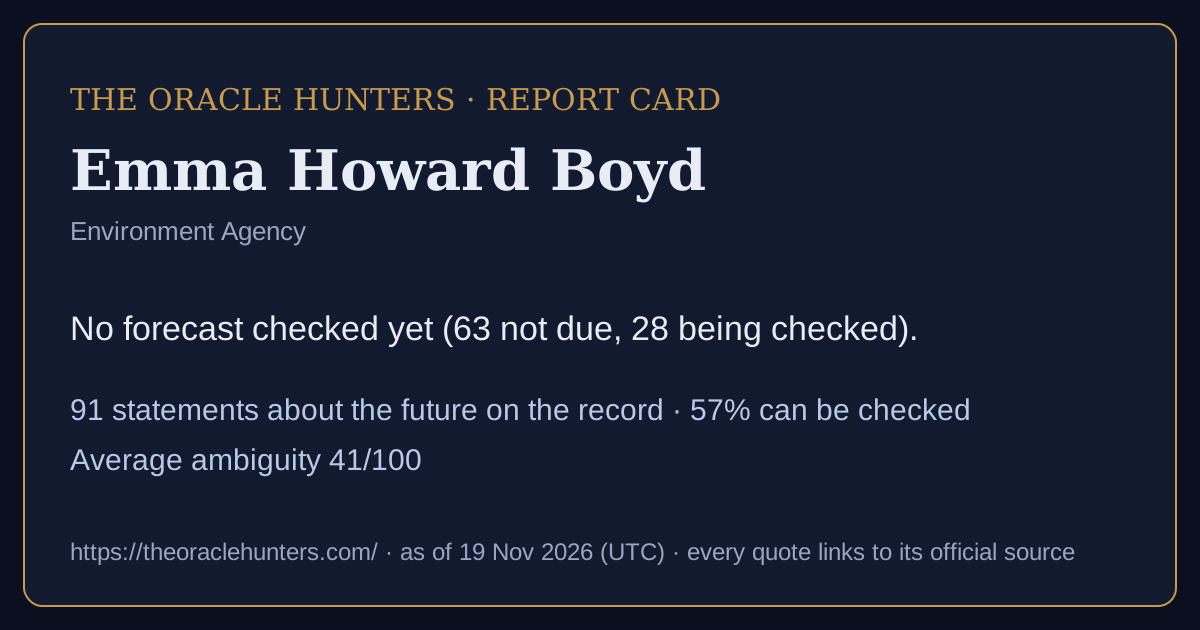
Track record: No forecast checked yet (63 not due, 28 being checked).
91forecasts & commitments on the record
57%can be checked as stated
41average ambiguity (0-100)
0goalpost moves recorded
0confirmed U-turns
Timeline
came true partly did not not due / being checked / too vague
Calibration score: shown after 10 checked forecasts with a stated likelihood (now 0).
How they speak about the future: based on data 83, stated on authority 8.
Kinds of claim: forecast 61, mixed claim 19, scenario (if… then) 11. · Download this report card as a picture
In the nine words
πρόγνωσιςInference from evidence72 · 79%πρόνοιαPreparing for the future11 · 12%μαντείαInspired knowledge8 · 9%
How to read this
Each box is one sentence a public figure or institution said about the future, word for word, with a link to the official text. Can be checked means it names what will happen, by when, and how likely - so it can be compared with official figures later. Too vague to check means it does not. Ambiguity (0-100) is how many different ways the sentence can be read. When the date passes, the forecast is compared with official data and marked came true, partly or did not come true. Labels judge the sentence, never the person. Full guide and glossary.On the record (91)
The Infrastructure and Projects Authority has analysed over £200 billion of this, up to 2024/25.
They showed that UK banks and insurers will end up taking on nearly £340 billion worth of climate-related losses by 2050, unless action is taken to curb rising temperatures and sea levels.
Investment in climate adaptation for sub-Saharan Africa could cost between 30 to 50 billion dollars each year over the next decade, or roughly two to three percent of GDP.
This year, COP27 will be held in Africa.
There will be a likely 50 percent increase in global food demand between 2010 and 2050.
By 2030, the population of the world will be over 8.5 billion people.
We will work with the NFU, other farming bodies, Water UK and government to deliver clarity around the risk based approach we will apply to autumn spreading this year.
by 2050, we will need around 3,435 million extra litres of water per day
Informed by the valuation report for the Climate Change Committee’s evidence it estimates that economic damages could exceed many billions of pounds every year by 2050 even under 2 degrees of global heating.
Even if we reach net zero by 2050, sea levels will continue to rise well into the next century.
By 2024, we will have revised and extended our assessment of risk from coastal erosion to properties and infrastructure.
It points to other sources of evidence that suggest, by 2045, the cost of climate change to the UK could be at least 1 percent of GDP.
The Barrier was opened in 1982 - and was expected to last until 2030.
In that it said that by 2050, it expected:
The National Framework for Water Resources says that if significant action is not prioritised, then by 2050, around 3,435 million extra litres of water per day will be needed to address future pressures.
By 2050, the number of people who lack sufficient water at least one month per year, could soar from 3.6 billion, to more than 5 billion.
“Furthermore, 60 percent of the 172 countries reporting are unlikely to reach the target of integrated water-resources management by 2030.
How many construction projects will be invested in before 2050 that are not currently subject to the rigour demanded by our net zero goals?
While Germany had targeted to lower greenhouse gas emissions 55 percent by 2030, compared to 1990 levels, the court ordered the government to revise the law by the end of the year.
Research from the Rocky Mountain Institute, the Natural Resources Defense Council, and – in the UK - the Green Finance Institute, has shown that there are 27 operational green banks in 12 countries that have invested over $25 billion of their own capital, and attracted twice as much from the private sector into low-carbon and resilient projects.
It will have £22 billion of financial capacity, is expected to support at least £40 billion of investment in infrastructure projects, and one of its core objectives will be to help tackle climate change.
The Chancellor is also expected to confirm the world’s first sovereign green savings bond, which will invest £20 million in offshore wind, £70 million in long-term low-carbon energy storage and £4 million to boost the production of green energy crops.
Tomorrow, in the Budget, the Chancellor is expected to confirm £22 billion to fund a national infrastructure bank that will fund £40 billion of infrastructure projects.
We will reduce our emissions by a further 45 percent by 2030, and address the effect of our remaining emissions through offsetting.
But, without flood defences, the economic damages could have been about 70 times higher at around £3.9 billion.
“At current estimates from the Climate Change Committee, UK low carbon investment each year will need to increase from around £10 billion in 2020 to around £50bn by 2030.
The funding will be allocated from the UK’s existing commitment of £11.6 billion for international climate finance.
The social benefits of physical activity in England have been valued at an estimated £2.18 billion a year, but this could be higher if more people had access to good places to exercise in.
In early 2021, the Environment Agency will be launching the government’s Investment Readiness Fund and welcoming applications.
Now should be a time to change, and the Environment Agency will continue to do everything we can in 2021 to ensure it is.
We will achieve our ambitious ten year target by reducing our emissions by at least 45 percent by 2030…
In Greater Manchester, we are part of a project that aims to increase the city’s green infrastructure 10 percent by 2038.
Results from the Action Track will be showcased at the virtual Climate Adaptation Summit – which will also be hosted by the Dutch Government on 25 January 2021, a key moment in the run up to the UK hosted COP26.
I hope the Environment Agency’s goal to become a net-zero organisation by 2030, will also demonstrate how to do both at the same time.
Rising seas could force hundreds of millions of people in coastal cities from their homes, with total costs of more than one trillion dollars each year by 2050.
“There could also be a race to zero vulnerability of every country by 2030 as an equivalent to the race to zero emissions.”
The number of people who lack sufficient water, at least one month per year, could soar from 3.6 billion today, to more than 5 billion by 2050.
Climate change could also push more than 100 million people in developing countries below the poverty line by 2030.
Without adaptation, climate change could depress growth in global agriculture yields up to 30 percent by 2050, disproportionately affecting small farms around the world.
Last year, the GCA released a report that says investing 1.9 trillion dollars in adaptation efforts globally from 2020 to 2030, could guarantee 7 trillion dollars in total net benefits.
But, we will reduce our emissions 45 per cent by 2030, and offset what remains through activities including tree planting, restoring soil quality and peat bogs.
recognise the contribution the 58 per cent of grade one agricultural land currently at risk of flooding makes to domestic food security
We will be able to do a lot with the £4 billion the government has pledged for the next budget.
As we look ahead to what might change in the next year, and the next decade, let’s work together, use the opportunities in the Environment Bill, and in hosting COP26, so that just as we value the wonder of a diamond, we value the wonder of the natural world.
Later this year the UK will host COP26 – in the run up the government has an incredible opportunity to show the bold leadership required to begin to ease the pressure.
If it weren’t for flood and coastal infrastructure in England, the January 2017 tidal surge alone could have caused £37 billion in economic damages.
This year the Environment Agency will launch its new Flood and Coastal Erosion Risk Management Strategy.
But, without flood defences, the damages could have been £1.6 billion higher.
Later this year, the UK will be hosting COP26 in Glasgow.
And extreme once-a-century sea level events will become annual events by 2050, in all future climate scenarios.
Showing the newest 50 - the ledger has all 91.
Also said - not checkable as stated (12 newest)
Remarks about the future with no date, figure or likelihood that could be checked. They are kept on the record and shown here, but not scored.
“Human beings have been fantastic at adapting to change, adapting to climate emergencies, and we will continue to do so.
These decisions define what we will deliver.
Several years of structural change will take resources, staff time and management focus away from delivery – at a time when delivery must be the priority.
I hope they will get the support they need to deliver what we are going to ask of them in the years to come.
“If we throw away the UK’s international leadership on the environment, we will lose the support of a broad coalition of voters.
We will be digging our electoral grave.”
In England we know that this century, we are likely to see 40-degree heat during the summer, but developers don’t have to mitigate against that - not now nor at any point in the future.
If a local council is approving investment in new housing - or roads, or a shopping centre - they must demand that climate resilience runs through the veins of the project.
In May, the Bank of England published its first climate stress tests.
The learning from this will help us, and others all over the world, to steer large and small infrastructure projects that reduce emissions, help society and drive economic development.
Environmental tax relief of this kind could be extremely useful to finding finance for future environmental projects.
It says we will work with farmers, land managers, water companies and internal drainage boards in the Fens to better assess risks and discover what climate adaptation means in low-lying catchments where premium food production is dependent on flood risk management and land drainage.