Emma Hardy
Department for Environment, Food & Rural Affairs · GBR
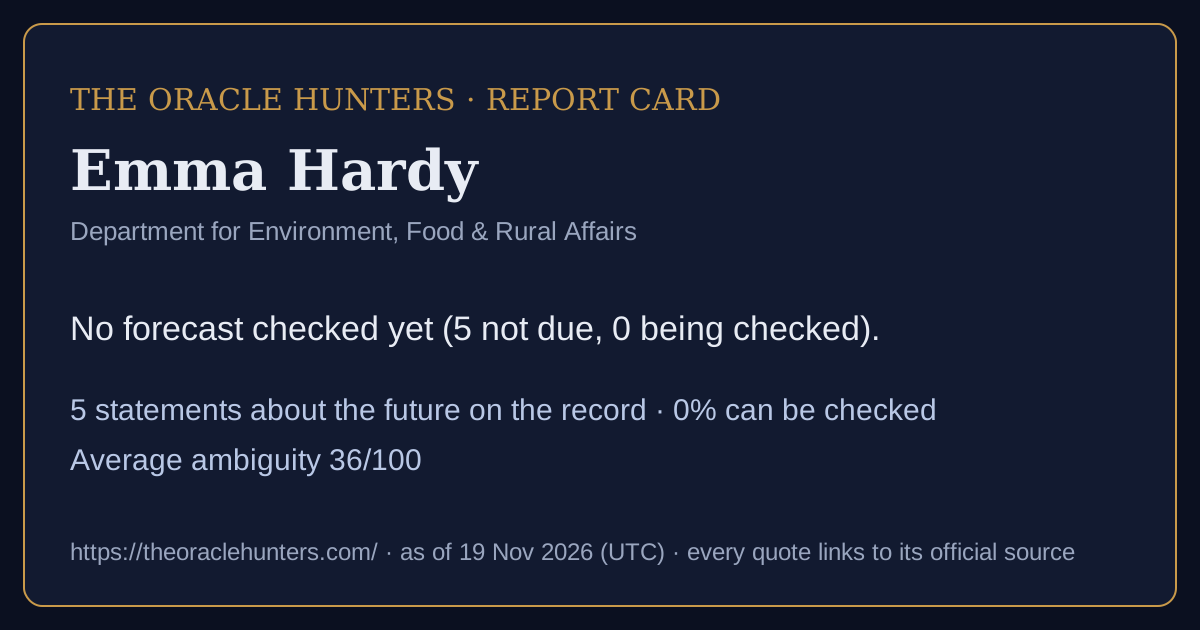
Track record: No forecast checked yet (5 not due, 0 being checked).
5forecasts & commitments on the record
0%can be checked as stated
36average ambiguity (0-100)
0goalpost moves recorded
0confirmed U-turns
Timeline
came true partly did not not due / being checked / too vague
Calibration score: shown after 10 checked forecasts with a stated likelihood (now 0).
How they speak about the future: based on data 5.
Kinds of claim: forecast 3, mixed claim 2. · Download this report card as a picture
In the nine words
How to read this
Each box is one sentence a public figure or institution said about the future, word for word, with a link to the official text. Can be checked means it names what will happen, by when, and how likely - so it can be compared with official figures later. Too vague to check means it does not. Ambiguity (0-100) is how many different ways the sentence can be read. When the date passes, the forecast is compared with official data and marked came true, partly or did not come true. Labels judge the sentence, never the person. Full guide and glossary.On the record (5)
If we get this right, the water system of 2050 will be cleaner, smarter, more resilient, and more trusted than anything we have today.
By 2050, public confidence will be built through openness through real-time reporting, independent monitoring, and clear accountability.
By 2050, the UK will face hotter, drier summers, wetter winters, more intense rainfall, and greater pressure on water resources.
The pipes, treatment works, data platforms, and supply chains that will still be operating in 2050 are being designed and deployed today.
By 2050, we should expect real-time visibility across the entire system, from catchments and rivers, to networks, treatment works, and customer demand.
Also said - not checkable as stated (7 newest)
Remarks about the future with no date, figure or likelihood that could be checked. They are kept on the record and shown here, but not scored.
And this White Paper outlines how we will work together with water companies, investors, communities and the environment to transform our water system, ensuring a sustainable water system for future generations.
We are working with companies and trade unions to foster a culture of respect and collaboration, and we will continue to engage closely to ensure that every employee can work without fear.
Bringing people together to share best practice will enable the sector to deliver the real change this country needs to see.
But through our reforms, this Government will ensure regulation is stable, predictable, and fair, moving away from short-term decisions and recognising the unique challenges faced by individual companies.
The government will respond to Sir Jon Cunliffe’s recommendations in a full White Paper, and we will be seeking your consultation on this.
As part of this, we will establish a single, powerful regulator – bringing together the roles of Ofwat, the Environment Agency, Natural England, and the Drinking Water Inspectorate.
For major infrastructure projects, such as the new reservoirs, we will continue to use the Specified Infrastructure Project Regulations (SIPR), following the successful model used for the Thames Tideway Tunnel.