Elvira Nabiullina
Bank of Russia
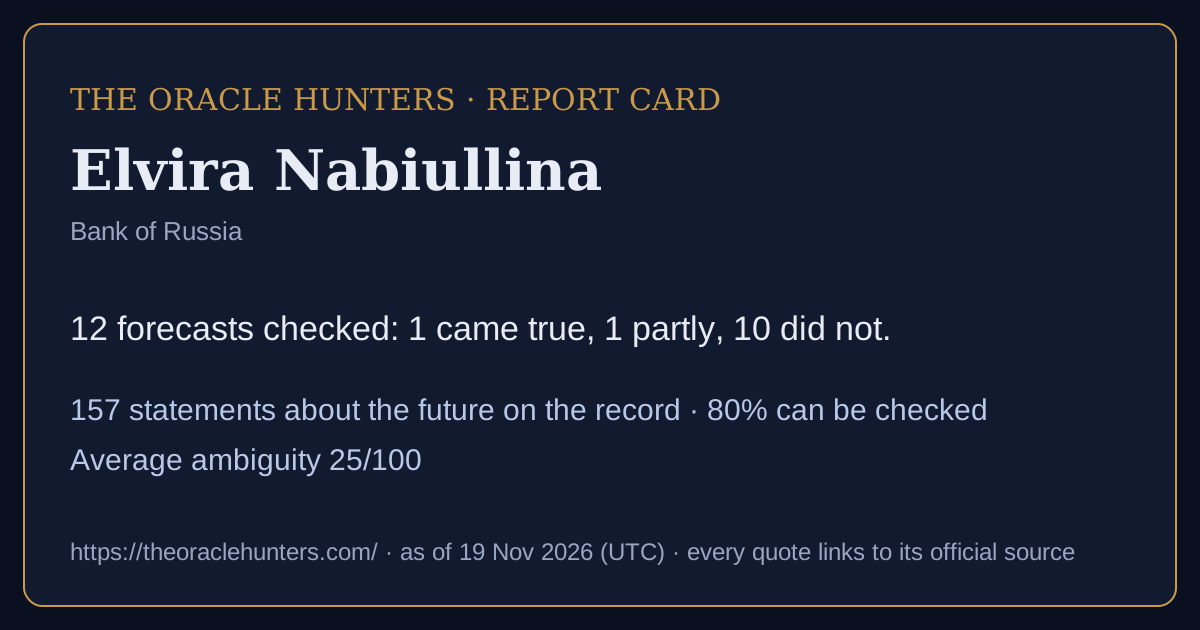
Track record: 12 forecasts checked: 1 came true, 1 partly, 10 did not.
157forecasts & commitments on the record
80%can be checked as stated
25average ambiguity (0-100)
0goalpost moves recorded
0confirmed U-turns
Timeline
came true partly did not not due / being checked / too vague
Calibration (Brier score, 0 is perfect, 0.25 is a coin toss): 0.516 over 12 checked forecasts.
How they speak about the future: based on data 131, stated on authority 20, educated guess 6.
Kinds of claim: forecast 131, mixed claim 19, commitment 4, scenario (if… then) 3. · Download this report card as a picture
In the nine words
πρόγνωσιςInference from evidence129 · 82%μαντείαInspired knowledge17 · 11%προαναγγελίαPublic pre-announcement4 · 3%πρόνοιαPreparing for the future3 · 2%εἰκασίαConjecture3 · 2%πρόβλεψιςSeeing the signs1 · 1%
How to read this
Each box is one sentence a public figure or institution said about the future, word for word, with a link to the official text. Can be checked means it names what will happen, by when, and how likely - so it can be compared with official figures later. Too vague to check means it does not. Ambiguity (0-100) is how many different ways the sentence can be read. When the date passes, the forecast is compared with official data and marked came true, partly or did not come true. Labels judge the sentence, never the person. Full guide and glossary.Checked
Our baseline forecast assumes that inflation will decrease to 4-4.5% by the end of 2022.
Did not come true. Said: inflation at the end of the year between 4% and 4.5% in 2022. Official figure for Russian Federation: 11.9% (BIS consumer prices (December, year on year)). Missed. Off by 7.4 points. official data · checked 17 Nov 2026 · automatic check against official data (rules v4)
GDP will increase by 4-4.5% this year and by 2-3% further on, which is in line with the sustainable growth path.
Did not come true. Said: economic growth between 4% and 4.5% in 2021. Official figure for Russian Federation: 5.9% (World Bank open data). Missed. Off by 1.4 points. official data · checked 14 Nov 2026 · automatic check against official data (rules v3)
Considering such policy, inflation will decline to 4.0-4.5% next year.
Did not come true. Said: inflation between 4% and 4.5% in 2022. Official figure for Russian Federation: 13.7% (World Bank open data). Missed. Off by 9.2 points. official data · checked 14 Nov 2026 · automatic check against official data (rules v3)
Our decision to accelerate the return to the neutral key rate will make it possible to bring annual inflation back to 4% by the middle of 2022.
Did not come true. Said: inflation around 4% in 2022. Official figure for Russian Federation: 13.7% (World Bank open data). Missed. Off by 9.7 points. official data · checked 14 Nov 2026 · automatic check against official data (rules v3)
The economy will expand by 2.5-3.5% in 2022 and by 2-3% in 2023.
Did not come true. Said: economic growth between 2.5% and 3.5% in 2022. Official figure for Russian Federation: -1.4% (World Bank open data). Missed. Off by 3.9 points. official data · checked 14 Nov 2026 · automatic check against official data (rules v3)
Inflation is expected to be in the range of 4.6-4.9% as of the end of 2020.
Came true. Said: inflation at the end of the year between 4.6% and 4.9% in 2020. Official figure for Russian Federation: 4.9% (BIS consumer prices (December, year on year)). On target. official data · checked 17 Nov 2026 · automatic check against official data (rules v4)
We also take into account that it is essential to maintain accommodative monetary conditions next year in order to stabilise inflation close to 4% over the forecast horizon.
Did not come true. Said: inflation around 4% in 2021. Official figure for Russian Federation: 6.7% (World Bank open data). Missed. Off by 2.7 points. official data · checked 14 Nov 2026 · automatic check against official data (rules v3)
We expect that the GDP growth rate will gradually increase to 1.5-2.0% in 2020 and to 2-3% in 2022.
Did not come true. Said: economic growth between 1.5% and 2% in 2020. Official figure for Russian Federation: -2.7% (World Bank open data). Missed. Off by 4.2 points. official data · checked 14 Nov 2026 · automatic check against official data (rules v3)
We therefore leave our GDP growth forecast unchanged at 1.2-1.7% for 2019, admitting it may rise to 2-3% in 2021 as the Government implements its structural reforms.
Partly came true. Said: economic growth between 1.2% and 1.7% in 2019. Official figure for Russian Federation: 2.2% (World Bank open data). Close: outside the margin, but within one more half point. Off by 0.5 points. official data · checked 14 Nov 2026 · automatic check against official data (rules v3)
The baseline scenario assumes that a reduction in oil prices will trigger no growth in inflation, which will continue to slow down on track to reach 4% before the end of 2017 and will be subsequently maintained near this level on condition our monetary policy remains moderately tight.
Did not come true. Said: inflation at the end of the year around 4% in 2017. Official figure for Russian Federation: 2.5% (BIS consumer prices (December, year on year)). Missed. Off by 1.5 points. official data · checked 17 Nov 2026 · automatic check against official data (rules v4)
As a result, GDP is expected to decrease by 3.5%-4% in 2015 and 1%-1.6% in 2016.
Did not come true. Said: economic growth between 1% and 1.6% in 2016. Official figure for Russian Federation: 0.2% (World Bank open data). Missed. Off by 0.8 points. official data · checked 14 Nov 2026 · automatic check against official data (rules v3)
In the baseline scenario, we expect an acceleration of the GDP growth from 0.4% in 2014 (these are our assessments for this year) to 1.0% in 2015, 1.9% in 2016 and 2.3% in 2017.
Did not come true. Said: economic growth around 1% in 2015. Official figure for Russian Federation: -2.0% (World Bank open data). Missed. Off by 3.0 points. official data · checked 14 Nov 2026 · automatic check against official data (rules v3)
On the record (157)
If people expect price growth to stay as high in the future, their saving activity will be low.
Our baseline scenario assumes that price trends in some product groups will reverse to a certain extent next year.
Of course, a very tight policy aggressively responding to transitory factors could bring inflation back to 4% more quickly.
As I have already said, our forecast assumes that some disinflationary factors will materialise next year.
As of the end of the year, the overall increase in GDP might reach nearly 4.5%.
Our baseline forecast assumes that inflation will decrease to 4-4.5% by the end of 2022.
Did not come true. Said: inflation at the end of the year between 4% and 4.5% in 2022. Official figure for Russian Federation: 11.9% (BIS consumer prices (December, year on year)). Missed. Off by 7.4 points. official data · checked 17 Nov 2026 · automatic check against official data (rules v4)
Our policy rate will range between 7.3% and 8.3% on average over the year.
Under the baseline forecast, next year inflation will come close to the target of 4-4.5%.
Our monetary policy, aimed at reducing inflation and returning it to the 4% target, will help entrepreneurs who are investing in business development so they can make definite plans for the future.
Y ou may remember that inflation at the time was below target: about 2.3% at the start of the pandemic.
According to the data on GDP for the second quarter and recent statistics for the third quarter, gross fixed capital formation also grows fast this year, and even faster than we assumed in our July forecast.
We have also increased the forecast range of the annual average key rate for the next year by 1.3 percentage points, as compared to July.
In this context, we have revised our forecast range of retail lending growth for this year upwards by 3 percentage points to 2125%.
GDP will increase by 4-4.5% this year and by 2-3% further on, which is in line with the sustainable growth path.
Did not come true. Said: economic growth between 4% and 4.5% in 2021. Official figure for Russian Federation: 5.9% (World Bank open data). Missed. Off by 1.4 points. official data · checked 14 Nov 2026 · automatic check against official data (rules v3)
Considering such policy, inflation will decline to 4.0-4.5% next year.
Did not come true. Said: inflation between 4% and 4.5% in 2022. Official figure for Russian Federation: 13.7% (World Bank open data). Missed. Off by 9.2 points. official data · checked 14 Nov 2026 · automatic check against official data (rules v3)
We have considerably raised our inflation forecast for this year, as compared to July, namely to 7.4-7.9%.
We currently expect that our monetary policy stance will ensure that inflation returns to 44.5% in the second half of next year.
We forecast that GDP will equal 2-3% in the next two years.
We expect inflation to slow down to 4.0-4.5% next year and stay close to 4% further on.
According to our revised forecast, the average key rate next year will equal 6.0-7.0% per annum.
According to our preliminary estimates, the expansion of oil output under the new OPEC+ agreements will add about 0.1 pp to GDP growth this year and 0.2-0.3 pp next year.
Taking this into consideration, we have raised the oil price path in our forecast by 5 US dollars per barrel in the next three years.
Considering these trends, we have revised our economic growth forecast for this year upwards from 3-4% to 4-4.5%.
I would like to stress that we will increase the buffers further if growth in this segment does not subside.
This might induce proinflationary pressure, even if unemployment stays close to prepandemic rates.
We estimate that the growth rate in this market might reach 20% this year, whereas household incomes are not recovering that fast.
According to our estimate, growth in mortgage lending might exceed 20% as of the end of the year.
This year, we are going to make such a review as well.
In any case, the introduction of the standard will not take place earlier than 2022.
If such rates persist, then the annual growth will be about 20%, which is much higher than the growth of household incomes.
A delay might force us to raise the key rate more significantly and not only return to a neutral rate (which ranges from 5% to 6% in nominal terms), but, possibly, even switch to tight monetary policy.
However, if lending standards continue to lower (this is a trend we are observing) or housing price growth remains fast, we might not rule out the need to increase these buffers.
The current account surplus will grow to 56 billion US dollars this year from 34 billion US dollars last year.
Taking into account this factor and the slower recovery of oil production under the OPEC+ agreements, we have raised our forecast for oil prices from 50 to 60 US dollars per barrel this year and to 55 US dollars per barrel next year.
In this regard, we have revised our inflation forecast for the end of 2021.
However, given the period of substantially accommodative monetary policy and the time-lagged influence of our decisions on inflation, we believe that elevated inflationary pressure may persist until the end of the year due to the impact of the steady factors.
Taking into account high-frequency indicators for the first quarter, we keep unchanged our GDP growth forecast for this year at 3-4%.
Our decision to accelerate the return to the neutral key rate will make it possible to bring annual inflation back to 4% by the middle of 2022.
Did not come true. Said: inflation around 4% in 2022. Official figure for Russian Federation: 13.7% (World Bank open data). Missed. Off by 9.7 points. official data · checked 14 Nov 2026 · automatic check against official data (rules v3)
Some banks 'conceal' the actual cost of a loan in insurance premiums and fees, while their amount may reach up to 50% of the loan cost.
As to an individual limit for systemically important banks, we will reduce it over the next 12 months not by 30%, as we planned before, but only by 15%.
We can see that mortgage lending surged last year by over 20%, but I will dwell on this topic later.
As I have already said, if we estimate the potential amount of issues related to restructured loans in the current situation and banks' revenues as the banking system's profit decreased by 6% against 2019, we will see that there are no reasons why anti-crisis measures should not be terminated gradually.
Banks consider that this figure may reach 2030%.
This year, we are going to publish a consultation paper on the regulation of banks developing ecosystems, which will become the first step towards the start of our joint efforts with the market community aimed at devising ecosystem regulation approaches.
Given the current positive trends, we keep unchanged our forecast of GDP growth at 34% for 2021.
The economy will expand by 2.5-3.5% in 2022 and by 2-3% in 2023.
Did not come true. Said: economic growth between 2.5% and 3.5% in 2022. Official figure for Russian Federation: -1.4% (World Bank open data). Missed. Off by 3.9 points. official data · checked 14 Nov 2026 · automatic check against official data (rules v3)
Therefore, we have increased our forecast of oil prices from 45 to 50 US dollars per barrel for 2021 and 2022.
Furthermore, the economy may reach its pre-pandemic levels already by late 2021, and not by mid-2022, as we assumed earlier.
Given the monetary policy pursued, inflation will return to the target at the end of 2021 and stay close to 4% further on.
The banking system's claims on companies are forecast to increase by 7-11% this year, and those on households by 14-18%, largely as a result of the accelerated expansion of mortgage lending.
Showing the newest 50 - the ledger has all 157.
Also said - not checkable as stated (12 newest)
Remarks about the future with no date, figure or likelihood that could be checked. They are kept on the record and shown here, but not scored.
Conversely, if we miss the right moment to make a prompt monetary policy response, we will then have to raise the key rate even more.
It has to be targeted for us to avoid a situation where accelerated growth of property prices (their growth in the primary market was accelerated precisely by the subsidised programmes) will continue to reduce housing affordability for households.
We must realise that energy transition is likely to be a challenge for us.
We should keep pace with the trends, considering that corporate environmental performance is set to become a key factor driving investor and creditor decisions, as if we fail to address this problem in due time, we risk losing our competitive advantages and could be consigned to a global economic backwater.
Thereafter, in the middle of next year, market participants are due to receive our recommendations as to how they should move ahead.
We recently outlined our approaches to monetary policy for the next three years and our outlook, as well as our scenarios in the draft Monetary Policy Guidelines.
We might have to raise those buffers still further.
In the next few weeks, we are going to release a consultation paper to discuss these and other proposals in greater detail.
With account for the fact that the pandemic has had a serious impact on society, on the economy as a whole, and on the financial sector, we must think about the future, and about how the financial sector will help the development of the economy.
All innovations that affect banks, will be discussed conceptually as advisory reports, then we will give everyone time to discuss the draft regulations themselves, and then give everyone time to implement these regulatory acts.
We will not turn a blind eye to problems and risks, but where we can, we will try to help banks reduce costs, which we believe is important.
Banks with a basic license will be the focus of our attention because there are questions banks with a basic license need to answer.