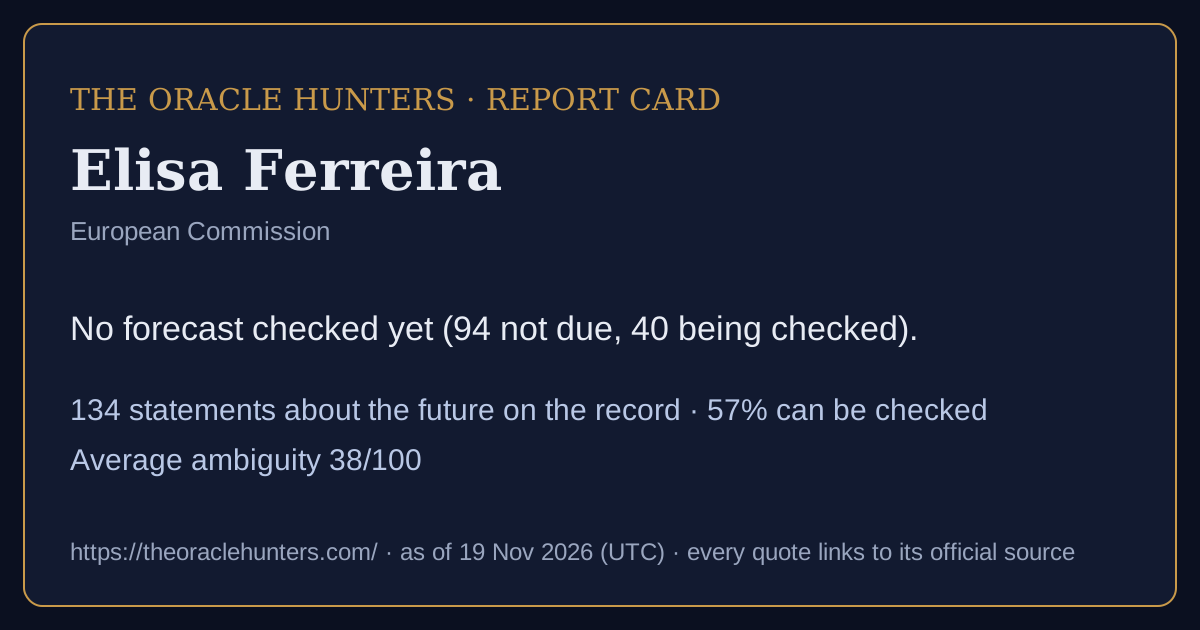
Elisa Ferreira
European Commission
Track record: No forecast checked yet (94 not due, 40 being checked).
134forecasts & commitments on the record
57%can be checked as stated
38average ambiguity (0-100)
0goalpost moves recorded
0confirmed U-turns
Timeline
came true partly did not not due / being checked / too vague
Calibration score: shown after 10 checked forecasts with a stated likelihood (now 0).
How they speak about the future: based on data 121, stated on authority 11, educated guess 2.
Kinds of claim: forecast 108, mixed claim 18, commitment 7, scenario (if… then) 1. · Download this report card as a picture
In the nine words
πρόγνωσιςInference from evidence116 · 87%μαντείαInspired knowledge9 · 7%προαναγγελίαPublic pre-announcement7 · 5%πρόνοιαPreparing for the future1 · 1%εἰκασίαConjecture1 · 1%
How to read this
Each box is one sentence a public figure or institution said about the future, word for word, with a link to the official text. Can be checked means it names what will happen, by when, and how likely - so it can be compared with official figures later. Too vague to check means it does not. Ambiguity (0-100) is how many different ways the sentence can be read. When the date passes, the forecast is compared with official data and marked came true, partly or did not come true. Labels judge the sentence, never the person. Full guide and glossary.On the record (134)
And in the current period 2021-2027, Cohesion investments will continue to support our common priorities: green transition, competitiveness, and innovation.
Cohesion investments are expected to help create 1.3 million jobs and increase the EU's GDP by 0.5% by the end of the implementation period.
Implementation has now accelerated and by June this year, 23% of projects had been selected, reaching over 40% in some Member States.
Over the 2021-2027 period, Cohesion Policy's 380 programmes will thus disburse a total of 378 billion euro (half a trillion euro if we include the national co-financing) to support almost 850 000 enterprises, help 6.5 million unemployed people find jobs and 723 000 homes with improved energy performance, to give you just a few examples.
To take just one example, macroeconomic modelling suggests that the GDP of Europe as a whole will be 1% higher as a result of the current and previous programme rounds, and each euro invested in Cohesion Policy is expected to generate 3 additional euros of GDP.
We will not be able to seize the opportunities of the green and digital transition, without ensuring that this is done in a just and fair manner, and that the leveraged growth and development is anchored on the new axes of competitiveness.
And this approach is matched with funding: in the current financing period, which will be implemented until 2029, over 36 billion euros of European funds will finance innovation across Europe.
And in the current period of 2021-2027 Germany will receive 20 billion euros from Cohesion policy.
So we will need a strong Cohesion Policy, and a strong EU budget, which goes beyond the 1% ceiling of the EU's collective wealth.
Increased trade, increased investment, and more supply chains, mean that by 2030, GDP per head will be around 1% higher for the EU as a whole.
In Greece, a combination of the Cohesion Fund and of the European Regional Development Fund – over 4.4 billion euros – will be invested in energy efficiency, in renewable energy, in sustainable transport, in state-of-the-art waste facilities, and in the transition of islands to clean energy, as well as their inter-connection with the mainland.
It is estimated that 2 million new jobs will be generated in new green industries, from renewable energy and recycling to deep renovation.
Also the Ukrainian Facility has been set up, with 50 billion euros that will be provided up to 2027 to support you in the so needed recovery, reconstruction and modernisation efforts of Ukraine.
Therefore, an important share of this year's Prizes will be awarded to real-life examples from these regions.
In addition, in this year's prizes, we also put the spotlight on regions, for which the transition to a carbon neutral economy may pose a particular challenge.
For instance, Croatia's GDP will be 8% higher, Poland and Slovakia's 6% higher driven by investments supported by Cohesion Policy.
The 9th Cohesion Report confirms that the support of Cohesion Policy funding between 2014 and the end of the current programming period, in 2027, will help to create some 1.3 million new jobs across Europe, and to increase EU GDP by 1% in 2030.
We estimate that 1.3 million new jobs will be created by 2027 thanks to the combined impact of the 2014-20 and the 2021-27 programmes.
As your own analysis reminds us, these disparities, if not addressed, will be exacerbated by emerging challenges from artificial intelligence and the green transition, to demographic decline, and enlargement to new Member States.
A total of 31 reforms this year will benefit the new generations.
And this year, 200 civil servants from 12 Member States will be involved in over 70 exchanges on a wide variety of topics, naturally, going from green finance to digital public administration, from data-driven decision-making to the improvement in the management of EU Funds.
Second, many measures this year will support the green and digital transitions. 95 of the 307 proposed reform projects, almost one third, will focus on the transition to a net zero economy.
We will also provide 6 billion euros of support to your investments in ‘catching-up settlements'.
So we will provide 4.5 billion euros of support to stimulate productivity, business process efficiency, and digitalisation.
We will provide 6.7 billion euros of European support to your Hungarian investments in areas such as: renewable energy, energy efficiency, the circular economy, and sustainable transport.
And by 2050, another 2.5 billion people will join them.
The recently published 2023 annual summary report on 2014-2020 implementation highlighted that by the end of 2022 Cohesion Policy supported 2.7 million enterprises and supported the creation of 370 000 new jobs in enterprises.
Cohesion Policy is supporting your investments with 21 billion euros in the current 2021-2027 programmes and will continue to support you in future.
We will bring together the various strands of debate in the 9th Cohesion Report, early next year.
But it is clear that further changes will be required after the end of the current programmes in 2027.
Their final report, prepared under their direct responsibility, is expected by the end of February next year.
In terms of next steps, the High-level Group on the future of Cohesion Policy that I launched early this year will meet two more times.
And the Commission will publish the 9th Cohesion Report in March 2024.
The green economy alone, will bring an estimated 2 million jobs to the European Union.
A group of high-level specialists has been meeting monthly since the beginning of the year and will prepare a report early next year.
And in 2021-2027, Cohesion Policy's programmes will help regions to prepare for the twin transitions and continue the convergence process.
The 2014-2020 Cohesion Programmes are expected to contribute by 0.5% to the EU GDP, reaching 3.2% in less developed regions, more than 5% for some of them.
Yet another example: in Trofa, the Cohesion Policy supported Preh Portugal with 9.3 million euros for various innovative projects, including electronic components, E-mobility, and energy efficiency.
And further calls for innovation support will be published in the first half of 2024.
Support will start in January 2024, continuing until May 2026.
We will launch a new call next month for those regions that are at risk, if nothing is done, of falling into such a trap.
This is particularly important in a context where the working age population will fall by 35 million people by 2050 – 35 million people is a big country! – and where some places are suffering brain drain, especially of the young and talented.
As we face the accelerated pace of climate change and energy transition, of technological change and globalisation, and of brain drain and an aging population, our goals remain the same, but we will need to adapt our tools and methods.
We have jointly invested several billion of euros to date, and the 2021-2027 programmes will support the regions with another 2 billion euros.
Next year we will celebrate 20 years of Poland's membership of the European Union.
They have already met 7 times, and will continue to meet until early next year.
And in the energy crisis that followed, Cohesion funds once again provided support to those most affected by the surge in prices, with the SAFE initiative – Supporting Affordable Energy – mobilising an expected 3.3 billion euros for small businesses, short-term work schemes and vulnerable households.
With further use of the new measures and emergency flexibilities introduced in Cohesion policy funds – CARE, FAST-CARE and SAFE – we expect implementation to increase further by the end of the year.
The impact of the 2014-2020 Cohesion Programmes is expected to be approximately 0.5% of EU GDP by the end of the implementation period, reaching 3.2% in less developed regions, in line with the Policy's objective for convergence and balanced growth.
Hopefully, we will not need to discuss these legal minutiae in the future because in the current period 2021-2027, for the sake of simplification, we have abolished the category of major project.
Showing the newest 50 - the ledger has all 134.
Also said - not checkable as stated (12 newest)
Remarks about the future with no date, figure or likelihood that could be checked. They are kept on the record and shown here, but not scored.
They keep returning for support, and we will continue to support them.
The success of the flagship, led to a project this year covering 9 countries across the EU.
So, let me conclude using the words of the Schuman declaration: “Europe will not be built all at once, but little by little, by concrete acts of solidarity”.
It should also include the necessary growth-enhancing reforms and the building, or reinforcement, of administrative capacity which are essential for enhanced impact and efficiency of European investments.
But this pace must be maintained in the coming months and years.
Cohesion Policy must continue to support the territorial development of all regions, with a particular focus on the less developed, and those at risk of getting stuck in development traps.
To this must be added investments in renewable energy and in public services, including education, health and transport.
And we will not be able to make the future enlargement a success without continued support for both future members, which currently stand at half of the EU GDP average, and current members which still have to deal with emerging challenges.
We will not be able to win the global competition against China and the US, without mobilising the strengths of every region.
We will remain committed to evidence-based policymaking, which is why I am here today, and why I thank all those who are working so hard on these matters.
Allow me to thank Germany's regions for their continuous support and engagement in highlighting the merits of the policy, its importance for all territories, as even those that are economically advanced will need support to undergo the transformations underway, to stay competitive and retain their leadership role in today's turbulent geopolitical context.
We will all benefit from your different points of view and experiences.