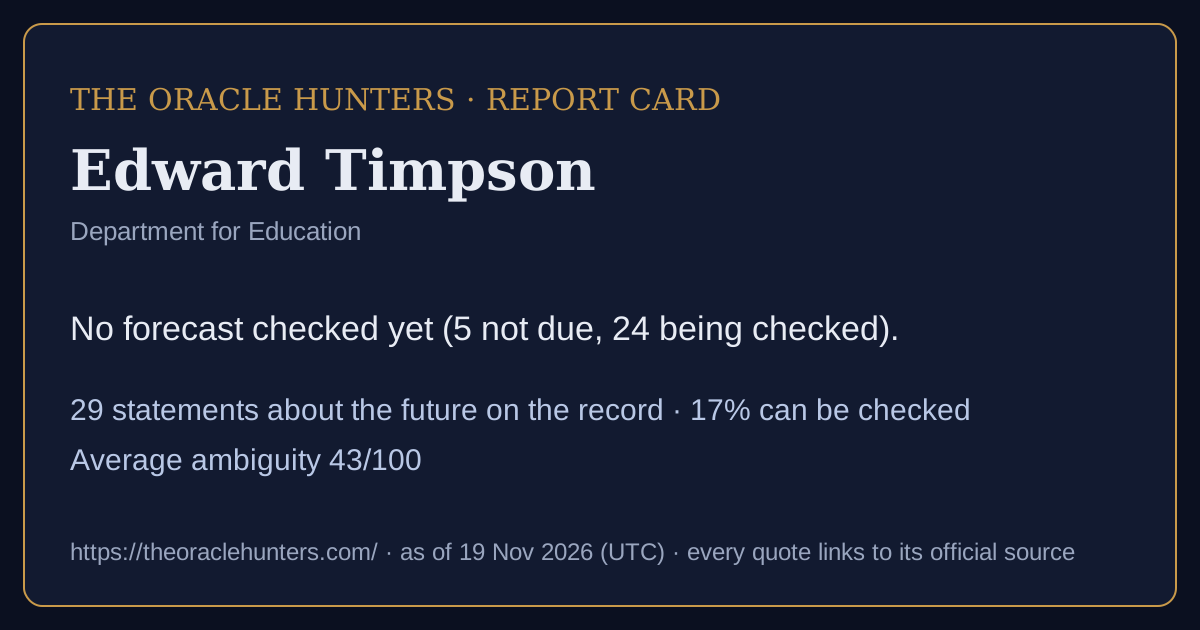
Edward Timpson
Department for Education · GBR
Track record: No forecast checked yet (5 not due, 24 being checked).
29forecasts & commitments on the record
17%can be checked as stated
43average ambiguity (0-100)
0goalpost moves recorded
0confirmed U-turns
Timeline
came true partly did not not due / being checked / too vague
Calibration score: shown after 10 checked forecasts with a stated likelihood (now 0).
How they speak about the future: based on data 20, stated on authority 9.
Kinds of claim: forecast 22, mixed claim 3, scenario (if… then) 3, commitment 1. · Download this report card as a picture
In the nine words
πρόγνωσιςInference from evidence16 · 55%μαντείαInspired knowledge9 · 31%πρόνοιαPreparing for the future3 · 10%προαναγγελίαPublic pre-announcement1 · 3%
How to read this
Each box is one sentence a public figure or institution said about the future, word for word, with a link to the official text. Can be checked means it names what will happen, by when, and how likely - so it can be compared with official figures later. Too vague to check means it does not. Ambiguity (0-100) is how many different ways the sentence can be read. When the date passes, the forecast is compared with official data and marked came true, partly or did not come true. Labels judge the sentence, never the person. Full guide and glossary.On the record (29)
We’re beginning to consult with you all on the specification for Staying Close and will be running events with councils, residential care providers and charities working with care leavers who are interested in piloting Staying Close, before the end of the year.
And the report’s challenge to find ways to improve educational achievements of children in residential settings is timely following the Prime Minister’s announcement of Sir Martin Narey’s review into residential care for looked-after children, who will report next year.
As you’ve heard, Ofsted is currently consulting on the framework, and inspections will be introduced next year.
And perhaps most crucially of all, the Prime Minister has personally committed to funding the primary PE and sports premium into 2020 - an additional £750 million that will ensure the progress you have made will not be lost.
As I’m sure all of you here will be aware, the employment rate for people with learning difficulties has been stubbornly low at around 7%.
95% of respondents will be running tailored study programmes next year, matching their students’ strengths to a programme that suits their abilities.
There’s £30 million available this year and much more to follow next year, if the ideas are there to merit it.
It’s one of the main reasons why we’re currently working with 10 local areas, including Lewisham, to trial a smaller version of the fund and using the insights gained to shape the national fund, which will be fully up and running in 2015.
There’s a £2.3 million project in Bury, too, called ‘I will if you will’, seeing what sort of activities would bring more women and girls into sport.
We will extend funding for an additional 12 months - £250,000 for 2014 to 2015 - to help continue the Ambassador’s efforts - and get more and more children into sport.
And if they can also be supported to live semi-independently rather than in residential care, these costs could drop by around £1 million.
The funding will come from the £150 million early intervention grant topslice next year - we’ll be releasing full details later this month as part of the local government settlement.
And if they can also be supported to live semi-independently rather than in residential care, their lifetime support costs could shrink by around £1 million.
There’s also more detail on what we think ‘best endeavours’ looks like in chapter 6 of the new draft code of practice, that makes clear what will be expected of local authorities and other services and applies to colleges for the first time next year.
So, from 2014, children adopted from care will be eligible for the pupil premium and pupil premium plus and for free early education under the programme aimed at the most disadvantaged 2-year-olds.
In housing, DfE is funding NCAS to run a residential children’s home project over the next 2 years - while DCLG is consulting on social housing guidance that will prioritise the most vulnerable groups, including care leavers.
In health, next year, DfE and DH will jointly update guidance on promoting the health of looked-after children.
This new 0 to 25 system will be up and running from September 2014, and it will be up to all of you to make sure it runs smoothly.
The pilot will begin this September, with an initial group of 100 graduates in training from 2014.
This money, a total of £3.7 million over the next 2 years, will help another 22 local authority partnerships - on top of the 35 we’re already backing - to develop a range of programmes that support all kinds of care; offering training and support to birth parents, adopters, residential staff, kinship as well as foster carers.
I’m keen to remedy this and so, later this year, we will be consulting on what more we can do to support these hugely dedicated carers, including on whether they should be able to request formal local authority recognition of their status as a long-term foster carer.
We expect the single family court to be up and running by April 2014 and will be looking to assist you to make it a success.
We’ll set out details of our preferred approach in a draft order which will be subject to formal consultation later this year.
As I said last year, the pathfinders will continue until September 2014 so we can make the most of their experience
Looking ahead, the Crown Prosecution Service will be publishing new legal guidance on prosecuting child sexual exploitation cases early this year, which will include advice on information sharing and improved support for victims.
The Crown Prosecution Service will be publishing new legal guidance on prosecuting child sexual exploitation cases early this year, which will include advice on information sharing and improved support for victims.
We recently announced that we will be making £150 million available to councils to boost adoption rates.
The consultation results will be available early next year.
I will continue pushing for more progress where you need it most, but I’ll also look to local authorities to take a lead. 2013 must be the year that we make real, sustained progress on improving the prospects for vulnerable young people.
Also said - not checkable as stated (12 newest)
Remarks about the future with no date, figure or likelihood that could be checked. They are kept on the record and shown here, but not scored.
But we have to acknowledge that we can’t expect local authorities to do it all.
And we want more departments to offer internships to care leavers, following the positive lead set by the DfE, the Department of Health and the Department for Work and Pensions, all of whom are recruiting care leaver interns over the next few weeks.
I’m looking forward to seeing the final findings next year.
It’s my job, as a decision maker, to set out how government is going to work with all of you to achieve our shared ambition to support the best possible outcomes for every care leaver.
To that end we’ve already identified a number of employers who are keen to get on board, but would encourage you to put the word out in an effort to connect to many more in the coming months and years ahead.
Another significant area for the group is around how you as virtual school heads, can work more closely with teachers and other school staff, and importantly with foster carers, to develop your understanding of the role they have to play in driving educational aspiration for looked-after children.
And virtual school heads should quite rightly be at the heart of these developments, central to modelling the way in which their local authority, schools and even health professionals should live and breathe the principles of every good corporate parent:
But in setting out to achieve just that, we also need to recognise that despite our collective impatience to ‘get on with it’, these reforms will take a while to embed.
Yet with continued support - and challenge - and with the voices of parents, children and young people at the heart of service delivery, I’m confident we will continue to see changes which empower, support and enable children and young people reach their full potential.
And although not all those barriers, system joins, communication vacuums and duplications of effort have disappeared, I urge you to keep at it because the rewards will be worth it.
It’s why closer monitoring of health’s role in joint-commissioning, co-production and other areas is going to be so vital as the reforms continue to evolve.
I personally garner invaluable knowledge from talking with parents and young people face to face and intend to carry on doing so in the coming months.