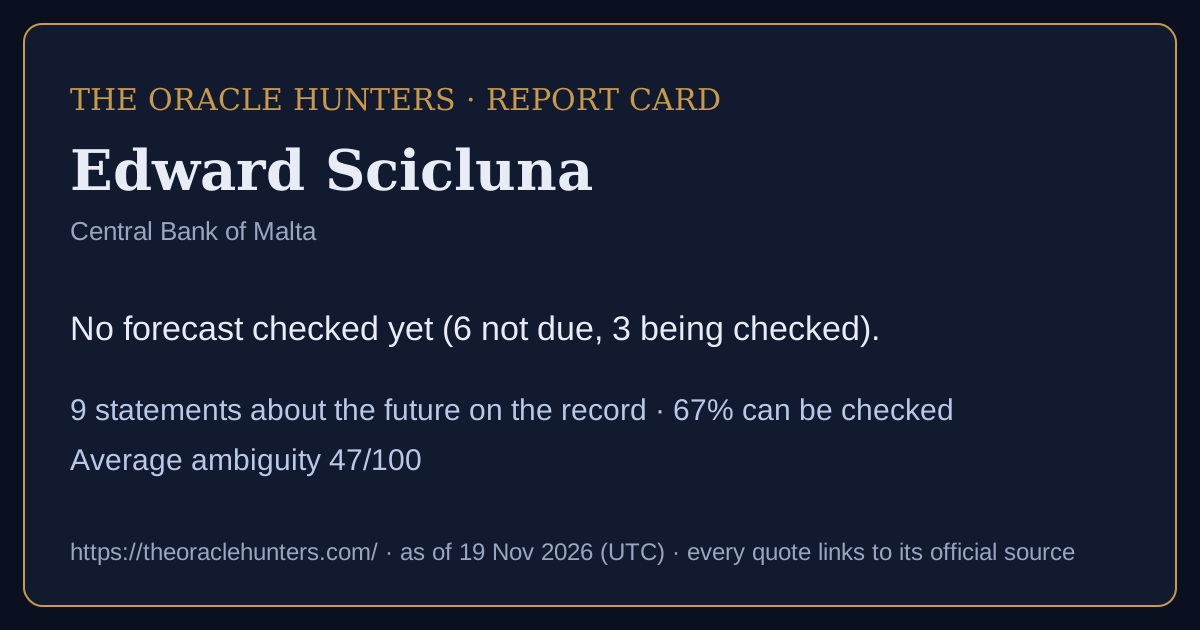
Edward Scicluna
Central Bank of Malta
Track record: No forecast checked yet (6 not due, 3 being checked).
9forecasts & commitments on the record
67%can be checked as stated
47average ambiguity (0-100)
0goalpost moves recorded
0confirmed U-turns
Timeline
came true partly did not not due / being checked / too vague
Calibration score: shown after 10 checked forecasts with a stated likelihood (now 0).
How they speak about the future: stated on authority 4, based on data 3, educated guess 2.
Kinds of claim: forecast 6, scenario (if… then) 2, commitment 1. · Download this report card as a picture
In the nine words
πρόγνωσιςInference from evidence3 · 33%μαντείαInspired knowledge3 · 33%πρόνοιαPreparing for the future2 · 22%προαναγγελίαPublic pre-announcement1 · 11%
How to read this
Each box is one sentence a public figure or institution said about the future, word for word, with a link to the official text. Can be checked means it names what will happen, by when, and how likely - so it can be compared with official figures later. Too vague to check means it does not. Ambiguity (0-100) is how many different ways the sentence can be read. When the date passes, the forecast is compared with official data and marked came true, partly or did not come true. Labels judge the sentence, never the person. Full guide and glossary.On the record (9)
The ECB's Governing Council will ensure that policy rates will be set at sufficiently restrictive levels for as long as necessary to ensure that inflation returns to its 2% medium-term target in a timely manner.
Overall inflation in Malta is set to ease further in the coming months.
Earlier this week the Commission provided us with more clarity regarding the forthcoming fiscal rules, with an agreement expected in December, asthe Stability and Growth Pact (SGP) escape clause will be deactivated before the end of the year.
This reflects some base effects of sharply declining energy prices in other countries with lower subsidies than ours, but as we shall see there are some domestic factors at play.
This assessment may seem surprising against the background of a 200 basis points increase in policy rates since July and the intention of the ECB's Governing Council to lift these rates higher as needed.
The much expected recession at the end of this year might not materialise after all.
This is a clue that if properly supported by policymakers, for example with the adoption of a common regulatory standard, the demand for green bonds could pick up rapidly, fostering the transition towards net zero.
If the financial system is weakened, the transmission of monetary policy is impaired, meaning that changes to the monetary policy stance will not be properly transmitted to the real economy.
Now, low inflation rates are being seen as just as much of a cause for concern and as a result, the target has now been set to 2% - over the medium-term - and the red flags are not only rates above that, but also rates below it.
Also said - not checkable as stated (12 newest)
Remarks about the future with no date, figure or likelihood that could be checked. They are kept on the record and shown here, but not scored.
The Governing Council has shown and will continue to show its commitment to safeguard price stability.
This state of play may be good for economic growth in the short-term.
The spike in inflation was also expected to go back to moderate levels in the course of 2022.
While domestic economic activity can be expected to gradually slow down during the current and coming quarters, the European Commission's forecasts that Malta isstill expected to have the second highest rate of growth in the euro area.
In our view, even this forecast is quite cautious given the resilience of the economy, as shown, for example by the unemployment rate, which is still below the lowest rate
Furthermore, even if trading partners were to enter a technical recession at the turn of the year, imported inflation may not fall significantly.
The more funds are channelled towards environmentally sustainable projects, the quicker the transition to net zero and the less resources will have to be deployed to adapt to climate change.
agriculture and livestock will have to withstand more severe repercussions than services or manufacturing.
This investment will need to be financed.
The rising of global temperatures could render vast regions unsuitable for land cultivation, straining access to food and prompting mass migration.
My understanding is that the financial markets and economic forecasters do not believe that the recession as seen today will be so deep that it will do all our work.
The reason for taking this stance issupported by the currentsituation that fiscal policy this time around will not be in synch with the restrictive policy taken by Central banks.