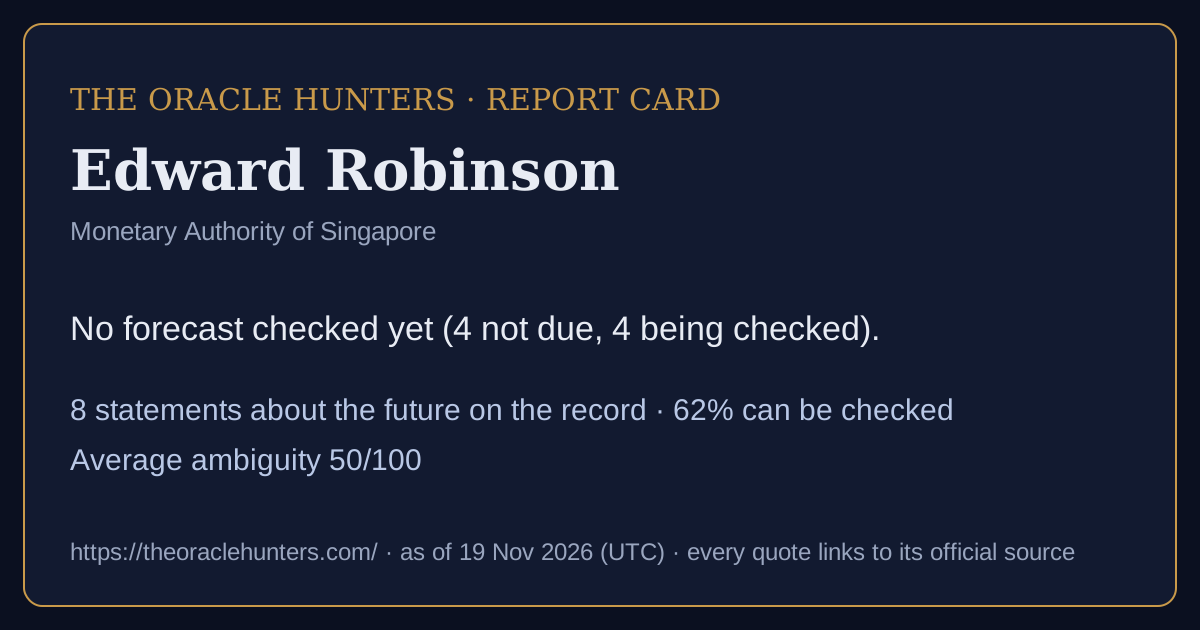
Edward Robinson
Monetary Authority of Singapore
Track record: No forecast checked yet (4 not due, 4 being checked).
8forecasts & commitments on the record
62%can be checked as stated
50average ambiguity (0-100)
0goalpost moves recorded
0confirmed U-turns
Timeline
came true partly did not not due / being checked / too vague
Calibration score: shown after 10 checked forecasts with a stated likelihood (now 0).
How they speak about the future: based on data 4, educated guess 2, stated on authority 2.
Kinds of claim: forecast 6, scenario (if… then) 2. · Download this report card as a picture
In the nine words
πρόγνωσιςInference from evidence4 · 50%πρόνοιαPreparing for the future2 · 25%μαντείαInspired knowledge2 · 25%
How to read this
Each box is one sentence a public figure or institution said about the future, word for word, with a link to the official text. Can be checked means it names what will happen, by when, and how likely - so it can be compared with official figures later. Too vague to check means it does not. Ambiguity (0-100) is how many different ways the sentence can be read. When the date passes, the forecast is compared with official data and marked came true, partly or did not come true. Labels judge the sentence, never the person. Full guide and glossary.On the record (8)
If instead, the global economy veers off the ridge to a hard landing and equilibrating forces are stifled, the result will be higher inflation for longer, a more protracted period of monetary tightening, possibly higher unemployment, and mounting debt vulnerabilities.
Post-Covid normalisations could see the return of some of the 'missing' 1-1.5 million workers that have exited the labour force because of the pandemic.
- However, productivity gains of the mid-nineties that allowed the Federal Reserve to hike by 300bps with minimal output loss were exceptional and are unlikely to be replicated.
Singapore's GDP growth is likely to come in between 3 and 4% this year, which would bring the average pace of expansion over 2021-22 to around 5.5%.
And they will each have some hearing at this year's Forum.
- 14 Anchoring today's discussions is Professor Ricardo Reis, the author of this year's Commissioned Paper, who will discuss whether monetary policy has placed an undue emphasis on the natural real rate of interest, which we term r* and measure by government bond yields, a parameter that is inherently tricky to define and problematic to measure.
She will speak on 'Inflation, Monetary Policy and the Phillips Curve', a topic that that has become dominant to policy considerations this year.
Demand-pull price increases could pick up and rise to the fore in the latter part of the year if the growth recovery continues apace, and it could interact with the concurrent firming in short-run supply-side costs.
Also said - not checkable as stated (12 newest)
Remarks about the future with no date, figure or likelihood that could be checked. They are kept on the record and shown here, but not scored.
Lower rates should help boost local economies, improving the outlook for capital inflows and creating space for Asian central banks to loosen policy domestically, should local conditions warrant it.
These include the possibility that inflation will resurge, the chance of recession as still-restrictive monetary policy continues to percolate through some markets, and the disconcerting spectre of global fragmentation.
Some of the policy initiatives already mentioned - notably the increased use of macroprudential measures and stronger commitment to inflation targeting - likely contributed to this encouraging development.
While capital flows might be less linked to the global financial cycle than they once were, the same cannot be said for some important domestic economic variables.
Possible alternative channels could include trades in currency and interest rate derivatives, which have grown significantly since the Global Financial Crisis.
Other channels, including trade channels, may be doing more to transmit external shocks, although the evidence for this is preliminary.
Accordingly, in the absence of further major global price shocks, domestic inflation should not accelerate further in Q4, but could remain elevated relative to the historical average.
At that point, a relatively contained period of sustainable below trend growth should ensue with inflationary pressures gradually receding into 2023.
Chief Economist, Monetary Authority of Singapore, at the 9th Asian Monetary Policy Forum on 27 May 2022
Soon aer the Lehman crisis, Queen Elizabeth, during a visit to the LSE, posed an inconvenient question: 'why didn't anyone see this coming?' Conceivably if Her Majesty made another visit today, she may very well ask the same question about global inflation.
monetary tightening in the recovery phase to anticipate subsequent inflationary consequences.
First, I will make some broad observations on the somewhat complex inflation dynamics that confront us since the onset of COVID-19.