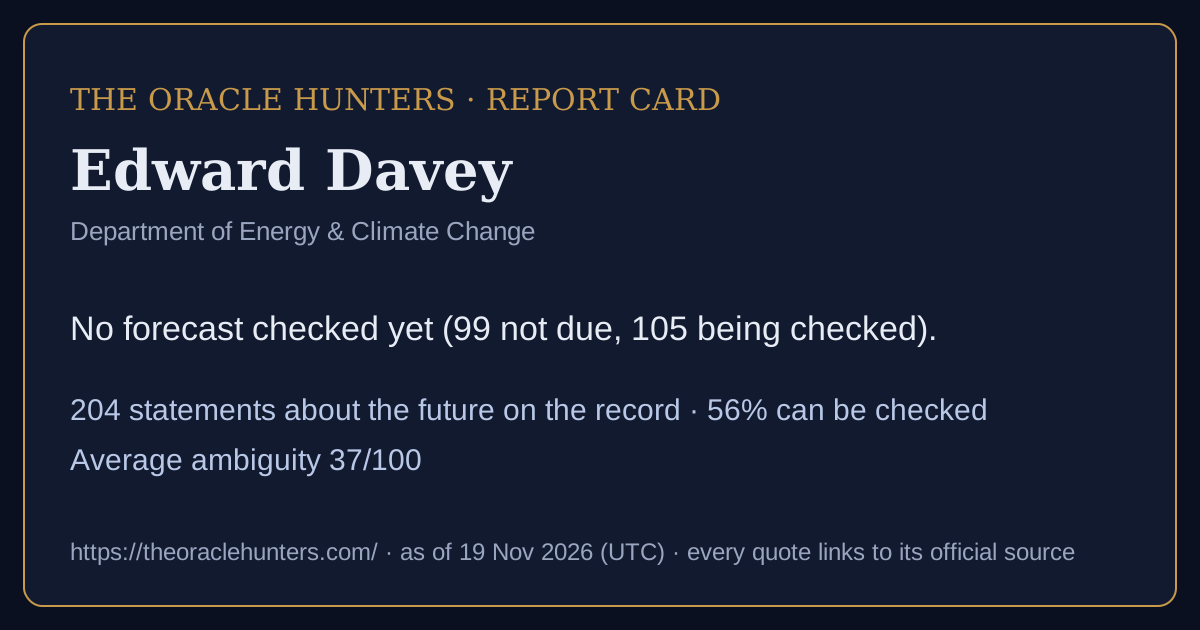
Edward Davey
Department of Energy & Climate Change · GBR
Track record: No forecast checked yet (99 not due, 105 being checked).
204forecasts & commitments on the record
56%can be checked as stated
37average ambiguity (0-100)
0goalpost moves recorded
0confirmed U-turns
Timeline
came true partly did not not due / being checked / too vague
Calibration score: shown after 10 checked forecasts with a stated likelihood (now 0).
How they speak about the future: based on data 158, stated on authority 36, educated guess 10.
Kinds of claim: forecast 148, mixed claim 41, commitment 9, scenario (if… then) 6. · Download this report card as a picture
In the nine words
πρόγνωσιςInference from evidence151 · 74%μαντείαInspired knowledge29 · 14%προαναγγελίαPublic pre-announcement9 · 4%πρόνοιαPreparing for the future6 · 3%εἰκασίαConjecture5 · 2%πρόβλεψιςSeeing the signs3 · 1%προφητείαInterpreting the will of authority1 · 0%
How to read this
Each box is one sentence a public figure or institution said about the future, word for word, with a link to the official text. Can be checked means it names what will happen, by when, and how likely - so it can be compared with official figures later. Too vague to check means it does not. Ambiguity (0-100) is how many different ways the sentence can be read. When the date passes, the forecast is compared with official data and marked came true, partly or did not come true. Labels judge the sentence, never the person. Full guide and glossary.On the record (204)
And they will be able to get up to £1250 for installing two other energy saving measures from the list - a 25% increase as we want to encourage people to think about making more than one improvement where that will benefit them.
From midday on Monday 16th March, people will be able to apply for new money off vouchers worth up to £70m, with up to £5,600 available to household in England and Wales to help with the cost of installing energy saving home improvements.
Up to another £2 million will support local fuel poverty innovation and by the end of March we will invite stakeholders to come forward with their own ideas for tackling the types of fuel poverty they believe would benefit from pilot funding.
From April 2018, it will be illegal for private domestic and non-domestic landlords to rent out properties to new or existing tenants unless their properties reach at least an E EPC rating, or have installed those improvements that could be funded using available Green Deal finance or subsidies available to pay for them,
Once these regulations are passed, from April 2016, residential private tenants will be able request their landlord’s consent for energy efficiency improvements where Green Deal finance or subsidies are available to pay for them.
This year will be a watershed moment in meeting that objective.
And they are preparing to launch a national scheme from 2016 which will be bigger than the EU’s ETS.
And we continue to believe that post-2020 marine energy will have a much bigger role to play in helping us meet our low-carbon ambition.
But the International Energy Agency estimates that generation could increase from around 05.TWhs now to 66 TWhs by 2040 – with the majority of that being generated within the European Union.
And we’re doing it because tidal power could be one of the cornerstones of the global low-carbon economy that we need to develop if we are to tackle the growing threat of climate change.
The Marine Energy Programme Board estimated this year that by 2035 the UK marine energy industry could be worth over £6bn a year, employing around 20,000 people supplying both domestic and global markets.
We estimate that it could lead to businesses saving over £250m a year on their energy bills if they reduce their consumption by less than 1% as a result of energy audits.
It is estimated that the right energy efficiency framework in the UK could save us the equivalent of the output of 22 new power stations by 2020.
So we will be reviewing the CRC Energy Efficiency Scheme and the Energy Savings Opportunity Scheme in 2016 to listen to your views.
In April I announced that eight major renewable energy projects had been awarded Investment Contracts under the Final Investment Decision CfD allocation that will provide up to £12bn of private sector investment.
For your industry, this new European 2030 policy provides additional certainty, and will underpin British law – especially the targets we set in our Carbon Budgets.
So, by the period of the 4th Carbon Budget – 2023 to 2027 – Britain will continue to have to up its low carbon game still further.
With this kind of momentum, I am confident that by 2020 we will more than meet our objective to supply at least 30% of our electricity needs from renewables.
Ambitious because it will put Europe in the driving seat as we approach a global climate change deal next year.
So it is energy security I want to concentrate on today – and that huge historic European energy security and 2030 climate policy deal that could be agreed this week.
As the Prime Minister said at the United Nations, we will be pushing EU leaders to cut emissions by at least 40 per cent by 2030.
Fail, and we miss the opportunity to influence the USA, China, India and the rest of the world, as they prepare their plans to cut their greenhouse gas emissions ahead of their UN announcements before March next year.
If the EU adopts the ambitious 2030 Framework that we expect, Europe will cement its place as the low carbon capital of the world.
And I am confident that next month, when the EU meets to agree the new 2030 Energy Framework, we will see the fruits of that effort in an ambitious deal for a domestic greenhouse gas target of at least 40%.
Our shared strategy sees the potential for community projects to supply enough electricity for up to 1 million homes by 2020 and make significant contributions to reducing energy bills and fuel poverty.
OxFutures themselves looking to bring in £20m of investment in local energy projects over the next year or so.
We expect to formally respond to recommendations by the end of the year, but that does not means we will be standing still in the meantime.
On Hydro, we will make sure that the review of the Feed-In Tariff scheme next year could look at ways to adapt the scheme to support more community development.
The models show that through following a low carbon pathway, fossil fuel import dependence could be reduced to between 25-30% by 2047, as opposed to over 60% under business as usual.
And this could jump to $230 billion by 2023, according to Goldman Sachs.
China will have invested over $1.2 trillion in its green economy between 2011 and 2015.
We are pushing the EU to agree a 40% cut on 1990 emissions by 2030, and to increase this to a 50% cut if there is ambitious global deal on Climate Change, next year.
By the end of that Budget carbon emissions compared to 1990 levels have to be down by 50%- legal obligations on the British Government.
So I believe there will be global deal on climate next year – but it must be a fair deal
And if the next Government were to fall prey to the populist siren call of micromanaging purchasing and prices, without any regard for the reality of the international markets, the result could be the same.
If UKIP and those on the climate change denying, Europhobic right are able to hold the next Government hostage, and Britain turns away from the low-carbon path and turns away from the European Union, we could see investment melt away.
I’m proud to say that the UK is the only country in Europe with two carbon capture and storage projects in development supported by up to £1bn of government funding.
The households of Britain embracing the power we are putting into their hands, demanding change – and changing the way they use energy themselves – something our smart meter rollout from next year will only further encourage.
And I am supremely confident we will stay high in that energy security league in the future.
The Renewable Heat Incentive could unlock around £13bn of investment in lower-carbon heating systems by 2020.
The Smart Meters programme will replace 53 million meters - with smart gas and electricity meters - by 2020.
This year will see the start of the UK-China Joint Scientific Innovation Fund, also known as the Newton Fund, through which our governments will jointly invest £200 million over five years in research and innovation collaboration – with energy and climate change being a priority area.
More than £16bn has been invested in building and upgrading electricity transmission and distribution networks since 2010, with around £35bn further expected over the rest of the decade.
And as Energy Secretary, I’m convinced that this Government now has in place the detailed plan our country previously lacked – so the lights will stay on this year, next year and into the future.
Ofgem’s 2013 Capacity Assessment showed that without intervention, capacity margins could fall from the 2013 level of around 6% to a low of between 5% and 2% in 2015/16, before steadily recovering as new generation comes on line.
Despite all the uncertainties I know investors face – political ones with Labour’s threatened regulation on energy prices and market ones such as the expected competition enquiry – we believe our capacity market through this year’s auction and next year’s will make real strides in improving the otherwise tight electricity margins expected by the end of the decade.
The International Energy Agency estimates that it will grow by at least a third by 2035.
And even though we have turned round power investment in the UK, with record levels of investment, we will still need up to £100bn of investment just through to 2020.
This will not only assist energy security, but it will aid the recovery by pinning jobs and investment into Europe – maintaining Europe’s leading position in the global green energy market worth some £3.3 trillion and growing at the rate of 4% a year.
And we will allow interconnected capacity to participate directly in the mechanism from 2015.
Showing the newest 50 - the ledger has all 204.
Also said - not checkable as stated (12 newest)
Remarks about the future with no date, figure or likelihood that could be checked. They are kept on the record and shown here, but not scored.
Many of the mechanisms and concepts we will need to implement a global climate deal already exist.
We will need to make sure we continue to help the most vulnerable countries adapt to the effects of climate change.
But let me also be clear – we will still need a lot of oil and gas over the next few decades, as we decarbonise rapidly.
Outcomes that will damage our prosperity, our security and our health.
Only yesterday, public health experts warned that climate change could see tropical diseases such as malaria establish themselves in Britain in a few short decades.
With climate change, our children and their children will face a harsher and more brutal world.
To do that I will obviously have to paint the picture of how things have changed over the past few years – and give you an idea of how I see the future.
The licence modifications for QR codes were signed off by my Department last week, so they should be hitting bills by the end of June – and apps will be available to read them.
And as a third of fuel poor families live in rented homes – so for the first time we are going to make sure landlords improve draughty properties.
And as Smart Meters roll out people will get near real time information about their energy use, so they can see what it is in their homes that is costing them most money.
We will also be working with the Royal College of General Practice to develop their plans to pilot a new electronic referral system for health and fuel poverty which already has local support in areas such as Wiltshire.
I believe bringing together health and fuel poverty will be the most significant boost your sector has ever seen – and I wanted to create the platform to do this.