Eddie Yue
Hong Kong Monetary Authority
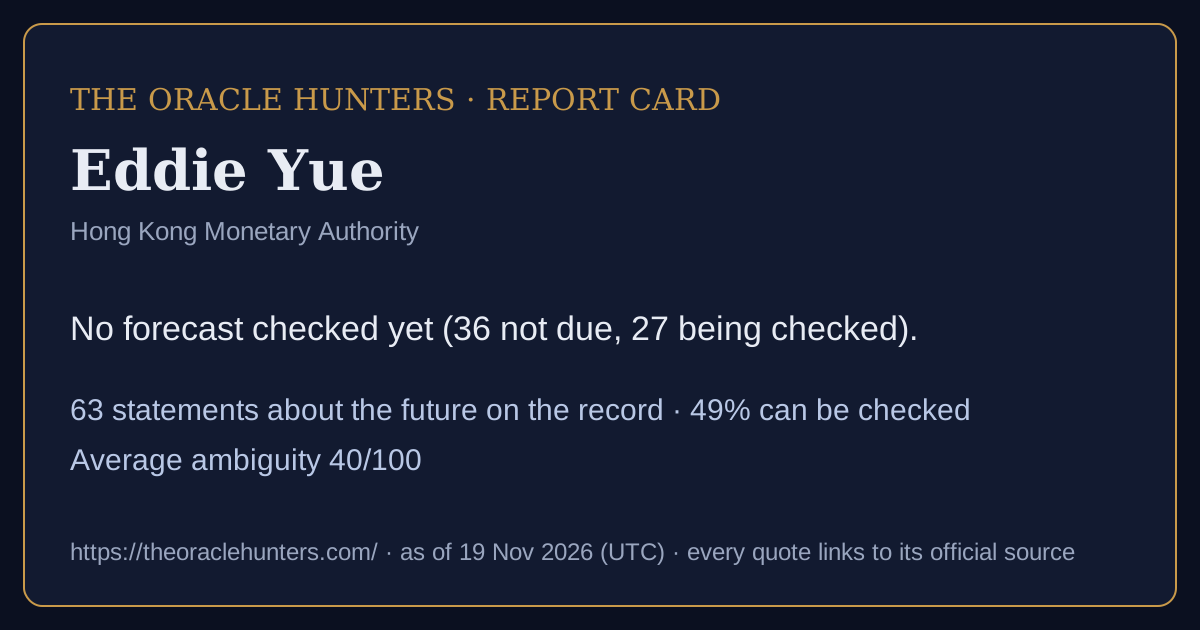
Track record: No forecast checked yet (36 not due, 27 being checked).
63forecasts & commitments on the record
49%can be checked as stated
40average ambiguity (0-100)
0goalpost moves recorded
0confirmed U-turns
Timeline
came true partly did not not due / being checked / too vague
Calibration score: shown after 10 checked forecasts with a stated likelihood (now 0).
How they speak about the future: based on data 43, stated on authority 18, educated guess 2.
Kinds of claim: forecast 44, mixed claim 10, commitment 7, scenario (if… then) 2. · Download this report card as a picture
In the nine words
πρόγνωσιςInference from evidence42 · 67%μαντείαInspired knowledge12 · 19%προαναγγελίαPublic pre-announcement7 · 11%πρόνοιαPreparing for the future2 · 3%
How to read this
Each box is one sentence a public figure or institution said about the future, word for word, with a link to the official text. Can be checked means it names what will happen, by when, and how likely - so it can be compared with official figures later. Too vague to check means it does not. Ambiguity (0-100) is how many different ways the sentence can be read. When the date passes, the forecast is compared with official data and marked came true, partly or did not come true. Labels judge the sentence, never the person. Full guide and glossary.On the record (63)
- The HKMA will also step up the management of Southbound Bond Connect market makers starting from this year;
Its platform will continue to be upgraded, and a Digital Asset Platform will be developed later this year to support the issuance and settlement of digital bonds and, in the future, other digital assets.
The momentum behind this transformation is underscored by substantial technological investment, with total spending projected to reach HK$100 billion annually over the next three years.
In fact, according to a recent survey on central banks, over 30% of the respondents expect to increase their RMB holdings in the next five years.
The facility will provide banks in Hong Kong with up to RMB 100 billion in liquidity for up to six months, and that will help reinforce Hong Kong's position as the global leader in offshore RMB business.
The findings will be published next year.
Building on our first study, we will update the skill mapping exercise to identify potential skill shortages in the banking sector over the next five years, from 2026 to 2030.
What the future may hold for us is uncertain, but we are committed to charting the next phase of financial innovation with continuing efforts in the two areas I just talked about: tokenisation and AI.
Equally exciting is the use of innovative technologies in trade finance - from blockchain, AI to digital signatures - and greater cooperation around cross-border interoperability that will help close the widening global trade finance gap, estimated by the Asian Development Bank last year to have reached a record US$2.5 trillion.
The HKMA will stay vigilant against potential and emerging risks to our financial security and stability, and we will continue to enhance our regulatory framework to meet evolving market needs and international standards.
We are conducting a number of research studies with the CBDC Expert Group, which was formed last year, and we hope that the results of some of these research studies will become available to the public later this year.
Most central banks are now expected to begin easing monetary policy later this year, while the world is preparing for the biggest election year in history.
Fourth, the Government will increase the government debt ceiling to HK$500 billion to cover sustainable finance and infrastructure projects.
Here in Hong Kong, our emissions are very small given our small physical size, but we are committed to doing our part and will aim to achieve zero carbon emissions by 2050 through four main decarbonisation strategies: "net-zero electricity generation," "energysaving and green buildings," "green transport," and "waste reduction".
The Committee is now conducting studies on issues such as digital infrastructure and digital transformation of enterprises, and it will put forward its recommendations early next year.
A government-led data sharing initiative will be launched by the end of this year, which will not only enhance data sharing among government departments, but also open up more types of government data for banks to access through the HKMA's Commercial Data Interchange, or CDI as we call it.
To support this gradual adoption of tokenisation, we will also witness an increased adoption of blockchain-based payment methods, including stablecoins and tokenised deposits.
In addition, the launch of a government-led data sharing initiative by the end of this year will not only streamline data sharing among government departments, but also open up more types of government data for banks to access through the HKMA's Commercial Data Interchange (CDI).
According to the IMF, if the world were to segregate into two distinct blocs with little or no trade between them, Asia Pacific's GDP could be reduced by over 3% annually.
Advanced economies see a bigger decline in growth in 2023 to 1.5%, from 2.7% in 2022 while growth in emerging markets and developing economies is expected to stay flat at 4.0% in 2023 vs. 2022.
Diversification remains an effective first-line defence against market uncertainties, and we will continue to spread our investments across asset class types, geographies and currencies.
- 3 Based on the IMF's forecast in Jul, 2023 global economic growth for both 2023 and 2024 is expected to slow to 3.0%, down from 3.5% for 2022.
More events will be planned for the rest of this year.
We will have a busy event season in Hong Kong later this year:
It is estimated that 100-150 trillion US dollar in climate finance will be needed in the next three decades to achieve a Paris-aligned scenario of limiting global warming to 1.5° Celsius.
In Asia, we will need 66 trillion US dollar; a significant share of this would go to China.
With a 50-basis-point rate hike as expected by the market, the Fed has raised the federal funds target range seven times consecutively by a total of 425 basis points since March.
China alone will need over RMB100 trillion (or USD15 trillion equivalent) in green investment over the next three decades to achieve its declared goal of achieving carbon neutrality by 2060 2 .
According to a report by the Global Financial Markets Association and Boston Consulting Group in December 2020, it is estimated that the region will require USD66 trillion of climate investment in the coming three decades 1 .
The increased prominence of the RMB in international trade and foreign currency reserves was underlined in May when the International Monetary Fund increased the RMB's weighting in its Special Drawing Rights basket from 10.92% to 12.28%, the rst time the weighting has been reviewed since the RMB was added to the basket in 2016.
As expected by the market, the Fed announced a rate hike of 75 basis points this time after having done the same in June.
It is estimated that 66 trillion USD of climate investment is required for the region in the coming three decades.
Therefore, we have launched a new Fintech 2025 strategy recently and will work hand in hand with the industry along this fintech journey.
As the industry demand for fintech and green finance knowledge is strong, we will launch a new ECF on fintech later this year to provide more structured and comprehensive training programmes for fintech practitioners.
On that, we have developed a vision that by 2025, Hong Kong will become a leading hub for developing Regtech solutions and cultivating Regtech talents.
I believe the same could be said for Fintech 2025.
If everything goes according to plan, you can expect to see the results in the first half of 2022.
The Fintech 2025 strategy we are announcing today aspires to help the financial sector adopt technology comprehensively by 2025; so that they will deliver fair and efficient financial services, benefitting Hong Kong people and the Hong Kong economy.
Under the Fintech 2025 strategy, we will be rolling out a Tech Baseline Assessment to help the HKMA identify those areas that we may be able to offer support.
By the end of this year, we will also launch a new fintech module for the Enhanced Competency Framework to raise the professional competencies of existing banking practitioners.
To build on this momentum, the Financial Secretary just announced in his latest Budget that the government will double the size of the green bond programme and increase the diversity of future issuances.
The Asian Development Bank (ADB) estimates that US$1.7 trillion per year will be needed through 2030 for the region to maintain growth momentum, eradicate poverty and respond to climate change.
Indeed, the Asian region is expected to grow at 5 percent per year through 2023, easily topping all other regions of the world.
The HKSAR Government is launching a HK$100 billion Government Green Bond Programme and the first green bond will be issued later this year.
- If I am asked to predict what will be an emerging theme for the financial services sector in 2018, green finance looks like a safe bet.
HKMA announced September this year a series of measures to facilitate the financial services industry to grasp the opportunities in fintech, covering financial infrastructure, regulatory sandbox, research and talent development, etc. I will leave this to my colleague, Shu-pui, to share more with you in the panel on fintech later this afternoon.
With a combined GDP of some US$1.3 trillion, it will be the fifth largest economy in Asia, just after South Korea.
- The Stock Connect schemes have been running smoothly and next year, A-share will be included in the MSCI Emerging Markets Index, which is tracked by some US$1.6 trillion in assets.
The concessionary tax rate at 8.25% will be among the most competitive in the region and can be obtained through simple election as part of a corporation's tax filing process.
In other words, the applicable tax rate will be cut from the current 16.5% to 8.25%.
Showing the newest 50 - the ledger has all 63.
Also said - not checkable as stated (12 newest)
Remarks about the future with no date, figure or likelihood that could be checked. They are kept on the record and shown here, but not scored.
You may ask, what does it have to do with "green"?
While CDI is not specifically designed for green finance, it could provide an important enabling catalyst.
We will continue to work closely with the PBoC to ensure that all measures are implemented in a smooth manner.
We will also pay attention to feedback from the industry and the general public, further enhancing and expanding the measures to contribute to market development and people's welfare.
The HKMA will explore to introduce a tendering mechanism of a 7-day offshore RMB liquidity to add a new channel to support banks' short-term RMB funding needs.
Furthermore, the HKMA will also explore the issuance of offshore RMB short-term debt instruments, supporting the building of the offshore RMB yield curve and providing the market with high-quality investment and liquidity management products.
We will continue to deepen and scale up the tokenisation ecosystem by onboarding more banks, incubating new use cases and driving broader adoption.
I understand that you will have a rich agenda on cross-border payments, covering issues such as frictions in the last mile, data harmonisation, and interlinking payment systems.
I understand that Swift is building a blockchain-based shared ledger that will enable interoperability between banks' tokenised deposits, which will facilitate cross-border payments on a 24/7 basis.
Such effort will reduce fragmentation in the emerging tokenised economy, which is crucial to maintaining an efficient multicurrency cross-border payment environment.
And we will learn from academic studies on climate policy as well as the macroeconomic effects of climate change and green innovation.
We will hear keynote addresses examining the current and future state of ESG from different angles.