Ed Vaizey
Department for Digital, Culture, Media & Sport (2017 to 2023) · GBR
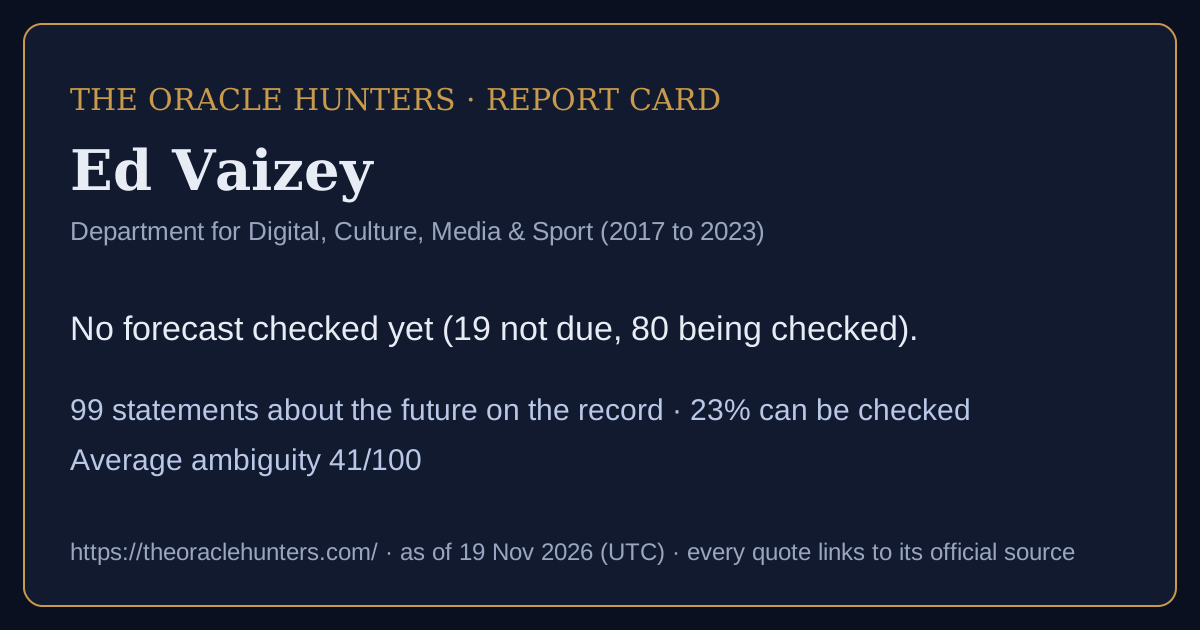
Track record: No forecast checked yet (19 not due, 80 being checked).
99forecasts & commitments on the record
23%can be checked as stated
41average ambiguity (0-100)
0goalpost moves recorded
0confirmed U-turns
Timeline
came true partly did not not due / being checked / too vague
Calibration score: shown after 10 checked forecasts with a stated likelihood (now 0).
How they speak about the future: based on data 74, stated on authority 23, educated guess 2.
Kinds of claim: forecast 64, mixed claim 23, commitment 8, scenario (if… then) 4. · Download this report card as a picture
In the nine words
πρόγνωσιςInference from evidence67 · 68%μαντείαInspired knowledge19 · 19%προαναγγελίαPublic pre-announcement8 · 8%πρόνοιαPreparing for the future4 · 4%εἰκασίαConjecture1 · 1%
How to read this
Each box is one sentence a public figure or institution said about the future, word for word, with a link to the official text. Can be checked means it names what will happen, by when, and how likely - so it can be compared with official figures later. Too vague to check means it does not. Ambiguity (0-100) is how many different ways the sentence can be read. When the date passes, the forecast is compared with official data and marked came true, partly or did not come true. Labels judge the sentence, never the person. Full guide and glossary.On the record (99)
As announced in the Budget, we will bring in a new Museums and Galleries tax relief from April next year, and will begin our consultation on this in the summer.
Whatever the outcome of that review, cyber security will remain a priority for Government and we will continue to tackle the danger posed by cyber threats.
If the North of England grew at the same rate that is forecast for the rest of the UK the prize would be huge – we could add £37 billion to the economy by the end of the next decade.
And this year Leeds will benefit from superfast broadband.
Once installation is complete by the end of March 2016, over 98% of libraries will be able to provide free WiFi access to their users.
The 10 small-scale DAB trials will complete next year and – subject to a successful technical evaluation – DCMS will be working with Ofcom to bring forward plans to enable these types of services to be licensed.
Due to the demand from commercial operators a second national digital commercial multiplex (D2) will launch next year with plans to carry up to 15 more national commercial stations – further broadening the appeal.
Whatever the outcome of that review, cyber security will remain a priority for Government and we will continue to tackle the danger posed by cyber attacks.
The Strategic Defence & Security Review is currently looking at the future of cyber security and will report later this year.
After a successful first iteration, also announced here five years ago, we are now reintroducing an even more ambitious £4 million Prototype Fund to support video games projects, create jobs and develop games talent all around the UK.
From this year, innovative degree apprenticeships, delivered in partnership between universities and employers, will equip individuals with the highly prized mix of high level technical skills and on-the-job learning.
That’s why we are holding mobile operators to their legally-binding commitment to ensure that 90 per cent of the UK landmass will have voice and SMS coverage by 2017 from each operator.
Superfast broadband is currently available to over 80% of homes and businesses in the UK and we will have achieved 95% by 2017.
The issue at the top of the in-tray will be the review of the BBC’s Charter, which has to be renewed at the end of 2016.
London has more digital stations than any city on the world, and next year we will have 24 national commercial digital stations.
It’s probable that the radio switchover criteria will be met by 2017 and the Government of the day will be able to take a measured and informed decision of when to set a timetable for the switchover from analogue to digital.
It will also signify that - by the end of 2016 - coverage criteria set by Government for a switchover decision will have been met.
And I can also announce that we have laid the regulations which will allow local Mux operators who build out to the plan to extend their local licences to 2030, something I announced in December 2013.
These new transmitters start to be built next month and will increase local DAB coverage from less than 75 per cent of households today to above 91 per cent.
Our overall aim is for the UK to be a leading digital economy, with 88 per cent of the whole country having access to superfast broadband by the end of next year.
Our objective will be to carry this out quickly in order to give us the option of bringing in the necessary changes before the end of March next year, subject to sufficient Parliamentary time being available.
For that reason I can say that we are planning to consult shortly on changes to further extend the durations of analogue radio licences that have received the second and final roll overs and which will start to expire from 2017.
I am also delighted to see that the digital radio tick mark will appear on the envelopes of the 40 million car tax reminders DVLA are sending to motorists.
I am delighted that Ofcom are making a progress on this development and that Ofcom announced at TechCon on Monday that it will shortly be consulting on proposals to issue licences for some trial small-scale multiplexes, which will take place next year.
The “moggies” as we have described the multiplex operators collectively are almost there and subject to final agreements which we anticipate will be concluded in the next couple of weeks, the main works are due to start next March finishing mid-2016.
I will therefore convene a “Digital Dashboard summit” early next year to better understand how radio and audio in connected cars will evolve and to help ensure that the increase in connected car functionality is an addition to, rather than at the expense of, consumers.
On the first of June, applications opened for domestic radio manufacturers who want to be part of the scheme, and Pure has already announced that it will be carried across its entire digital product range from later this year.
However, I am very much aware that FM and AM licences rolled over under the 2010 Digital Economy Act will start to come up for renewal at the end of 2017, and that Ofcom has no power to extend them further.
That’ll take the coverage from 72 per cent of homes to around 90 per cent – and also bring almost 6,000 miles of roads under the DAB umbrella I hope that final details the plans will be announced in the next few weeks.
Thanks to the commitment of the Government, the BBC and commercial radio, another 4.3 million households will be able to tune in to DAB by end of 2016.
Research last year found that if all households had the ability to record TV programmes, they would expect the level of playback to settle at around 15 to 20 per cent, with most of the emerging demand for on-demand content coming at the expense of recorded programming.
Arqiva will extend the national commercial mux to match the coverage of classic FM by 2016.
This new roll out phase will give around 4m households access to local commercial and BBC services on digital by 2016.
I was delighted that the BBC announced in October that it will extend the coverage of its national DAB multiplex from just over 94% today to 97.3% by the end of 2015.
I can announce today that we will be providing new funding to Ofcom over the next two years to build on the work of its Brighton pilot to develop small-scale DAB solutions, to allow smaller radio stations to go digital.
We will also enable Ofcom to extend licences terms - where services are built out under the agreement reached with commercial radio - to a common 2030 date.
In the next phase, the BBC, Commercial radio and the Government will together fund the build out of the local DAB tier to near commercial FM equivalence by 2016
In addition, we understand that Brazil is proposing further international discussions in April or May next year.
In 2015 the United Nations will conduct a ten year review of the actions which came from the World Summit on the Information Society.
[Evidence suggests that 2 mobile library have closed] since April this year, but I recognise that the outcome of the on-going reviews by Authorities will result in further changes in the provision of library services in England.
East Sussex - a new £6 million development in Seaford due to open in 2014 which will include a brand new library, day services for older people and supported living flats.
Birmingham, Liverpool and Manchester are all making major investments in their central libraries, and Birmingham’s will soon be the largest library in Europe when it opens this year.
The Heritage Lottery Fund too, is now projected to receive £379 million in 2015, £160 million more than prior to 2010.
This increased chunk, combined with growing Lottery sales, means Arts Council England is now projected to receive £262 million in 2015, that’s over £100 million more than it received prior to May 2010.
And it is on that note that I want to tell you about the White Paper that will come out later this year.
My Department will be commissioning reports on all library authorities in England, which will be available in December this year.
Today I am delighted to announce that the Arts Council will be allocating £6 milllion from its Grants for the Arts programme over the next two years for library authorities to lead projects working with artists, arts organisations and other cultural organisations on arts and cultural activity through libraries.
And Birmingham is planning to open the biggest library in Europe next year, costing almost £200 million.
When YouView hits our stores later this year it will revolutionise the public’s appetite for these new technologies by coupling them with free to air content.
These will help inform a White Paper in early 2013.
Showing the newest 50 - the ledger has all 99.
Also said - not checkable as stated (12 newest)
Remarks about the future with no date, figure or likelihood that could be checked. They are kept on the record and shown here, but not scored.
We introduced tax credits for theatres and orchestras, and now we will do the same for exhibitions.
So the Government will challenge all cultural organisations in receipt of government funding to do more to reach out to people of all circumstances and backgrounds.
We will pilot the programme in three areas – the North-West, North-East and West Midlands - and hope that by the end of the third year it will be operating in up to 70 places and reaching 14,000 young people.
We will make it clear to arts organisations that we want to see real and tangible progress in diversity – that is a legitimate expectation of anyone who applies for public funds.
So we will introduce a new Great Place Scheme, which will bring national arts and heritage Lottery funders together to work with councils, cultural organisations and universities to make culture a core part of local authority’s plans and policies.We will initially pilot this in twelve areas, at least four of them rural.
So we’ve been pretty busy on cyber security recently, as you might imagine.
There will be a stronger Active Defence Programme to divert more malware attacks and block bad addresses used against British internet users.
We’re really serious about this, because it will have a transformative effect upon the cyber security of UK industry.
I hope many large firms will follow the Government’s lead in requiring their suppliers to adopt Cyber Essentials - this will enhance security for all of us.
The Strategic Defence and Security Review is currently looking at the future of cyber security and will report soon.
We are pressing for more detail about the Commission’s proposals, which will need to be evidence-based and respect the rights of businesses to tailor products to their markets.
We will bring them together to set out the action they are taking.