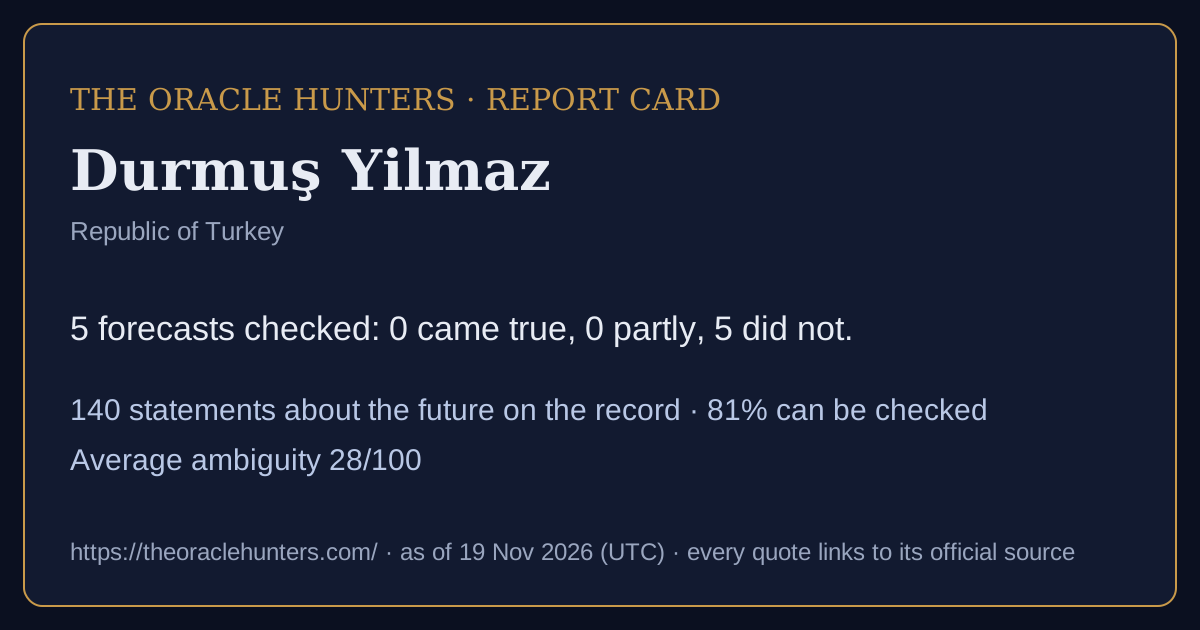
Durmuş Yilmaz
Republic of Turkey
Track record: 5 forecasts checked: 0 came true, 0 partly, 5 did not.
140forecasts & commitments on the record
81%can be checked as stated
28average ambiguity (0-100)
0goalpost moves recorded
0confirmed U-turns
Timeline
came true partly did not not due / being checked / too vague
Calibration score: shown after 10 checked forecasts with a stated likelihood (now 5).
How they speak about the future: based on data 131, educated guess 5, stated on authority 4.
Kinds of claim: forecast 122, mixed claim 10, scenario (if… then) 7, commitment 1. · Download this report card as a picture
In the nine words
πρόγνωσιςInference from evidence127 · 91%πρόνοιαPreparing for the future7 · 5%μαντείαInspired knowledge3 · 2%πρόβλεψιςSeeing the signs2 · 1%προαναγγελίαPublic pre-announcement1 · 1%
How to read this
Each box is one sentence a public figure or institution said about the future, word for word, with a link to the official text. Can be checked means it names what will happen, by when, and how likely - so it can be compared with official figures later. Too vague to check means it does not. Ambiguity (0-100) is how many different ways the sentence can be read. When the date passes, the forecast is compared with official data and marked came true, partly or did not come true. Labels judge the sentence, never the person. Full guide and glossary.Checked
Furthermore, inflation is expected to decline to 5.0 percent by the end of 2012 (Figure 33).
Did not come true. Said: inflation at the end of the year around 5% in 2012. Official figure for Turkiye: 6.1% (Eurostat HICP (December, annual rate)). Missed. Off by 1.1 points. official data · checked 17 Nov 2026 · automatic check against official data (rules v4)
Furthermore, inflation is expected to decline to 5.0 percent by the end of 2012 (Figure 34).
Did not come true. Said: inflation at the end of the year around 5% in 2012. Official figure for Turkiye: 6.1% (Eurostat HICP (December, annual rate)). Missed. Off by 1.1 points. official data · checked 17 Nov 2026 · automatic check against official data (rules v4)
Furthermore, inflation is expected to decline to 4.9 percent by the end of 2012 (Figure 34).
Did not come true. Said: inflation at the end of the year around 4.9% in 2012. Official figure for Turkiye: 6.1% (Eurostat HICP (December, annual rate)). Missed. Off by 1.2 points. official data · checked 17 Nov 2026 · automatic check against official data (rules v4)
Furthermore, inflation is expected to go down to 4.2 percent by the end of 2011.
Did not come true. Said: inflation at the end of the year around 4.2% in 2011. Official figure for Turkiye: 10.4% (Eurostat HICP (December, annual rate)). Missed. Off by 6.2 points. official data · checked 17 Nov 2026 · automatic check against official data (rules v4)
We expect inflation to come down to 4.9 percent by the end of 2011 (Graph 27).
Did not come true. Said: inflation at the end of the year around 4.9% in 2011. Official figure for Turkiye: 10.4% (Eurostat HICP (December, annual rate)). Missed. Off by 5.5 points. official data · checked 17 Nov 2026 · automatic check against official data (rules v4)
On the record (140)
As of the first quarter of 2011, the 24-month ahead inflation expectation stands at 6.29 percent, hovering slightly above our medium-term target of 5 percent.
* On May 18, 2010, 1-week repo rate was adopted as the key policy rate and was set 50 basis points above the overnight borrowing rate at 7 percent.
Although year-end inflation expectations fluctuated due to the volatile course of food prices throughout 2010, medium-term expectations remained basically unchanged.
As you will recall, we underlined in the October 2010 Inflation Report that the increases in unprocessed food and tobacco prices - which are beyond the immediate control of the CBRT - added about 5 percentage points to annual inflation, and suggested that these items would leave sizable room for disinflation.
Hence, assuming that a limited monetary tightening will bring credit growth rate down to 20-25 percent in 2011, our revised forecasts indicate that inflation would be close to the target by the end of 2011.
The changes in our assumptions have led us to revise our inflation forecasts for end-2011 upwards by around 35 basis points.
Inflation is expected to reach the medium-term target of 5 percent by mid-2012 once the effects of rising commodity prices wear off.
Assuming that the policy mix is suited to deliver an additional limited monetary tightening during the rest of 2011, inflation is expected to be, with 70 percent probability, between 4.5 and 7.3 percent with a mid-point of 5.9 percent at end-2011, and between 3.3 and 6.9 percent with a mid-point of 5.1 percent by the end of 2012.
The October Inflation Report envisaged food inflation to be 10.5 percent at end-2010, to fall gradually to 7 percent at end-2011 and to remain at these levels throughout the forecast horizon.
This baseline scenario assumes a policy framework that the measures outlined in our exit strategy are completed by the end of the year, and that policy rates are kept constant at current levels for some time followed by limited increases starting from the last quarter of 2011, with policy rates staying at single digits throughout the forecast horizon (in other …
In that case, as indicated in the latest Inflation Report, should the global economy face a longer-than-anticipated period of anemic growth, the monetary tightening envisaged to start in the final quarter of 2011 under the baseline scenario might be postponed.
Within this scope, we expect the inflation indicator excluding unprocessed food and tobacco and alcoholic beverages to follow a volatile trend in the first half of 2011 due to the base effect and to gain stability slightly above 4 percent in the medium term (Figure 32).
Accordingly, we assume that annual inflation in unprocessed food products will be 17 percent for end-2010 and 9 percent for the following two years.
Overall, the impact of the upward revision in the food price assumption is offset by lower-thanexpected non-food inflation, leading to an unchanged inflation forecast at 7.5 percent for end2010.
Furthermore, inflation is expected to decline to 5.1 percent by the end of 2012 (Figure 28).
Within this framework, we project that, with 70 percent probability, inflation will be between 7 and 8 percent with a mid-point of 7.5 percent at end-2010, and between 3.9 and 6.9 percent with a mid-point of 5.4 percent by the end of 2011.
The revision in question pushed our inflation forecast for end-2010 up by 0.8 percentage points.
Furthermore, inflation is expected to decline to 5.0 percent by the end of 2012 (Figure 33).
Did not come true. Said: inflation at the end of the year around 5% in 2012. Official figure for Turkiye: 6.1% (Eurostat HICP (December, annual rate)). Missed. Off by 1.1 points. official data · checked 17 Nov 2026 · automatic check against official data (rules v4)
Within this framework, medium-term forecasts suggest that, with 70 percent probability, inflation will be between 6.5 and 8.5 percent with a mid-point of 7.5 percent at end-2010, and between 3.6 and 7.0 percent with a mid-point of 5.3 percent by the end of 2011.
Overall, the mid-point of the end-2010 inflation forecast has been revised down by 0.9 percentage points, owing to the downward revisions in food and energy prices assumptions and the recent slowdown in core inflation indicators.
This change yielded 0.1 percentage point downward revision in the end-2010 inflation forecast.
This decline led to a 0.2 percentage point fall in our year-end inflation forecast.
Should the global economy face a longer-than-anticipated period of anemic growth, which would consequently delay domestic recovery significantly, the monetary tightening envisaged in 2011 under the baseline scenario may be postponed towards the end of 2011.
We assess that if fiscal discipline is not compromised and structural reforms go into effect, in the Turkish economy, equilibrium real interest rate will continue to remain at low single digits in the upcoming period as well.
Likewise, as you may recall, real interest rates reached 20-25 percent from time to time and entrenched in the minds of economic decision-makers as 'normal' in the 1990's.
As a result, growth forecasts of international institutions for the Turkish economy have been revised upwards repeatedly and reached as much as 7.2 percent, the highest among OECD countries.
Inflation is expected to drop significantly in the last quarter of 2010 and the first quarter of 2011 (Figure 34).
Accordingly, it is envisaged that the rising debt-to-GDP ratios would gradually reverse course starting in 2011, and hence the risk premium would not display any significant changes throughout the forecast horizon.
Regarding fiscal policy, it is assumed that, in line with the Medium Term Program, the fiscal stance will remain expansionary - but less so than in 2009 - throughout 2010, and that fiscal consolidation would gradually ensue starting from 2011 as guided by the fiscal rule set out in the Medium Term Program.
Furthermore, inflation is expected to decline to 5.0 percent by the end of 2012 (Figure 34).
Did not come true. Said: inflation at the end of the year around 5% in 2012. Official figure for Turkiye: 6.1% (Eurostat HICP (December, annual rate)). Missed. Off by 1.1 points. official data · checked 17 Nov 2026 · automatic check against official data (rules v4)
However, worse than expected outcomes regarding unprocessed food prices and ongoing supply-side structural problems led to an upward revision in the assumption for food inflation from 7 percent to 9 percent for 2010, which added 0.55 percentage points to end-2010 inflation forecast (Table 2).
First of all, the revisions to the Gross Domestic Product (GDP) series, and somewhat stronger than expected domestic demand have led to an upward revision in the output gap estimates, which have pushed the inflation forecast for end-2010 up by 0.4 percentage points (Table 2).
Accordingly, envisioning that undershooting the inflation target at year-end has been more likely, we continued the rate cut cycle that we initiated in November 2008 by pursuing a front-loaded monetary policy in early 2009.
Accordingly, we expect that after following a volatile course significantly above the target for some period, inflation will be back on a downtrend by the phasing out of temporary effects as of the last quarter of the year and return to target-consistent levels as of early 2011.
In this step, the fixed interest rate for one-week repo auctions will be determined by adding 50 basis points to the declared overnight borrowing interest rate of the Central Bank.
The CBT foresees that inflation will follow a fluctuating course significantly above the target and then reassume a decreasing trend in the last quarter of the year once the temporary factors taper off and come back to levels consistent with targets in the first months of 2011.
In this respect, it is envisaged that the rising debt-to-GDP ratios would reverse their course steadily starting from 2011, and hence the risk premium would not display any significant changes throughout the forecast horizon.
Moreover, it is assumed that the fiscal stance will remain expansionary - but less so than in 2009 - throughout 2010, and subsequently fiscal tightening would be gradually adopted starting from 2011.
- *WEO January 2010 Revision Bulletin, no revision could be made as it had not been published by 26 January 2010, the date for the publication of the January 2010 Inflation Report.
In this context, our medium-term forecasts suggest that the output gap - albeit closing faster than envisaged in the October Report - will remain disinflationary until the beginning of 2012.
Furthermore, inflation is expected to decline to 4.9 percent by the end of 2012 (Figure 34).
Did not come true. Said: inflation at the end of the year around 4.9% in 2012. Official figure for Turkiye: 6.1% (Eurostat HICP (December, annual rate)). Missed. Off by 1.2 points. official data · checked 17 Nov 2026 · automatic check against official data (rules v4)
Therefore, we revised our assumptions for food inflation up from 6 percent to 7 percent for end-2010 (Table 1) and this added around 0.3 percentage points to the 2010 inflation forecast.
For instance, if the repo interest rate is set as 16.25 percent, then the CBT borrowing rate will be 15.00 percent, while the CBT lending rate will be 17.50 percent.
In order to avoid potential negative impacts of such a situation, interest rates of one-week repo auctions will be set as the reference rate for monetary policy operations, in the event of an increase in liquidity shortage and/or having high probability to become permanent.
According to the Central Bank, if this situation becomes permanent, the cost of fighting inflation will increase.
For instance, if the Committee decides the interest rate on one-week maturity repo auctions is to be 16.25 percent, then it will remain as 16.25 percent unless the Committee changes this.
For instance, if the interest rate on repo auctions is set as 16.25 percent, then the interest rate on borrowing facilities provided for primary dealer banks will be 17 percent.
For instance, if the interest rate on repo auctions is set as 16.25 percent, then the CBT LON borrowing rate will be 12.25 percent, while CBT LON lending rate will be 20.25 percent.
In this respect, it is assumed that the fiscal stance will remain expansionary - but less so than the one in 2009throughout 2010, and fiscal tightening will gradually be adopted starting from 2011.
In this context, our medium-term forecasts envisage that the output gap - albeit closing faster than envisaged in the July Report - will remain disinflationary until mid-2012.
Showing the newest 50 - the ledger has all 140.
Also said - not checkable as stated (12 newest)
Remarks about the future with no date, figure or likelihood that could be checked. They are kept on the record and shown here, but not scored.
I would hereby like to remind you that we will be more extensively providing the public with updated evaluations and forecasts on the medium-term inflation outlook along with possible risks and policy measures, in the Inflation Report to be published on April 28, 2011.
In line with our primary objective of achieving and maintaining price stability, we will continue to monitor macroeconomic risks and financial stability, and hence, take measures towards enhancing the effectiveness of the monetary policy and liquidity management in 2011.
This outlook confirmed our projection that policy rates should be kept at low levels for an extended period.
Liquidity risk is directly related to the ability of a bank to maintain sufficient funds to meet its commitments, which may, in turn, be related to its ability to attract deposits or sell its assets.
The IILM is expected to issue high quality, liquid, tradable and low risk Shari'ah-compliant financial instruments at both the national level and across borders to enhance the soundness and stability of the Islamic financial markets.
The instruments of the IILM will be utilized in liquidity management as eligible collateral for interbank transactions and central bank financing, or through trading of IILM instruments (either within the same country or crossborder) in the secondary market.
As the IILM is intended to facilitate cross-border liquidity management, its instruments shall be denominated in major reserve currencies.
As it is known, another kind of interest-free security, which could be useful for participation banks especially in their liquidity management, is a specially designed financial certificate, called 'Sukuk'.
We believe that such interest-free securities, which could also be traded in secondary markets, is very beneficial for the participation banks in their liquidity management operations.
During the two-day conference, issues towards improving banking and financial cooperation among Syria, Lebanon, Jordan and Turkey will be discussed in the context of Turkey's recently developing relations with her neighbors and other countries in the region.
The conference will address issues such as enhancing banking cooperation between these countries, Banks Associations' possible contributions to the process, payment systems, Islamic banking implementations and prospective cooperation fields, funding of small and medium-scale enterprises in the region and the future political and economic outlook of ShamGen countries.
The significant increase in the share of OIC member states in our exports might be, at first sight, attributed only to the economic slowdown in the European Union.