Donald T Brash
Bank of New Zealand
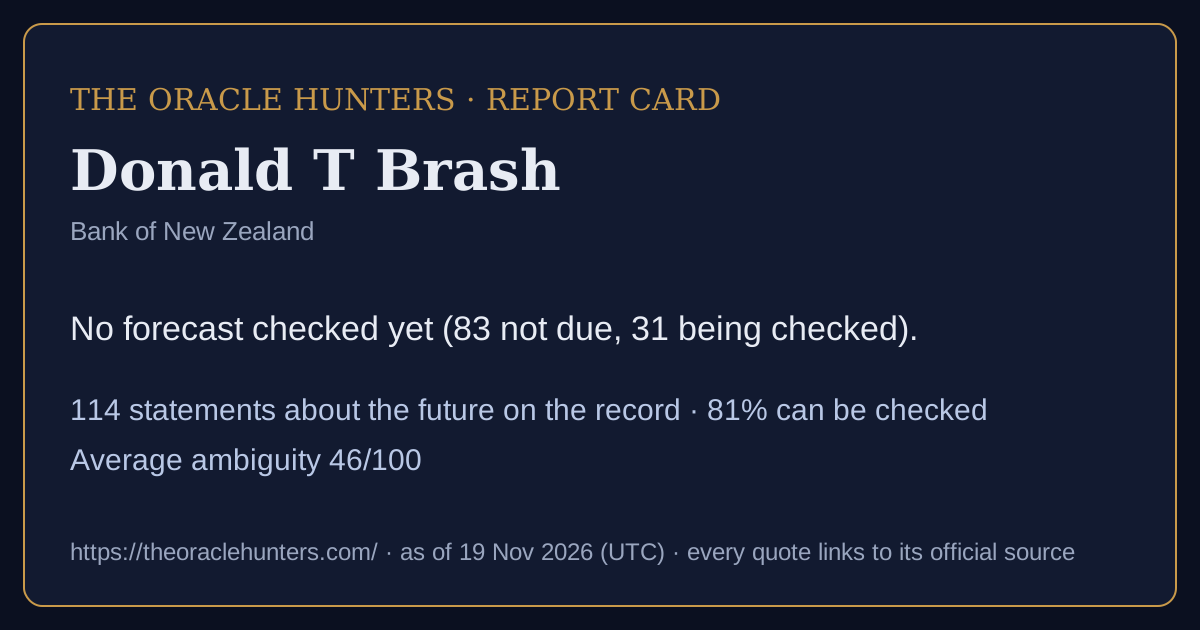
Track record: No forecast checked yet (83 not due, 31 being checked).
114forecasts & commitments on the record
81%can be checked as stated
46average ambiguity (0-100)
0goalpost moves recorded
0confirmed U-turns
Timeline
came true partly did not not due / being checked / too vague
Calibration score: shown after 10 checked forecasts with a stated likelihood (now 0).
How they speak about the future: based on data 66, educated guess 35, stated on authority 13.
Kinds of claim: forecast 51, mixed claim 31, scenario (if… then) 27, commitment 5. · Download this report card as a picture
In the nine words
πρόγνωσιςInference from evidence62 · 54%πρόνοιαPreparing for the future27 · 24%μαντείαInspired knowledge10 · 9%εἰκασίαConjecture9 · 8%προαναγγελίαPublic pre-announcement4 · 4%φρόνησιςPractical wisdom2 · 2%
How to read this
Each box is one sentence a public figure or institution said about the future, word for word, with a link to the official text. Can be checked means it names what will happen, by when, and how likely - so it can be compared with official figures later. Too vague to check means it does not. Ambiguity (0-100) is how many different ways the sentence can be read. When the date passes, the forecast is compared with official data and marked came true, partly or did not come true. Labels judge the sentence, never the person. Full guide and glossary.On the record (114)
Unless the current account deficit stays below around 4 per cent of GDP or we achieve a rather faster rate of economic growth than we have managed in recent decades, the ratio of net foreign capital to GDP will continue to increase from already unusually high levels.
Later this year, the Retirement Commissioner will release a report based on a fairly comprehensive survey of New Zealand household wealth.
We recognise that there is a trade-off, not between growth and inflation, but rather between the volatility of growth and the volatility of inflation, and we are prepared to accept some degree of inflation volatility to avoid throwing the real economy around too violently.
If a Minister were, say, to instruct the Bank to ignore the inflation rate and focus instead on increasing the growth rate - as he could do by invoking the override provision - markets would almost certainly deliver an immediate increase in interest rates across almost the entire yield curve (the Bank would still, of course, be able to anchor …
By this time, many people, again both inside the central bank and outside it, were coming to believe not only that inflation could be kept inside a 0 to 2 per cent target, but also that keeping inflation within the target was not such a difficult job after all.
"Clearly, if the New Zealand dollar falls sharply, this may have implications for the future inflation rate, and this might require us to push up interest rates somewhat, but the mere fact that the exchange rate declines does not require us to push rates to 500 per cent." He was appalled, and warned me that if my views became known …
Last week, we issued our latest assessment of the outlook for the economy and for inflation, and reduced the Official Cash Rate by a further 50 basis points to 4.75 per cent.
As you can see from the graph (figure 8), the National Bank survey for September, taken prior to the tragic events of 11 September, showed that only 6 per cent of businesses expected that their own business would deteriorate over the year ahead.
- First, the Reserve Bank is as committed to avoiding deflation as to avoiding inflation, and that means that we will always be leaning against the wind to the best of our ability, tending to tighten policy if inflation looks likely to rise in the future, and tending to ease policy if inflation looks likely to fall below the bottom …
It is important that we don't talk ourselves into a gloomy frame of mind just because the slowdown in the world economy could be substantial, and could last well into next year.
As the Japanese have discovered in recent years, all the investment in the world will not encourage growth if the extra capital produces few of the goods and services which people actually want.
And most of the other factors which have adversely affected our growth are ones which we ourselves can change, if only we have the will to do so.
If we want to retain a relatively egalitarian society, we absolutely need economic growth - without it, too many of our highly skilled people will leave our shores, forcing up the relative incomes of the skilled people who choose to stay.
But increasingly it is recognised that we will not achieve a radical improvement in our economic growth rate while we have to provide income support to more than 350,000 people of working age - 60,000 more than when unemployment reached its post-World-War-II peak in the early nineties - to say nothing of the 450,000 people who derive most of their …
To have any chance of doubling our per capita growth rate we will need to see quite radical changes in people's attitude and behaviour, and quite radical changes in public policy to encourage those changes in attitude and behaviour.
If we eased policy too much now, and that easing had its biggest effect next year, as we expect, we might find that policy would be stimulating the economy at the very time that the world economy was picking up.
Indeed, many commentators are predicting that the US economy will "bounce back" in the second half of this year, or at least by the fourth quarter.
Or in other words, will the slow-down in the world economy reduce inflationary pressures in New Zealand so much that some time in the next year or so inflation will fall towards the bottom of the agreed 0 to 3 per cent target band?
It is entirely possible that we will need to ease monetary policy more than we have done to date.
Back in November, as we prepared our December Monetary Policy Statement , the Consensus forecast for the 14 countries of most relevance to us had growth in those countries this year at 3.5 per cent.
Although not too much should be made of it at this relatively early stage, Consensus forecasts for our 14 major export markets suggest growth next year of 3.6 per cent, well up from the 2.3 per cent expected for the same markets this year.
In late November, as we finalised the text for the Monetary Policy Statement published on 6 December, it still seemed likely that the economies of our main trading partners would remain reasonably robust this year; the New Zealand dollar was near its all-time lows; petrol prices were high; and business confidence had recovered strongly.
The focus of our gathering and processing of data is the production of our quarterly Monetary Policy Statements, to be published this year in March, May, August and November.
On the other hand, if the Bank failed to lean against that inflation, we would almost certainly see not only the economic and social damage of the inflation itself but also a still lower exchange rate - and still a need to tighten monetary policy, indeed by even more, to reign that inflation back in.
If the Bank were obliged to tighten monetary policy because of ongoing upwards pressure on prices, the result would probably be at least a temporary increase in unemployment and a loss of output.
(Not all of those price increases will reach consumers in full, however, if some of the price increases are absorbed out of the margins of foreign exporters or local importers and distributors.
If the export sectors, and the sectors supplying import substitutes, were demanding more resources than the domestic sectors of the economy were willing to release, then interest rates would need to rise somewhat to avoid that conflict generating on-going inflation.
Some commentators are suggesting that inflation is now likely to exceed 3 per cent for the year to December 2000, and almost all commentators are at least expecting inflation to well exceed our midMay estimate.
Within weeks of the publication of that May Statement , the price of petrol had increased by some 15 per cent, the result of a sharp further increase in the international price of oil and of the depreciation of the New Zealand dollar.
As a result, it was clear well before the announcement of the actual inflation figure for the June quarter, of 0.7 per cent, that inflation for that quarter would considerably exceed our original estimate of 0.3 per cent, and that inflation for the year to March 2001 will almost certainly considerably exceed our estimate of 1.6 per cent.
In the middle of May this year, when the Reserve Bank last issued a quarterly Monetary Policy Statement , we projected inflation in the June quarter to be just 0.3 per cent, and inflation in the year to March 2001 to be just 1.6 per cent.
And when we look forward to the end of the year, it seems pretty clear that much of the sharp increase in inflation which is now expected by most commentators will be the direct result of such factors, and should as a result be ignored by the Reserve Bank in setting monetary policy.
Similarly, it may well be that if central banks in some other Asian countries had not been so preoccupied with trying to avoid the appreciation of their currencies against the US dollar as capital flowed into these economies in the mid-nineties, their interest rates would have been higher and asset price inflation commensurately reduced.
The concern we have is that New Zealand banks might end up being penalised (for example, through higher borrowing costs if risk weights in the Capital Accord are linked to compliance with international standards).
If these proposals were implemented in New Zealand, they could considerably weaken market incentives and distort the behaviour of bank directors and managers.
Bank management certainly has little incentive to carefully assess credit risk if, at the end of the day, the decision on whether or not to lend will be made by the bank's board under the influence or direction of higher political authority.
More recently, New Zealand has been running a very large balance of payments deficit, probably amounting to more than 7 per cent of GDP at the present time.
If New Zealand continues to keep inflation well under control, and continues to maintain the confidence of financial markets by following a prudent fiscal policy, it seems entirely reasonable to expect that in time New Zealand interest rates could fall below those in both Australia and the United States.
If demand exceeds the line A/B, then prices will have a tendency to demand falls short of that line, then prices will have a tendency to fall.
But if the economy is really capable of growing at 5 per cent and the Bank runs monetary the assumption that it is only capable of growing at 3 per cent, then quite quickly deman below capacity to supply, there will be a strong tendency for prices to fall, and the infl pushed down towards the bottom of the 0 …
Some people worry that the Reserve Bank can do considerable damage to the economy by assuming too low a sustainable growth rate, by assuming, say, a 3 per cent growth rate where in reali economy could grow at 4 or 5 per cent if only the Bank would allow demand to expand more rapidly
Seen in this light, we should perhaps not have been surprised that there was very little inflati second half of 1999, despite the fact that growth in that half of the year probably ran at an an rate of over 6 per cent; or that inflation in the year as a whole was just 1.3 per cent, despite the whole …
During the 1990s, many think that the sustainable medium-term growth rate of the US economy has risen from around 2.5 per cent in the early 1990s, to around 3 or even 3.5 per cent today.
As we speak, the US economy is on the verge of breaking all previous records for uninterrupted growth - by next month, a record 107 months.
The lower debt levels will also help the government cope with the marked increase in the pension burden after 2010 as the post-war 'baby-boomers' move into retirement years, without major increases in tax rates.
The last course was held in New Zealand last year, while the next one will be held next year in Sri Lanka.
But every economist knows from the days of Economics 101 that if you offer to supply something for free, the demand for it will be enormous, and that if you don't use price to limit that demand, you will soon be unable to meet the demand - whether you devote 6 per cent, 8 per cent, or 10 per cent …
Official forecasts suggest that growth in New Zealand over the next two years will be closely similar to that in Australia, as it was for the six years prior to 1998.
If we seek to eliminate risks, not only will we be bound to fail, but we will also risk undermining the prospects for strong and sustainable economic growth.
It implicitly accepts that, if its fiscal policy increases inflationary pressures, the Bank will need to tighten monetary policy to ensure that the agreed objective is met.
Showing the newest 50 - the ledger has all 114.
Also said - not checkable as stated (12 newest)
Remarks about the future with no date, figure or likelihood that could be checked. They are kept on the record and shown here, but not scored.
In principle, another possibility is that the savings rate (from current income) might be falling because households own assets that have risen in value, making people feel that there is less need to save
The disease must run its course and no one will rejoice more than the writer if a certain cure is found for it.
There are reckless lenders as well as reckless borrowers and the two must share the difficulties and troubles which may be in store for them in the future. 7
If we can effectively borrow from abroad in New Zealand dollars, someone must be willing to lend in New Zealand dollars - someone, most likely, without a strong "natural" interest in holding New Zealand dollar assets.
It is often hard enough to reach a decision on what the policy interest rate should be tomorrow without having to work out where it should be over the next year or two.
By agreeing the inflation target with the Governor, the Minister of Finance is implicitly agreeing that if fiscal policy is changed, monetary policy may need to change also, potentially offsetting any stimulus (or restraint) emanating from fiscal policy.
We can only have an interest rate which seems appropriate to the economy as a whole - and must accept that that interest rate will seem far too high for some parts of the economy and will be arguably too low for other parts.
Sometimes we will need to adjust interest rates in small incremental steps, as earlier in the year.
Most obviously, we will always be thousands of kilometres from our major markets, and it will take years before the high protection impeding our agricultural exports is eliminated.
However, at a general level, it can safely be said that the following types of policies will be needed in order to promote financial stability:
Ultimately, banking system risks are most likely to be reduced to acceptable levels by fostering sound risk management practices within individual banks.
- /Gb7 supervising banks for the purpose of promoting financial stability, but seeking to avoid supervisory practices that might erode market discipline and weaken the incentives for bank directors to take ultimate responsibility for the management of risks.