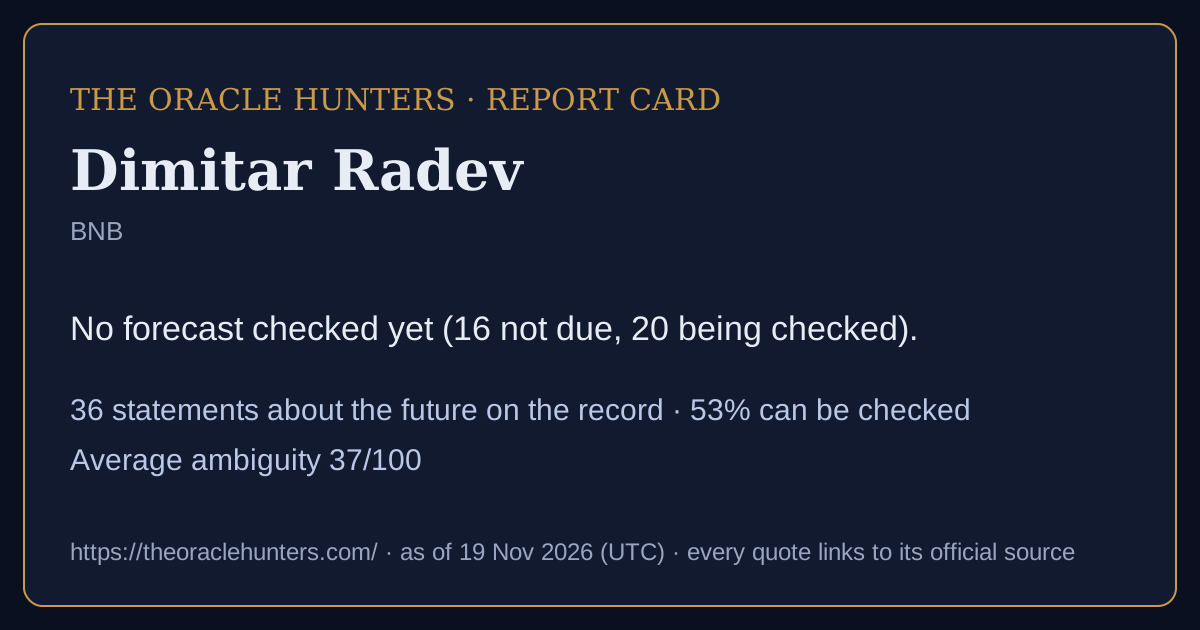
Dimitar Radev
BNB
Track record: No forecast checked yet (16 not due, 20 being checked).
36forecasts & commitments on the record
53%can be checked as stated
37average ambiguity (0-100)
0goalpost moves recorded
0confirmed U-turns
Timeline
came true partly did not not due / being checked / too vague
Calibration score: shown after 10 checked forecasts with a stated likelihood (now 0).
How they speak about the future: based on data 27, stated on authority 6, educated guess 3.
Kinds of claim: forecast 28, mixed claim 6, scenario (if… then) 2. · Download this report card as a picture
In the nine words
πρόγνωσιςInference from evidence27 · 75%μαντείαInspired knowledge6 · 17%πρόνοιαPreparing for the future2 · 6%εἰκασίαConjecture1 · 3%
How to read this
Each box is one sentence a public figure or institution said about the future, word for word, with a link to the official text. Can be checked means it names what will happen, by when, and how likely - so it can be compared with official figures later. Too vague to check means it does not. Ambiguity (0-100) is how many different ways the sentence can be read. When the date passes, the forecast is compared with official data and marked came true, partly or did not come true. Labels judge the sentence, never the person. Full guide and glossary.On the record (36)
But we should not assume that the current level of interest rates will necessarily remain sufficient if inflationary pressures persist.
The revisions for 2027 nevertheless suggest that the effects of the energy shock may prove more persistent than previously anticipated.
If we preserve that discipline, Bulgaria will be well placed not only to absorb the current shock, but also to emerge from it stronger, more competitive and better prepared for the next phase of growth.
Our current baseline suggests that growth in Bulgaria may moderate to around 3 percent this year, while inflation may rise to approximately 3.7 percent, driven primarily by higher energy prices and still elevated domestic inflationary pressures, particularly in services.
Against that background, the Governing Council decided to leave the key interest rates unchanged and reaffirmed its commitment to stabilising inflation at 2% over the medium term.
At the same time, under more adverse assumptions, inflation could be higher by between 0.7 and 1.2 percentage points in 2026, with the effects potentially proving more persistent in subsequent years.
The year 2026 will be the first year in which Bulgaria will be fully and actively involved not only in the formation, but also in the implementation of the euro area monetary policy.
In a broader perspective and in the context of 2026, our key task will be to continue supporting economic activity while keeping our role as a source of stability and confidence.
For example, the value of the eight fighter aircraft that have already begun to arrive this year is $ 1.2 billion, and eight more such aircraft worth $1.3 billion are expected to arrive in 2027.
This year, however, our trade balance is likely to turn negative, after taking into account the value of imports that constitute military equipment.
Next year, we expect inflation to slow down to around 2.5% and then remain at a similar level in 2027.
With regard to inflation, we forecast it to reach 3.5% at the end of this year and average annual inflation to reach 3.8%.
The baseline scenario forecasts that real GDP growth will again remain resilient this year and will be 2.8%.
If we look at the added value movement of all Bulgarian exports, we will see that around 4% of these exports is consumed in the US - so it can be concluded that Bulgarian exports worth around $1.8 billion are potentially exposed to the new customs regime.
By the end of 2024, the fiscal reserve reached its historical low, both as a percentage of GDP (4.7%) and as a percentage of total budgetary expenditure under the Consolidated Fiscal Programme (12.3%).
In 2024, the country's real GDP grew by 2.8%, i.e. above expectations, and according to the latest BNB forecast, economic growth will remain stable on positive territory, standing at 2.5% this year and 3.0% in 2026.
Here I mean above all the issues of the government's competence, since, as I indicated, the BNB and the banking sector are working according to plan and will be fully ready before the end of this year.
This year the BNB will continue to work intensely on the final phase of the preparations for Bulgaria's full membership in the EU's Economic and Monetary Union (the euro area), mainly in terms of the legislation, IT systems' connectivity, and logistics of the processes of printing euro banknotes and minting euro coins with a national side, their transportation and storage.
This risk might be reinforced by other potential challenges facing the banking sector this year, such as a slowdown in the expected recovery of the European economy and a cooling labour market, combined with a continuing relatively high inflation, a rising debt weight and a bigger portion of non-performing loans.
If in the middle of this year the Council of the EU decides to accept Bulgaria into the euro area as from 1 January 2025, we will proceed to a smooth and controlled reduction of the requirements for commercial banks regarding their mandatory minimum reserves in the BNB, reducing them to 1%, according to the regulated level for all euro …
Thus, the Bulgarian National Bank and commercial banks will be highly prepared for the euro changeover during this year.
Such a result, however, cannot be sustained without the adoption of a regular budget that is sufficiently disciplined, or in other words, guarantees the achievement of a budget deficit for this year and over the medium term firmly below 3% of GDP.
Progress on them and the achievement of the goal of joining the euro area as of 1 January 2024 will continue to depend on the development of the political situation and the motivation for common and coordinated efforts of all institutions involved in Bulgaria.
We expect that the rate at which the prices in Bulgaria will be rising in 2022 will reach its peak, on an annual basis, within the first half of the year, and at the end of the year, again on an annual basis, it will fall below that reported as of December 2021.
Consequently, it is logical to expect that we would continue to apply the measures of the anticrisis package, approved in March this year.
From 2021 the BNB will move on to the principle of the ECB and SRB to fund the relevant activities by collecting fees from credit institutions.
This could be a negative development for countries like Greece with its 28% tax, or Spain with its 25%, but it seems unrealistic for Bulgaria with its 10%.
The ECB's approach, however, included some quite unlikely scenarios, such as increasing corporate tax to 30% in the next three years.
We announced that we could increase the rate to a higher level earlier if credit growth significantly accelerates.
Nevertheless, the country is unlikely to enter the currency union until at least mid-2022, Valdis Dombrovskis, EU Commission Vice-President for the euro said in January, with Radev agreeing that obstacles to accession remain.
Bulgaria, which joined the European Union in 2007, already meets key criteria for adopting the euro, and its national currency is expected to enter the EU's Exchange Rate Mechanism II later this year.
He also expressed caution in response to suggestions the institution should lower its mandated medium-term inflation rate target from close to but below 2% to around 1%.
And now a few words about the Law on Payment Services and Payment Systems, which will come into effect from the beginning of 2018.
The process is expected to run smoothly and to become more ostensible in 2019.
- A mechanism to fund resolution measures by the newly established Bank Resolution Fund (BRF) which is funded by contributions from the banks; the target level of the resources collected in the BRF is 2% of the amount of covered deposits of all banks licensed in Bulgaria and must be achieved by end-2024;
The stress test indicated that if the latest 2018 macroeconomic forecasts materialize, the CET1 ratio would increase to 22.2%.
Also said - not checkable as stated (12 newest)
Remarks about the future with no date, figure or likelihood that could be checked. They are kept on the record and shown here, but not scored.
We will continue to decide meeting by meeting, taking into account the inflation outlook, underlying inflation and the strength of monetary policy transmission.
But the inflation outlook has deteriorated since September, and this must be reflected in our assessment of the appropriate monetary policy stance.
In December, we will have updated projections and additional economic and financial data.
This points to higher inflation than previously expected and a risk of a more prolonged deviation from our two per cent target.
Speech by Mr. Dimitar Radev, Governor of the BNB, at the opening of the "Money growth: Bulgaria in the eurozone" conference, organised by Capital newspaper, Sofia, 13 May 2026.
This is precisely why economic outcomes will increasingly depend on domestic policies and institutional quality - on fiscal discipline, competitiveness and the predictability of policymaking.
Economic stability will increasingly depend on fiscal discipline, structural competitiveness and institutional effectiveness.
To understand this new framework, we must first examine inflation dynamics, as they most immediately reflect the interaction between external shocks and domestic policies.
Sustainable income growth must be underpinned by higher productivity.
The role of credit should also be assessed carefully.
This is where the discussion should begin - with the real economy, not only with the forecast.
It means that, in the period ahead, firms may need to absorb a larger share of the adjustment themselves.