Dimitar Bogov
Republic of Macedonia
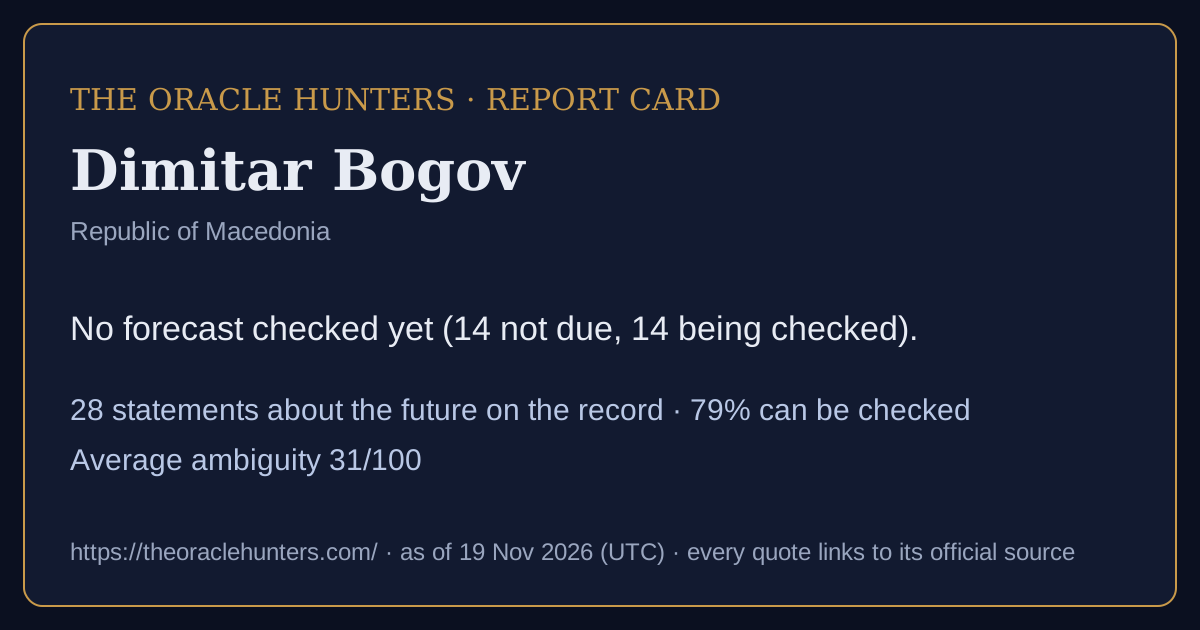
Track record: No forecast checked yet (14 not due, 14 being checked).
28forecasts & commitments on the record
79%can be checked as stated
31average ambiguity (0-100)
0goalpost moves recorded
0confirmed U-turns
Timeline
came true partly did not not due / being checked / too vague
Calibration score: shown after 10 checked forecasts with a stated likelihood (now 0).
How they speak about the future: based on data 16, stated on authority 10, educated guess 2.
Kinds of claim: forecast 20, commitment 4, mixed claim 3, scenario (if… then) 1. · Download this report card as a picture
In the nine words
πρόγνωσιςInference from evidence15 · 54%μαντείαInspired knowledge6 · 21%προαναγγελίαPublic pre-announcement4 · 14%πρόνοιαPreparing for the future1 · 4%εἰκασίαConjecture1 · 4%πρόβλεψιςSeeing the signs1 · 4%
How to read this
Each box is one sentence a public figure or institution said about the future, word for word, with a link to the official text. Can be checked means it names what will happen, by when, and how likely - so it can be compared with official figures later. Too vague to check means it does not. Ambiguity (0-100) is how many different ways the sentence can be read. When the date passes, the forecast is compared with official data and marked came true, partly or did not come true. Labels judge the sentence, never the person. Full guide and glossary.On the record (28)
In the EU, as already clearly announced, the accommodative monetary policy, although with lower amount of assets purchase, is expected to apply by September this year or beyond and interest rate changes to take place later.
Global growth rates are staggering slightly above 3%, on average, and the medium-term prospects do not seem to differ much.
It is encouraging that the economic recovery is expected to proceed in the monetary union, at a growth rate of slightly below 2%.
Therefore, tomorrow we will hold a panel discussion in order to encourage active participation of the Macedonian financial sector in the domain of card payments, e-commerce and innovations, in general, as well as of the National Bank from the aspect of its role in the payment system of the Republic of Macedonia.
We expect GDP growth of close to 4%, and therefore we see economy going up on the cycle.
The data since mid of the last year and the forecast for this year are pointing to an upturn of the global economy, although it is still fragile and surrounded by risks.
Even the hardest hit Southern European and Mediterranean countries have the potential to see growth as early as next year.
This year, due to the financial stimulus we are forecasted at 3.5%.
If this year we will see a 2.2% increase in overall growth we predict next year can yield 3.5% and it can certainly grow from there to over 4% in ensuing years.
No, the inflation is not an issue, since it is on quite moderate level, 2.8 percentages is the latest data for August and we expect average inflation of about 2.8 percentages for the entire year, there is no probability for inflationary pressures in the following period.
We are now launching the new round of projections which will be finalized near end of October, but it can be expected that the increase in the Gross Domestic Product this year will be over 3%.
Our projection for this year remains 2.2 percentages, but after the publication of the data on GDP for the second quarter, it will probably move upwards.
Because if we have a floating exchange rate, we will have higher inflation and higher interest rates for the real sector.
## What will we do when in 2015 an installment of 500 million euros falls due?
So, we should gradually pay back our debt, but when an old debt falls due it is common to take a new loan to repay the old one, and if it can be reduced, it will be even better.
For the entire year we expect credit growth of 7 percent and we believe we will achieve that rate.
You were the most optimistic, even more than the government, and projected growth of 2.2 percent for this year.
For the next year, we are more optimistic, and in our projections we expect credit growth of up to 9 percent.
However, our expectation for the economic growth in Macedonia is to be much better than this year, driven by diversification of the production into new export-oriented facilities that started to work this year, or will start to work in the next year, as well as infrastructural facilities for which funding has already been secured from foreign sources.
## In which direction will the interest rates on loans and deposits move next year?
## What will be the credit growth this year, and what do you expect it to be next year?
At the moment we are sure that risks to price stability undermining are eliminated, we will apply monetary measures appropriate for the slower economic growth.
However, due to the pressures from international prices we must give a clear signal that we will not allow undermining of price stability, while simultaneously adjusting the monetary policy to the slower economic growth.
## Dimitar Bogov: When pressures on prices are relieved, we will stimulate economic growth
The National Bank is honored by the given trust to host this exhibition, which I hope that over the next month will be an intriguing cultural event for the general public.
We consider that the credit growth could range around 7-8% without jeopardizing price and financial stability, and we clearly signalize this.
The banks, instead of investing the household savings, that increase faster than expected, in lending, purchased CB bills, the amount of which increased by Denar 10 billion, i.e. one third in only three months, even though the capital adequacy and liquidity are at exceptionally high levels.
The inflation rate reduced to around 2%, as expected for this year's average.
Also said - not checkable as stated (12 newest)
Remarks about the future with no date, figure or likelihood that could be checked. They are kept on the record and shown here, but not scored.
Considering the current global surrounding, this year's conference 'Around a Decade after the Crisis: Heading to the New Global Cycle and Monetary Policy Normalization' addresses a relatively long period since the onset of the global crisis and the need to face new challenges.
In such surrounding of prolonged lower inflation, the re-assessment of the time lag in affecting the inflation as well as the inflation measurement, the outlook of inflation expectations and their possible de-anchoring are to be considered.
The monetary policy normalization in advanced economies could produce different impacts for emerging economies and their monetary policy.
Having in mind country specific reasons, monetary policy normalization in emerging economies may come with different lag.
At this point, the questions to ask ourselves and to discuss during the conference would be: how strong and sustainable is the ongoing global recovery, what are the reasons behind the subdued inflation, what should be the pace of monetary policy normalization, are the banks now more resilient, are we better prepared to prevent the risks?
In Session 3, central bankers and asset managers will put forward their views on strategies for effective risk mitigation and how should asset managers prepare for the 'new normal' in the converging monetary policies.
I hope that we will be able to do this again.
Session 1 will cover issues related to the current and prospective conjuncture of the global economy, monetary policy and the future of interest rates.
Session 2 will tackle upon financial stability issues, and how well are we equipped to deal with potential turbulence.
Session 4 will focus on South East Europe and the perspectives of the region for European integration and growth.
Also, allow me to mention that in the forthcoming medium-term period, the deposit market will urge banks to make even greater efforts to modernize and increase their offer.
Such processes will inevitably touch the bank operations in the Republic of Macedonia.