Dennis Lockhart
Federal Reserve Bank of Atlanta
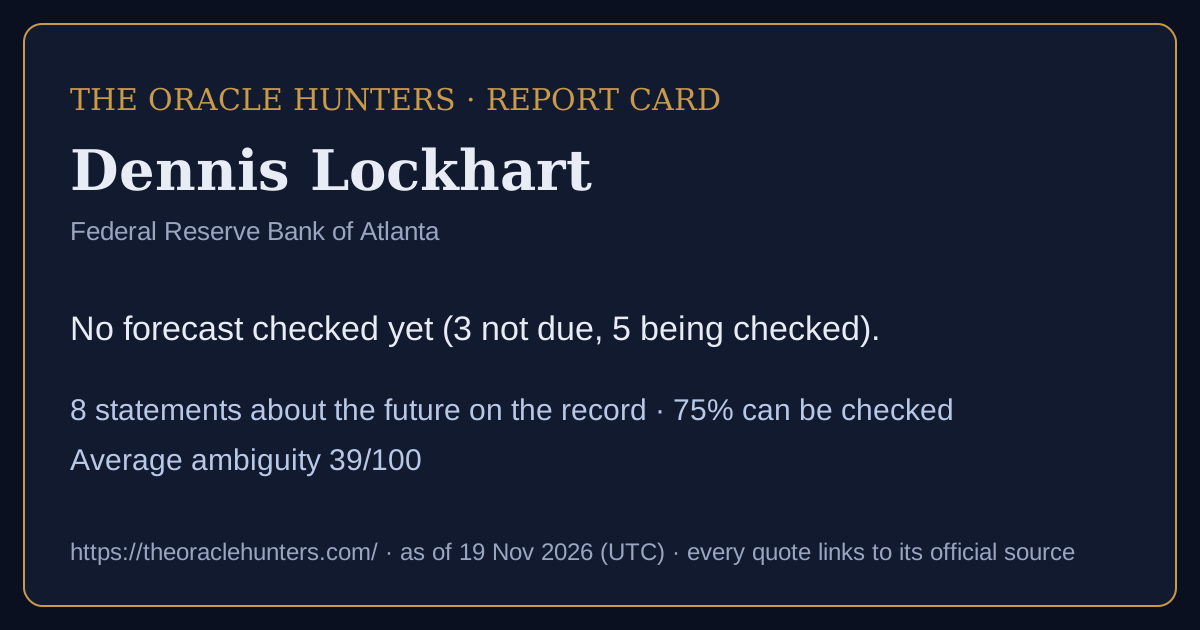
Track record: No forecast checked yet (3 not due, 5 being checked).
8forecasts & commitments on the record
75%can be checked as stated
39average ambiguity (0-100)
0goalpost moves recorded
0confirmed U-turns
Timeline
came true partly did not not due / being checked / too vague
Calibration score: shown after 10 checked forecasts with a stated likelihood (now 0).
How they speak about the future: based on data 6, educated guess 1, stated on authority 1.
Kinds of claim: forecast 6, mixed claim 2. · Download this report card as a picture
In the nine words
How to read this
Each box is one sentence a public figure or institution said about the future, word for word, with a link to the official text. Can be checked means it names what will happen, by when, and how likely - so it can be compared with official figures later. Too vague to check means it does not. Ambiguity (0-100) is how many different ways the sentence can be read. When the date passes, the forecast is compared with official data and marked came true, partly or did not come true. Labels judge the sentence, never the person. Full guide and glossary.On the record (8)
In my baseline forecast, I have inflation getting past this period of broad disinflation and resuming a gradual rise to 2 percent.
From a Main Street perspective, the important point for business planning is that monetary policy is likely to shift sometime this year, and a higher interest-rate environment will ensue.
A firming in the inflation compensation data from their year-end lows is an example of the kind of encouraging development that will bolster my confidence in the medium-term outlook.
My baseline outlook for 2015 and 2016 assumes growth at around 3 percent per annum.
- Lockhart's baseline outlook for 2015 and 2016 assumes growth at around 3 percent per annum.
If the early months of this year bring mixed news on the economy, the risk manager in me will lean to preferring a later date for the first policy move to an earlier one.
- Lockhart expects the annual rate of GDP growth for the second half of the year to be around 4 percent, which is strong growth.
In my view, the biggest factor influencing the actual timing of a liftoff decision should be the Committee's confidence that these objectives will be achieved in an acceptable timeframe and, especially, that inflation will move at deliberate speed toward the target of 2 percent per annum.
Also said - not checkable as stated (4 newest)
Remarks about the future with no date, figure or likelihood that could be checked. They are kept on the record and shown here, but not scored.
- From a Main Street perspective, Lockhart says, the important point for business planning is that monetary policy is likely to shift sometime this year, and that decision should be a signal that the FOMC is confident that the economy is on track to achieve its objectives.
That means we will be closely monitoring evidence of the performance of the economy as the year proceeds, and we will be assessing what the stream of economic data seem to indicate regarding the outlook.
My colleagues may not agree with what I have to say.
That process will begin with so-called 'liftoff' - that is, the first increase in the policy rate.