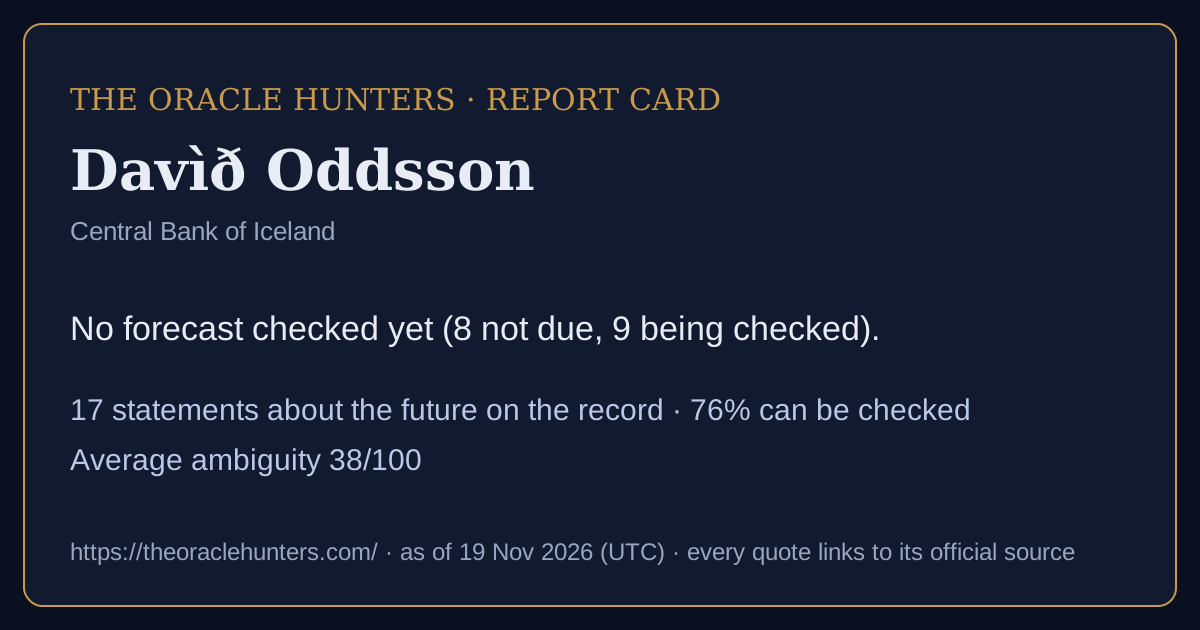
Davìð Oddsson
Central Bank of Iceland
Track record: No forecast checked yet (8 not due, 9 being checked).
17forecasts & commitments on the record
76%can be checked as stated
38average ambiguity (0-100)
0goalpost moves recorded
0confirmed U-turns
Timeline
came true partly did not not due / being checked / too vague
Calibration score: shown after 10 checked forecasts with a stated likelihood (now 0).
How they speak about the future: based on data 8, educated guess 5, stated on authority 4.
Kinds of claim: forecast 12, scenario (if… then) 5. · Download this report card as a picture
In the nine words
πρόγνωσιςInference from evidence7 · 41%πρόνοιαPreparing for the future5 · 29%μαντείαInspired knowledge4 · 24%πρόβλεψιςSeeing the signs1 · 6%
How to read this
Each box is one sentence a public figure or institution said about the future, word for word, with a link to the official text. Can be checked means it names what will happen, by when, and how likely - so it can be compared with official figures later. Too vague to check means it does not. Ambiguity (0-100) is how many different ways the sentence can be read. When the date passes, the forecast is compared with official data and marked came true, partly or did not come true. Labels judge the sentence, never the person. Full guide and glossary.On the record (17)
The Board of Governors' policy statement said the following: 'If the decrease does not reverse, it is clear that inflation will rise sharply, and persistent inflation will be imminent if nothing is done, with the accompanying upward spiral of prices, wages, and exchange rates against foreign currencies.
It becomes a serious problem if deviations persist, and it will cause important damage if it continues to grow and the Central Bank cannot contain it through conventional measures within a reasonable period of time.
And according to the latest reports, while there are reported write-downs of a mere 20 billion dollars on subprime mortgages, the actual amount could in the end be between 250 and 300 billion.
The Central Bank decided to raise the policy rate now because inflation has risen once again, and indicators suggest that it will be higher in 2007 and 2008 than earlier projected.
Uncertainties abound and many households in Iceland thread a narrow path of debt and wages, where if they lose their footing, the fall could be heavy.
By both measures, inflation will be close to target from the middle of 2008.
Monetary Bulletin reveals that inflation developments have turned rather more favourable than the Bank's previous forecast had indicated, and although underlying inflation was somewhat higher in February and March than was hoped, the Bank expects both headline and underlying inflation to decrease rapidly in the next months.
If the current outlook holds and everyone stays alert and strong, inflation will be brought down over a relatively short period.
That publication provides indications of the position and outlook at the end of this year and what is to be expected over the forecast horizon of the next two years.
If housing prices had risen by little or nothing, they could have offset the effects of the eventual depreciation.
In this process, investment is bound to contract sharply when the aluminium sector projects come to an end and private consumption will shrink as well, to leave very low or even zero GDP growth in 2007.
At that time the Bank forecast that the current account deficit would be equivalent to 12% of GDP in 2005 and inflation would be 2½% by today.
In the Central Bank's view, the real estate market will cool down significantly in the near future and private consumption growth will normalise next year.
A similar position could be on the cards in 2006.
Thus the outlook is for a slowdown in the inflation rate in the coming months, not least because the depreciation of the króna this year has only been passed
Some people may well have read into what the Bank wrote in connection with the policy rate hike in September that the increase this time would be greater, by 0.50 or even 0.75 percentage points.
The first formal interest rate decision date next year will be Thursday, January 26.
Also said - not checkable as stated (12 newest)
Remarks about the future with no date, figure or likelihood that could be checked. They are kept on the record and shown here, but not scored.
It is possible to advance theoretical support for the idea that the Central Bank alone could hold inflation down, but in order to do so the Bank would have to implement its measures with such force and rigidity that its actions might have an extremely negative effect on many other aspects of people's lives.
It is much more likely that we will experience a slowdown and, at worst, a sharp economic dip that need not be long-lasting.
It focuses both on the components that are measured with the officially required tools and on those that lie beneath the surface, not least on the indicators and expectations concerning how these components of inflation are likely to manifest themselves in the near future.
The explanation lies not least in the fact that the legislature - in Iceland as elsewhere - has realised that the battle against the disease called inflation could be lengthy and uncomfortable.
A huge investment bank like Merrill Lynch could not foresee that, in only two weeks' time, it would have to write down billions of dollars' worth of outstanding debt.
On the last two interest rate decision dates, in July and September of this year, the Bank emphasised strongly that the short-term inflation outlook had deteriorated and that, in the absence of a change for the better, it would respond in line with its duties.
It wanted to see the outcome of the turmoil in the global and domestic financial markets in August, and to see how the budgetary bill for next year would be received.
We must take decisive action against it, no matter how unpleasant - or even costly - the effort may be in the short run.
As if this was not enough, public sector involvement in housing finance was reformed around the same time; this structural reorganisation had unexpected multiplier effects when the recently privatised commercial banks eagerly followed that lead and ran ahead along the same path even faster than the policy makers had expected.
Then the question will arise about the impact that all this will have on the effectiveness of the Central Bank's policies for controlling inflation developments, and whether we might be better off locked away inside one of the super-currencies, obeying the laws that apply there and at the mercy of the decisions of others.
Yet others claim that if Iceland fixes itself against another currency and obeys the laws of others - interest rates based on what is happening in France, Italy and Germany and not in Iceland - that this will produce a more cautious attitude up here in the frozen north, the appetite for risk will diminish and economic developments will take …
The economic factors I mentioned earlier have driven strong inflationary pressures in Iceland, which have partly appeared in the form of higher measured inflation, but have to some extent been contained by Central Bank policy rate decisions, which in turn have affected the exchange rate of the Icelandic króna, at least for some while now.