David Jones
Office of the Secretary of State for Wales · GBR
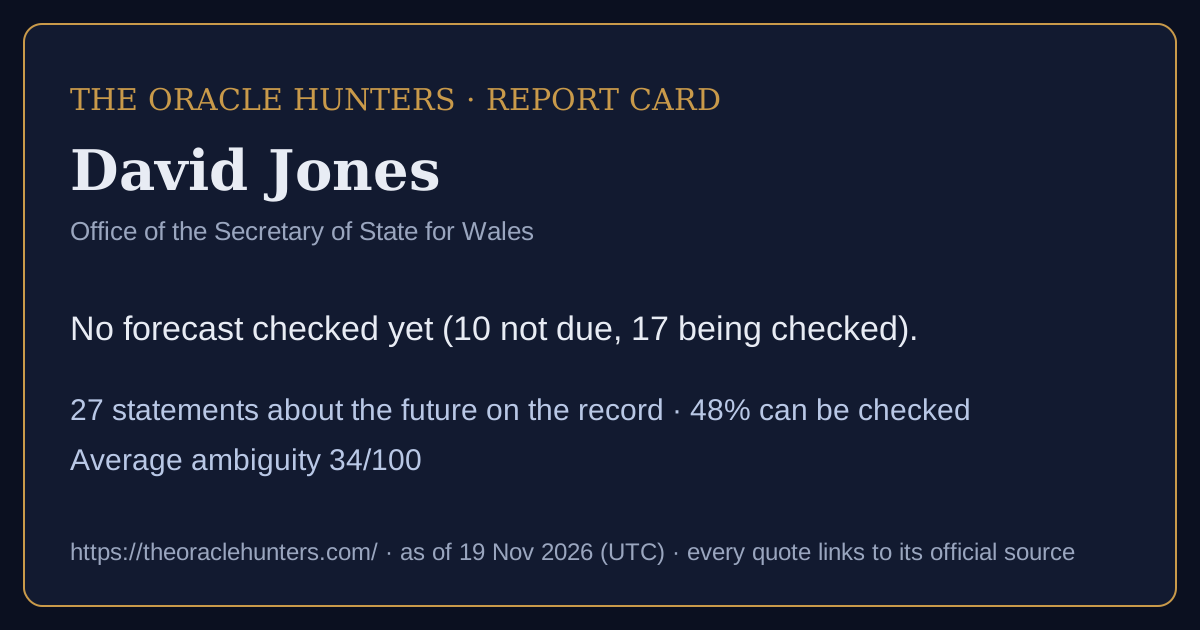
Track record: No forecast checked yet (10 not due, 17 being checked).
27forecasts & commitments on the record
48%can be checked as stated
34average ambiguity (0-100)
0goalpost moves recorded
0confirmed U-turns
Timeline
came true partly did not not due / being checked / too vague
Calibration score: shown after 10 checked forecasts with a stated likelihood (now 0).
How they speak about the future: based on data 21, stated on authority 6.
Kinds of claim: forecast 17, mixed claim 5, commitment 5. · Download this report card as a picture
In the nine words
πρόγνωσιςInference from evidence18 · 67%προαναγγελίαPublic pre-announcement5 · 19%μαντείαInspired knowledge4 · 15%
How to read this
Each box is one sentence a public figure or institution said about the future, word for word, with a link to the official text. Can be checked means it names what will happen, by when, and how likely - so it can be compared with official figures later. Too vague to check means it does not. Ambiguity (0-100) is how many different ways the sentence can be read. When the date passes, the forecast is compared with official data and marked came true, partly or did not come true. Labels judge the sentence, never the person. Full guide and glossary.On the record (27)
I saw from your Brexit manifesto that you regard Heathrow as of key importance and you intend to provide a new runway at Heathrow, which is expected to bring additional economic benefits to this country of up to £61 billion over 60 years.
The Prime Minister announced on Monday, as you probably know, that by the end of the Parliament, we will be investing an extra £2 billion a year in research and development to put post-Brexit Britain at the cutting edge of science and technology.
As to timing, we now made clear that we will invoke the provisions of Article 50 on the Treaty on European Union – the necessary first step in the process of withdrawal - no later than the end of March next year.
Following the announcement that Hitachi would be investing £20 billion into nuclear energy projects in the UK, I met members of their executive team on Anglesey to discuss their proposals for Wylfa.
Even with significant investment in the pipeline, there will still be parts of Wales in 2016 that will not be benefiting from high speed broadband.
So in this year alone, new projects worth an estimated £36 billion are due to start across the United Kingdom, helping creating thousands of jobs, securing future growth and delivering the world class infrastructure that the country - Wales included - deserves.
Redrow have estimated that, as a consequence of Welsh Government requirements for the sustainable building code, and for all new homes to be fitted with sprinklers, the cost of building a typical house in Wales will be £13,000 more than in England by 2016.
Subject to consultation, this Bill will support the development of gas and oil from shale and geothermal energy, potentially delivering the equivalent of up to 4 billion barrels of oil over the next 20 years.
Through the Infrastructure Bill we will increase investment in infrastructure and enhance the United Kingdom’s energy security and independence.
By 2037, fully a quarter of the population of Wales will be over 65 - some 292,000 more people than there are now – and it is right that they should have as much choice as possible in how they save for retirement and how they access the benefits they have saved.
By raising personal allowances, we are cutting income tax for over 1.2 million people in Wales - worth up to £805 a year by the end of this parliament - and by April next year we will have taken 155,000 people out of tax altogether.
You may be aware that the Government has committed to working up a guarantee for Hitachi’s investment in the Wylfa Newydd power station by the end of 2016.
Councils in the North East - including here in Durham - have been working together on proposals to create a Combined Authority from April next year, to work more closely to support economic growth in areas such as skills, transport and investment.
The Government is committed to an internationally competitive tax system and, when Corporation Tax falls to 20 per cent in 2015, it will be the lowest in the G20.
We will publish our 2013 update shortly and it will demonstrate our continued commitment to supporting renewable energy whilst emphasising the benefits from an economic growth, energy security and tackling climate change perspective.
The project represents huge potential in the marine sector and in February this year was successful in securing a share of the UK Government’s £20 million Marine Energy Array Demonstrator Scheme.
The Renewables Roadmap set out how the UK will generate 15% of our energy from renewables by 2020.
Between now and 2020, 20% of our energy generation will go offline.
The referendum next year has far-reaching implications for all parts of the United Kingdom, including Wales, and the next twelve months will certainly be momentous in terms of the future of our country.
In just fifteen months time, in September 2014, the people of Scotland will be asked to make a historic choice between a continuing union - staying within the UK, or going it alone.
Constitutionally, 2014 will be the most important year for the United Kingdom in over 300 years.
We must await the Silk Commission’s Part II report next year before considering the possible devolution of further powers to the Assembly.
On Budget day, we announced a package of regulation reduction that will save businesses £350 million a year.
By 2014, the UK will have one of the most competitive corporation tax regimes in the G20.
We will follow this with three further annual 1% reductions, which will provide a much-needed boost to business confidence.
The key to recovery will be growth; and this government will strive to be the most pro-growth government in living memory.
Over the next two years we will be reviewing the impact of regulation sector by sector– starting today with the retail sector.
Also said - not checkable as stated (12 newest)
Remarks about the future with no date, figure or likelihood that could be checked. They are kept on the record and shown here, but not scored.
I can assure you that we will continue to be an open and tolerant country, and one that recognises the immensely valuable contribution that migrants have made and continue to make to our economy and our society.
In addition, the Department for Transport has already held positive discussions with its American counterparts about the arrangements that we will need after Brexit for the vitally important transatlantic air links.
It is now law, it is an Act and very shortly we will be triggering the Article 50 process that will lead to our departure from the EU.
I know from having read the excellent FTA Brexit Manifesto that you do have questions about what sort of deal we will be getting from the European Union, what sort of future we can expect for our country after Brexit has been completed and how we will make the most of the opportunities that Brexit presents.
There will be many detailed technical issues and there will be preparations that we will need to make ourselves for life after we leave the EU.
A future in which we will do what all independent sovereign countries do.
Outside the EU, we will be free to pass our own laws.
We will make our own decisions about our spending priorities.
And whilst we will certainly want to maintain good neighbourly relations with the Member States of the continuing EU, we will be able to create new relationships with other countries right around the world.
As we improve our rail services within Wales, we must not close our eyes to projects across the border in England – indeed, we must seek and exploit every opportunity to connect Wales better.
But, as any business man or woman here will recognise, getting banks to lend has sometimes proved problematic.
Some 200 projects across the UK are due to be completed this year – including the Gwynt y Môr offshore wind farm, which is currently the largest in construction anywhere in Europe.